🧶 Beautiful ✨ Detailed 💝 Adorable

Trapeze Bag Pattern

Trapeze Bag Pattern
4.1★ Rating
5-7 Hours Time Needed
4.0K Made This
✂️

Intermediate Level

Ideal for those with basic crochet experience, featuring slightly more advanced stitches and techniques to expand your skills.

⏱️

Weekend Treat

Takes 5-7 hours, making it an enjoyable project to finish over a couple of days.

Stylish Touch

An elegant detail to elevate any look, combining traditional techniques with contemporary design sensibilities.

About This Trapeze Bag Pattern

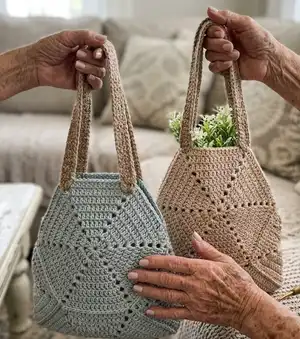
This pattern teaches you to crochet a trapeze bag made from three hexagon panels and two small square panels joined together. You will use 3-4 mm cord or yarn and a 5 mm hook to create a structured, fashionable tote. The design includes clear round-by-round instructions and accompanying photos to guide assembly and finishing.

Trapeze Bag Pattern crochet pattern - detailed view of completed project

Suitable for intermediate crocheters comfortable with DC, SC and joining techniques. The finished bag is sturdy and customizable by changing cord thickness or colors.

Why You'll Love This Trapeze Bag Pattern

I absolutely love this pattern because it transforms simple crochet motifs into a chic, sculptural bag with minimal finishing. I enjoy how the hexagon panels create an interesting textured surface and how the square panel cleverly forms the bag sides. The pattern is satisfying to stitch quickly and gives a professional looking result. I also appreciate that it is easy to customize by swapping cord color or handle style to match your wardrobe.

Trapeze Bag Pattern step 1 - construction progress Trapeze Bag Pattern step 2 - assembly progress Trapeze Bag Pattern step 3 - details and accessories Trapeze Bag Pattern step 4 - final assembly and finishing

Switch Things Up

I love experimenting with different cord colors to change the mood of this bag; a neutral base with a bold trim looks modern and chic.

Try using a slightly thicker cord and a larger hook to create a more rigid, basket-like tote that holds its shape better for heavier loads.

If you prefer a slouchy look, swap to a softer cotton yarn and a smaller hook to make the bag slightly smaller and more pliable.

I often add a lining for extra structure and to prevent small items from slipping through the holes; sew a fabric lining and hand stitch it inside.

You can replace the leather handles with wooden or crocheted handles for a different aesthetic—just make sure attachment points align with the corner spaces.

I like to embroider simple initials or add a small crocheted flower to personalize the front panel for gifts.

For a seasonal twist, use metallic cord or a sparkly yarn to make a festive version perfect for holiday parties.

To make a mini keychain version, use thinner cord and a smaller hook and scale down the number of rounds proportionally.

I recommend trying contrasting color hexagons for a patchwork look; join them in the same way but mix and match color placement.

If you want added functionality, stitch in an internal pocket before closing the second square side so it is hidden inside the bag.

Common Mistakes & How to Fix Them

✗ Not keeping consistent tension when working with cord; try practicing a few rows on a swatch to match the gauge before starting the panels. ✗ Cutting the cord too short when leaving ends for joining; leave the long ends specified (about 110-120 cm for hexagons) to ensure you have enough length to seam without joining additional yarn. ✗ Skipping the instruction to pull the cord out and close the round neatly; failing to do this can leave visible gaps—follow the pictures and use a needle to close and hide the tail. ✗ Forgetting that 1sc+ch1 counts as 1dc in this pattern; mark this note and treat those stitches accordingly to keep stitch counts correct. ✗ Joining hexagons with uneven tension that puckers the seam; use your yarn needle or sl st gently and pin parts to align edges before making the final joins.

Trapeze Bag Pattern

Create a stylish trapeze-shaped crochet bag using sturdy 3-4 mm cord and simple motifs. This pattern guides you step-by-step through making hexagon and square panels, joining them, and finishing with handles for a chic, structured tote. Perfect for crafting a durable everyday bag or a thoughtful handmade gift. Clear photos and instructions help you follow along easily.

Intermediate 5-7 Hours

Materials Needed for Trapeze Bag Pattern

— Main Fabric

  • 01
    3-4 mm cotton, acrylic or polyester cord - 300-350 meters total
  • 02
    Polyester cord 3 mm (sample used) - approx. 300-350 meters
  • 03
    Optional: extra 10-50 grams of contrast cord for decorative trims or handles

— Tools Required

  • 01
    Crochet hook size 5 mm
  • 02
    Scissors
  • 03
    Stitch markers
  • 04
    Yarn needle for sewing and hiding ends
  • 05
    Handles for bag with buttons or sewn ones (or leather straps)
  • 06
    Pins for assembly (optional)
  • 07
    Measuring tape

Progress Tracker

0% Complete

— Hexagon :

Round 1 :

Rnd 1: in MR: ch5 (counts as 1dc and a ch2), [ 2dc, ch2 ]*5, 1dc, tighten the ring firmly, sl st in 3rd ch (12) (pic. 1-5)

Info :

ch2 space will be referred to as the corner chain space = corner (pic. 5)

Round 2 :

Rnd 2: begin in the corner: (1sc, ch3, 1dc) 1sc and a ch1 counts as 1dc here and throughout pattern, dc in the next 2 stitches, [ in the next corner: (1dc, ch2, 1dc), 2dc ]*5, sl st in first ch of ch3 (24) (pic. 6-12)

Info :

Using a needle, weave in the loose thread that began the magic ring between stitches on the wrong side. Cut off the end (pic. 13)

Round 3 :

Rnd 3: begin in the corner: (1sc, ch3, 1dc), 4dc, [ in the next corner: (1dc, ch2, 1dc), 4dc ]*5, sl st (36) (pic. 14)

Round 4 :

Rnd 4: begin in the corner: (1sc, ch3, 1dc), 6dc, [ in the corner: (1dc, ch2, 1dc), 6dc ]*5, sl st (48)

Round 5 :

Rnd 5: begin in the corner: (1sc, ch3, 1dc), 8dc, [ in the corner: (1dc, ch2, 1dc), 8dc ]*5, sl st (60)

Round 6 :

Rnd 6: begin in the corner: (1sc, ch3, 1dc), 10dc, [ in the corner: (1dc, ch2, 1dc), 10dc ]*5, sl st (72)

Round 7 :

Rnd 7: begin in the corner: (1sc, ch3, 1dc), 12dc, [ in the corner: (1dc, ch2, 1dc), 12dc ]*5, sl st (84)

Round 8 :

Rnd 8: begin in the corner: (1sc, ch3, 1dc), 14dc, [ in the corner: (1dc, ch2, 1dc), 14dc ]*5, sl st (96)

Info :

Cut off the cord, leaving the end about 20 cm. Pull the cord out as shown on pic. 15. Using a needle close the round as it is shown on pic. 16-17. Hide the end on wrong side and cut it off.

Info :

Crochet two more hexagons using rows 1-8. In these 2 hexagons leave the ends of cord about 110-120 centimeters (pic. 22)

— Joining Hexagons :

Info :

Put the 1st and 2nd hexagons with the front side as shown on picture 21. Join parts: work sl st along 1 side through 2 layers (use the end of the 110 cm of cord that you left on the second hexagon). (pic. 22-24)

Info :

Make the first and the last sl st in ch of corner spaces. You'll have 18 sts in total. Hide the end on the wrong side and cut it off. (pic. 25-27)

Info :

Join the 2nd and 3rd hexagons in the same way (use the end of the 110 cm of cord that you left on the third hexagon) (pic. 28)

— Square Part :

Round 1 :

Rnd 1: in MR: ch3 (counts as a 1 dc), 3dc, [ ch2, 4dc ]*3, ch1, tighten the ring firmly, sl st in 3rd ch (16) (pic. 31-36)

Round 2 :

Rnd 2: into the corner just behind: (1sc, ch1, 1dc) 1sc and a ch1 counts as 1dc here and throughout pattern, [ dc in the next 4 stitches, into the next corner: (2dc, ch2, 2dc) ]*3, 4dc, into the last corner: (2dc, ch1, sl st in ch1 ) (32) (pic. 38-46)

Info :

Using a needle, weave in the loose thread that began the magic ring between stitches on the wrong side (pic. 47)

Round 3 :

Rnd 3: into the corner just behind: (1sc, ch1, 1dc), [ 8dc, into the next corner: (2dc, ch2, 2dc) ]*3, 8dc, into the last corner: (2dc, ch1, sl st) (48)

Round 4 :

Rnd 4: into the corner just behind: (1sc, ch1, 1dc), [ 12dc, into the next corner: (2dc, ch2, 2dc) ]*3, 12dc, into the last corner: (2dc, ch2, sl st) (64) (pic. 48)

Info :

Leave the end of the cord about 4 meters long. Pull out the cord as shown on picture 49. Crochet the second square using rows 1-4 (pic. 50)

— Assembly :

Info :

Steam the parts. Follow the recommendations for your cord or yarn

Info :

Take the part of 3 hexagons and fold it in half, front side outside. Put a square part near as shown on picture 51. The long end of the cord should be on top. Join the square to the hexagon with a sl st. One square side has 16 dc. One side of hexagon has 16 dc. Make the first sl st in ch of the corner spaces (pic. 52)

Info :

Pay attention on how to work in corners, shown on pictures 55-56. Join one ch of the corner with ch of one hexagon, then join second ch with ch of another hexagon.

Info :

Continue work with sl st to the end of square part. (pic. 57-58)

Info :

Make 5 sl st on sides of hexagons, connecting them (pic. 59)

Info :

Hide the end of cord on the wrong side. Cut off. (pic. 60-61)

Info :

Join the square part on the other side of the bag. Work in the same way. (pic. 62-63)

Info :

Steam the bag. Follow the recommendations for your cord or yarn.

Info :

Insert or sew the handles at the top of the bag in the corner spaces. Your bag is finished! (pic. 64)

Assembly Instructions

  • Steam all parts following the recommendations for your cord or yarn before joining to ensure panels lay flat.
  • Fold the three joined hexagons in half with the front sides outside and position one square panel near the folded edge; join the square to the hexagon by working sl st through both layers aligning 16 dc to 16 dc.
  • When joining corners, work sl st into the corner chain spaces: join one ch of the square corner with one ch of a hexagon, then join the second ch with the next hexagon corner ch to maintain smooth corners.
  • After joining the first square side, continue to sl st across the square part and make five sl st along the adjacent hexagon sides to connect panels as shown; hide and cut ends on the wrong side.
  • Repeat the same joining process for the square on the other side, steam the finished bag, then insert or sew handles in the top corner spaces to finish.

Important Notes

  • 💡Use stitch markers to mark the first stitch of rounds and corner chain spaces to keep track of increases and joins.
  • 💡Leave the long ends specified (about 110-120 cm on two hexagons and about 4 meters for the square cord) before cutting so you have enough length for seaming.
  • 💡Weave in and hide the magic ring loose thread between stitches on the wrong side before cutting to prevent unraveling.
  • 💡When joining panels with sl st, work through both layers evenly and keep tension gentle to avoid puckering the seams.

This Trapeze Bag pattern turns simple hexagon and square motifs into a fashionable, structured tote you will love carrying every day. The design is versatile, durable, and perfect for personalizing with different cords or handles. Whether you make one for yourself or as a thoughtful gift, it brings handmade charm to any outfit. 🧶✨

You ask,

we answer.

FAQs

What size will the finished bag be?

The crochet bag measures approximately 15" (38 cm) high and 12" (30.5 cm) wide when using the recommended cord thickness and a 5 mm hook.

Can I use a different cord or yarn weight for this pattern?

Yes, you can use different cord thicknesses, but the final size and stiffness will change; thicker cord creates a larger, chunkier bag while thinner cord makes a smaller, softer bag—adjust hook size accordingly.

Do I need prior crochet experience to make this bag?

This pattern is rated intermediate; you should be comfortable with double crochet (dc), single crochet (sc), slip stitch (sl st) and joining motifs, as well as reading round-by-round instructions.

How long does it typically take to complete this project?

Most crocheters complete this project in about 5-7 hours, depending on experience level and how quickly you work through joining and finishing steps.

How are the panels joined together?

Panels are joined using slip stitches through two layers, matching 16 dc on square sides to 16 dc on hexagon sides, and seaming sides with 5 sl st where indicated to create the bag shape.