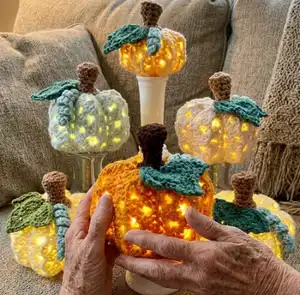
Create charming lighted pumpkins using simple granny-cluster techniques and medium worsted weight yarn. This pattern includes three sizes (Large, Medium, Small) so you can mix and match for glowing seasonal decor. Clear instructions and step-by-step photos help guide you as you crochet, assemble, and insert battery fairy lights for a cozy finish.
Progress Tracker
0% Complete
— Materials :
Info :
Suggested hook size: H8/5.00mm. All instructions are suitable for any medium worsted weight yarn. For the Large Pumpkins, I used less than 45g (83 yards) for each pumpkin of Caron One Pound in Cream or Red Heart Super Saver in Gold. For the Medium Pumpkins, I used less than 30g (55 yards) for each pumpkin of Caron One Pound in Off White or Pale Green. For the Small Pumpkins, I used less than 15g (28 yards) for each pumpkin of Red Heart Super Saver in Gold or Cornmeal. For stems, leaves, and curly vines, I used odds-and-ends amounts of Red Heart Super Saver in Coffee, Cafe Latte, Warm Brown, Dark Jade, or Caron One Pound in Soft Sage.
— Gauge :
Info :
Gauge is unimportant for this pattern. Although personal thread tension and yarn choice may impact finished size somewhat.
— Terminology :
Infos :
All instructions are in Standard/US terms. ch = chain. sc = single crochet. sc2tog = single crochet 2 together. sl st = slip stitch. sk st = skip stitch. hdc = half double crochet. dc = double crochet. FL = front loop of stitch. BL = back loop of stitch. Magic Circle: a method to begin the first round of a circular pattern; an alternative to ch 2, work # sc in second chain from hook.
— How to Make a Magic Circle :
Info :
Form the yarn into a circle, cross the top thread under the circle and pull through as though creating a slip knot without tightening, insert hook into the loop, while pinching tail and circle firmly together ch 1 (does not count as a stitch), crochet the first row's stitches into the circle over both strands. Pinch tail and pull tightly until circle closes.
— Large Pumpkin :
Info :
Hook size: US H8/5.00mm. Yarn: Caron One Pound in Cream or Red Heart Super Saver in Gold. Turning chains do not count as stitches. Begin by working ch 14.
Round Row 1 :
Row 1: sc in second chain from hook and in next st, 2 sc, sc, [2 sc in next 2 st, sc] 2 times, 2 sc, sc in last 2 st. Ch 1, turn. (19 st) (Fig. L-1)
Round Row 2 :
Row 2: sc in first two st, ch 1, sk st, [3 dc in next st, ch 1, sk 2 st] 4 times, 3 dc in next st, ch 1, sk st, sc in last 2 st. Ch 1, turn. (2 sc on each end + 5 granny clusters) (Fig. L-2)
Round Row 3 :
Row 3: sc in first two st, ch 1, dc in first ch-1 space, ch 1, [sk 3 st, 3 dc in next ch-1 space, ch 1] 4 times, sk 3 st, dc in last ch-1 space, ch 1, sc in last two st. Ch 1, turn. (2 sc on each end + 4 granny clusters) (Fig. L-3)
Round Row 4 :
Row 4: sc in first two st, ch 1, sk first ch and dc st, [3 dc in next ch-1 space, ch 1, sk 3 st] 4 times, 3 dc in next ch-1 space, ch 1, sk last dc and ch-1 space, sc in last 2 st. Ch 1, turn. (2 sc on each end + 5 granny clusters) (Fig. L-4)
Round Row 5 :
Row 5: sc in first two st, ch 1, dc in first ch-1 space, ch 1, [sk 3 st, 3 dc in next ch-1 space, ch 1] 4 times, sk 3 st, dc in last ch-1 space, ch 1, sc in last two st. Ch 1, turn. (2 sc on each end + 4 granny clusters) (Fig. L-5)
Round Row 6 :
Row 6: — (for this decrease row, do not count ch-1 spaces as stitches; skip over them as though they don't exist) — sc in first 2 st, [sc2tog, sc] 5 times, sc in last st. Ch 1, turn. (13 stitches) (Fig. L-6)
Round Row 7 :
Row 7: — working in front loops only — sc in first 2 st, 2 sc, sc, [2 sc in next 2 st, sc] 2 times, 2 sc, sc in last 2 st. Ch 1, turn. (19 st)
Round Row 8 :
Row 8: — working in both loops from now on — sc in first two st, ch 1, sk st, [3 dc in next st, ch 1, sk 2 st] 4 times, 3 dc in next st, ch 1, sk st, sc in last 2 st. Ch 1, turn. (2 sc on each end + 5 granny clusters)
Round Row 9 :
Row 9: sc in first two st, ch 1, dc in first ch-1 space, ch 1, [sk 3 st, 3 dc in next ch-1 space, ch 1] 4 times, sk 3 st, dc in last ch-1 space, ch 1, sc in last two st. Ch 1, turn. (2 sc on each end + 4 granny clusters)
Round Row 10 :
Row 10: sc in first two st, ch 1, sk first ch-1 space and dc st, [3 dc in next ch-1 space, ch 1, sk 3 st] 4 times, 3 dc in next ch-1 space, ch 1, sk last dc and ch-1 space, sc in last 2 st. Ch 1, turn. (2 sc on each end + 5 granny clusters)
Round Row 11 :
Row 11: sc in first two st, ch 1, dc in first ch-1 space, ch 1, [sk 3 st, 3 dc in next ch-1 space, ch 1] 4 times, sk 3 st, dc in last ch-1 space, ch 1, sc in last two st. Ch 1, turn. (2 sc on each end + 4 granny clusters)
Round Row 12 :
Row 12: — (for this decrease row, do not count ch-1 spaces as stitches; skip over them as though they don't exist) — sc in first 2 st, [sc2tog, sc] 5 times, sc in last st. Ch 1, turn. (13 stitches) (Fig. L-7)
Round Row 13 :
Row 13: — working in front loops only — sc in first 2 st, 2 sc, sc, [2 sc in next 2 st, sc] 2 times, 2 sc, sc in last 2 st. Ch 1, turn. (19 st)
Round Row 14 :
Row 14: — working in both loops from now on — sc in first two st, ch 1, sk st, [3 dc in next st, ch 1, sk 2 st] 4 times, 3 dc in next st, ch 1, sk st, sc in last 2 st. Ch 1, turn. (2 sc on each end + 5 granny clusters)
Round Row 15 :
Row 15: sc in first two st, ch 1, dc in first ch-1 space, ch 1, [sk 3 st, 3 dc in next ch-1 space, ch 1] 4 times, sk 3 st, dc in last ch-1 space, ch 1, sc in last two st. Ch 1, turn. (2 sc on each end + 4 granny clusters)
Round Row 16 :
Row 16: sc in first two st, ch 1, sk first ch-1 space and dc st, [3 dc in next ch-1 space, ch 1, sk 3 st] 4 times, 3 dc in next ch-1 space, ch 1, sk last dc and ch-1 space, sc in last 2 st. Ch 1, turn. (2 sc on each end + 5 granny clusters)
Round Row 17 :
Row 17: sc in first two st, ch 1, dc in first ch-1 space, ch 1, [sk 3 st, 3 dc in next ch-1 space, ch 1] 4 times, sk 3 st, dc in last ch-1 space, ch 1, sc in last two st. Ch 1, turn. (2 sc on each end + 4 granny clusters)
Round Row 18 :
Row 18: — (for this decrease row, do not count ch-1 spaces as stitches; skip over them as though they don't exist) — sc in first 2 st, [sc2tog, sc] 5 times, sc in last st. Ch 1, turn. (13 stitches)
Round Row 19 :
Row 19: — working in front loops only — sc in first 2 st, 2 sc, sc, [2 sc in next 2 st, sc] 2 times, 2 sc, sc in last 2 st. Ch 1, turn. (19 st)
Round Row 20 :
Row 20: — working in both loops from now on — sc in first two st, ch 1, sk st, [3 dc in next st, ch 1, sk 2 st] 4 times, 3 dc in next st, ch 1, sk st, sc in last 2 st. Ch 1, turn. (2 sc on each end + 5 granny clusters)
Round Row 21 :
Row 21: sc in first two st, ch 1, dc in first ch-1 space, ch 1, [sk 3 st, 3 dc in next ch-1 space, ch 1] 4 times, sk 3 st, dc in last ch-1 space, ch 1, sc in last two st. Ch 1, turn. (2 sc on each end + 4 granny clusters)
Round Row 22 :
Row 22: sc in first two st, ch 1, sk first ch-1 space and dc st, [3 dc in next ch-1 space, ch 1, sk 3 st] 4 times, 3 dc in next ch-1 space, ch 1, sk last dc and ch-1 space, sc in last 2 st. Ch 1, turn. (2 sc on each end + 5 granny clusters)
Round Row 23 :
Row 23: sc in first two st, ch 1, dc in first ch-1 space, ch 1, [sk 3 st, 3 dc in next ch-1 space, ch 1] 4 times, sk 3 st, dc in last ch-1 space, ch 1, sc in last two st. Ch 1, turn. (2 sc on each end + 4 granny clusters)
Round Row 24 :
Row 24: — (for this decrease row, do not count ch-1 spaces as stitches; skip over them as though they don't exist) — sc in first 2 st, [sc2tog, sc] 5 times, sc in last st. Ch 1, turn. (13 stitches)
Round Row 25 :
Row 25: — working in front loops only — sc in first 2 st, 2 sc, sc, [2 sc in next 2 st, sc] 2 times, 2 sc, sc in last 2 st. Ch 1, turn. (19 st)
Round Row 26 :
Row 26: — working in both loops from now on — sc in first two st, ch 1, sk st, [3 dc in next st, ch 1, sk 2 st] 4 times, 3 dc in next st, ch 1, sk st, sc in last 2 st. Ch 1, turn. (2 sc on each end + 5 granny clusters)
Round Row 27 :
Row 27: sc in first two st, ch 1, dc in first ch-1 space, ch 1, [sk 3 st, 3 dc in next ch-1 space, ch 1] 4 times, sk 3 st, dc in last ch-1 space, ch 1, sc in last two st. Ch 1, turn. (2 sc on each end + 4 granny clusters)
Round Row 28 :
Row 28: sc in first two st, ch 1, sk first ch-1 space and dc st, [3 dc in next ch-1 space, ch 1, sk 3 st] 4 times, 3 dc in next ch-1 space, ch 1, sk last dc and ch-1 space, sc in last 2 st. Ch 1, turn. (2 sc on each end + 5 granny clusters)
Round Row 29 :
Row 29: sc in first two st, ch 1, dc in first ch-1 space, ch 1, [sk 3 st, 3 dc in next ch-1 space, ch 1] 4 times, sk 3 st, dc in last ch-1 space, ch 1, sc in last two st. Ch 1, turn. (2 sc on each end + 4 granny clusters)
Round Row 30 :
Row 30: — (for this decrease row, do not count ch-1 spaces as stitches; skip over them as though they don't exist) — sc in first 2 st, [sc2tog, sc] 5 times, sc in last st. Ch 1, turn. (13 stitches)
Round Row 31 :
Row 31: — working in front loops only — sc in first 2 st, 2 sc, sc, [2 sc in next 2 st, sc] 2 times, 2 sc, sc in last 2 st. Ch 1, turn. (19 st)
Round Row 32 :
Row 32: — working in both loops from now on — sc in first two st, ch 1, sk st, [3 dc in next st, ch 1, sk 2 st] 4 times, 3 dc in next st, ch 1, sk st, sc in last 2 st. Ch 1, turn. (2 sc on each end + 5 granny clusters)
Round Row 33 :
Row 33: sc in first two st, ch 1, dc in first ch-1 space, ch 1, [sk 3 st, 3 dc in next ch-1 space, ch 1] 4 times, sk 3 st, dc in last ch-1 space, ch 1, sc in last two st. Ch 1, turn. (2 sc on each end + 4 granny clusters)
Round Row 34 :
Row 34: sc in first two st, ch 1, sk first ch-1 space and dc st, [3 dc in next ch-1 space, ch 1, sk 3 st] 4 times, 3 dc in next ch-1 space, ch 1, sk last dc and ch-1 space, sc in last 2 st. Ch 1, turn. (2 sc on each end + 5 granny clusters)
Round Row 35 :
Row 35: sc in first two st, ch 1, dc in first ch-1 space, ch 1, [sk 3 st, 3 dc in next ch-1 space, ch 1] 4 times, sk 3 st, dc in last ch-1 space, ch 1, sc in last two st. Ch 1, turn. (2 sc on each end + 4 granny clusters)
Round Row 36 :
Row 36: — (for this decrease row, do not count ch-1 spaces as stitches; skip over them as though they don't exist) — sc in first 2 st, [sc2tog, sc] 5 times, sc in last st. Ch 1, turn. (13 stitches)
Info :
Finish off, leaving 14" yarn tail. (Fig. L-8 & L-9) See assembly instructions beginning on page 27.
— Medium Pumpkin :
Info :
Hook size: US H8/5.00mm. Yarn: Caron One Pound in Off White or Pale Green. Turning chains do not count as stitches. Begin by working ch 12.
Round Row 1 :
Row 1: sc in second chain from hook and in next st, 2 sc, sc, 2 sc in next 3 st, sc, 2 sc, sc in last 2 st. Ch 1, turn. (16 st) (Fig. M-1)
Round Row 2 :
Row 2: sc in first two st, ch 1, sk st, [3 dc in next st, ch 1, sk 2 st] 3 times, 3 dc in next st, ch 1, sk st, sc in last 2 st. Ch 1, turn. (2 sc on each end + 4 granny clusters) (Fig. M-2)
Round Row 3 :
Row 3: sc in first two st, ch 1, dc in first ch-1 space, ch 1, [sk 3 st, 3 dc in next ch-1 space, ch 1] 3 times, sk 3 st, dc in last ch-1 space, ch 1, sc in last two st. Ch 1, turn. (2 sc on each end + 3 granny clusters) (Fig. M-3)
Round Row 4 :
Row 4: sc in first two st, ch 1, sk first ch and dc st, [3 dc in next ch-1 space, ch 1, sk 3 st] 3 times, 3 dc in next ch-1 space, ch 1, sk last dc and ch-1 space, sc in last 2 st. Ch 1, turn. (2 sc on each end + 4 granny clusters) (Fig. M-4)
Round Row 5 :
Row 5: — (for this decrease row, do not count ch-1 spaces as stitches; skip over them as though they don't exist) — sc in first 2 st, sc2tog, sc, sc2tog 3 times, sc, sc2tog, sc in last two st. Ch 1, turn. (11 stitches) (Fig. M-5)
Round Row 6 :
Row 6: — working in back loops only — sc in next 2 st, 2 sc, sc, 2 sc in next 3 stitches, sc, 2 sc, sc in last 2 st. Ch 1, turn. (16 st)
Round Row 7 :
Row 7: — working in both loops from now on — sc in first two st, ch 1, sk st, [3 dc in next st, ch 1, sk 2 st] 3 times, 3 dc in next st, ch 1, sk st, sc in last 2 st. Ch 1, turn. (2 sc on each end + 4 granny clusters)
Round Row 8 :
Row 8: sc in first two st, ch 1, dc in first ch-1 space, ch 1, [sk 3 st, 3 dc in next ch-1 space, ch 1] 3 times, sk 3 st, dc in last ch-1 space, ch 1, sc in last two st. Ch 1, turn. (2 sc on each end + 3 granny clusters)
Round Row 9 :
Row 9: sc in first two st, ch 1, sk first ch and dc st, [3 dc in next ch-1 space, ch 1, sk 3 st] 3 times, 3 dc in next ch-1 space, ch 1, sk last dc and ch-1 space, sc in last 2 st. Ch 1, turn. (2 sc on each end + 4 granny clusters)
Round Row 10 :
Row 10: — (for this decrease row, do not count ch-1 spaces as stitches; skip over them as though they don't exist) — sc in first 2 st, sc2tog, sc, sc2tog 3 times, sc, sc2tog, sc in last two st. Ch 1, turn. (11 stitches) (Fig. M-6)
Info :
Finish off, leaving 14" yarn tail. (Fig. M-7) See assembly instructions beginning on page 27.
— Small Pumpkin :
Info :
Hook size: US H8/5.00mm. Yarn: Red Heart Super Saver in Gold or Cornmeal. Turning chains do not count as stitches. Begin by working ch 8.
Round Row 1 :
Row 1: sc in second chain from hook, 2 sc in next 2 st, sc, 2 sc in next 2 st, sc in last st. Ch 1, turn. (11 st) (Fig. S-1)
Round Row 2 :
Row 2: sc, ch 1, sk st, [3 hdc in next st, ch 1, sk 2 st] 2 times, 3 hdc in next st, ch 1, sk st, sc in last st. Ch 1, turn. (1 sc in each end + 3 granny clusters) (Fig. S-2)
Round Row 3 :
Row 3: sc in first st, ch 1, hdc in first ch-1 space, ch 1, [sk 3 st, 3 hdc in next ch-1 space, ch 1] 2 times, sk 3 st, hdc in last ch-1 space, ch 1, sc in last st. Ch 1, turn. (1 sc on each end + 2 granny clusters) (Fig. S-3)
Round Row 4 :
Row 4: sc, ch 1, sk first ch-1 space and hdc, [3 hdc in next ch-1 space, ch 1, sk 3 st] 2 times, 3 hdc in next ch-1 space, ch 1, sk last hdc and ch-1 space, sc in last st. Ch 1, turn. (1 sc in each end + 3 granny clusters) (Fig. S-4)
Round Row 5 :
Row 5: — (for this decrease row, do not count ch-1 spaces as stitches; skip over them as though they don't exist) — sc in first st, sc2tog 2 times, sc, sc2tog 2 times, sc in last st. Ch 1, turn. (7 stitches) (Fig. S-5)
Round Row 6 :
Row 6: — working in back loops only — sc, 2 sc in next 2 st, sc, 2 sc in next 2 st, sc in last st. Ch 1, turn. (11 st)
Round Row 7 :
Row 7: sc, ch 1, sk st, [3 hdc in next st, ch 1, sk 2 st] 2 times, 3 hdc in next st, ch 1, sk st, sc in last st. Ch 1, turn. (1 sc in each end + 3 granny clusters)
Round Row 8 :
Row 8: sc in first st, ch 1, hdc in first ch-1 space, ch 1, [sk 3 st, 3 hdc in next ch-1 space, ch 1] 2 times, sk 3 st, hdc in last ch-1 space, ch 1, sc in last st. Ch 1, turn. (1 sc on each end + 2 granny clusters)
Round Row 9 :
Row 9: sc, ch 1, sk first ch-1 space and hdc, [3 hdc in next ch-1 space, ch 1, sk 3 st] 2 times, 3 hdc in next ch-1 space, ch 1, sk last hdc and ch-1 space, sc in last st. Ch 1, turn. (1 sc in each end + 3 granny clusters)
Round Row 10 :
Row 10: — (for this decrease row, do not count ch-1 spaces as stitches; skip over them as though they don't exist) — sc in first st, sc2tog 2 times, sc, sc2tog 2 times, sc in last st. Ch 1, turn. (7 stitches)
Round Row 11 :
Row 11: — working in front loops only — sc, 2 sc in next 2 st, sc, 2 sc in next 2 st, sc in last st. Ch 1, turn. (11 st)
Round Row 12 :
Row 12: sc, ch 1, sk st, [3 hdc in next st, ch 1, sk 2 st] 2 times, 3 hdc in next st, ch 1, sk st, sc in last st. Ch 1, turn. (1 sc in each end + 3 granny clusters)
Round Row 13 :
Row 13: sc in first st, ch 1, hdc in first ch-1 space, ch 1, [sk 3 st, 3 hdc in next ch-1 space, ch 1] 2 times, sk 3 st, hdc in last ch-1 space, ch 1, sc in last st. Ch 1, turn. (1 sc on each end + 2 granny clusters)
Round Row 14 :
Row 14: sc, ch 1, sk first ch-1 space and hdc, [3 hdc in next ch-1 space, ch 1, sk 3 st] 2 times, 3 hdc in next ch-1 space, ch 1, sk last hdc and ch-1 space, sc in last st. Ch 1, turn. (1 sc in each end + 3 granny clusters)
Round Row 15 :
Row 15: — (for this decrease row, do not count ch-1 spaces as stitches; skip over them as though they don't exist) — sc in first st, sc2tog 2 times, sc, sc2tog 2 times, sc in last st. Ch 1, turn. (7 stitches)
Info :
Finish off, leaving 14" yarn tail. (Fig. S-6 & S-7) See assembly instructions beginning on page 27.
These lighted granny pumpkins are a cozy, handmade addition to any seasonal display. They combine classic granny-cluster stitches with a modern twist—battery fairy lights—for a warm glow. Make a trio of sizes for a lovely centerpiece or scatter small ones along a mantle. 🧶✨