About This Leaf Garland Pattern
This pattern teaches you how to crochet a leafy garland using a simple repeat of chains, slip stitches and small leaf motifs. It is highly adaptable—you can alter spacing, yarn and hook to make anything from napkin rings to a long decorative garland. The instructions include an option to thicken the vine by working slip stitches back along the chain.
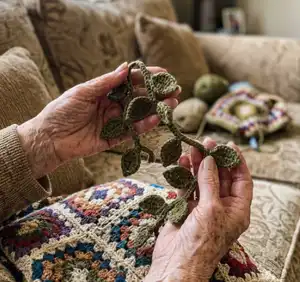
The example uses organic cotton DK (Category 3) with a 3.5mm (US E-4) hook, but you can use any non-stretchy yarn for different effects. Full step-by-step instructions are provided for small leaves, large leaves, nodules and finishing.
Why You'll Love This Leaf Garland Pattern
I absolutely love this pattern because it transforms a few simple stitches into an elegant organic garland that looks much more complicated than it is. I enjoy how adaptable it is — I can switch yarn and spacing to make something suitable for seasons, table settings or wearable accessories. The pattern is quick to work once you get the rhythm of the repeats, so I often make several in an afternoon. It feels rewarding to see a whole vine emerge from a simple chain and a handful of leaves, and I always enjoy gifting these as small handmade accents.
Switch Things Up
I love how easy it is to change the look of this garland by switching yarn and hook size: thicker yarn and a larger hook will give you a chunkier, more rustic vine, while fine cotton with a smaller hook yields a delicate, necklace-like garland.
You can vary leaf spacing by working longer or shorter chains between leaves; try long chains for a trailing vine or short chains for a clustered look.
I often mix leaf sizes in a single garland—work a few repeats of small leaves, then add a large leaf to create visual interest along the vine.
Try using a metallic or sparkly yarn for holiday decorations; the tiny leaves catch the light beautifully when draped over a mantel or tree.
If you want a sturdier vine, work the slip-stitch return pass described in the pattern and add extra nodules for texture and weight.
I sometimes make mini versions as keyrings or napkin rings by working fewer repeats and using thinner yarn; they make great gifts and take almost no time to finish.
For a natural look, experiment with undyed cottons or earthy tones; for a playful feel, go bold with bright, contrasting colors between leaves and the main vine.
I also like to embroider tiny veins onto the leaves with contrasting thread after finishing for a handcrafted botanical effect.
To make a loop for hanging, leave a longer starting chain at one end and secure it with a few extra slip stitches to form a neat hanger.
Finally, don’t be afraid to combine techniques—add a small pompom, bead or button at intervals along the vine to personalize your garland even more.
Common Mistakes & How to Fix Them
✗ Not counting your starting chain can throw off spacing and leaf placement; mark the start and count chains between leaves before you begin each repeat.
✗ Working through both loops when the pattern requires BLO will prevent the leaf shape from forming; always work in the back loop only where instructed to create the correct ridge.
✗ Using a very stretchy yarn for a long hanging garland can cause sagging and distortion; choose a non-stretchy yarn such as cotton, linen or hemp for long lengths.
✗ Skipping the slip-stitch joins at the base of the leaves can leave them flaring or loose; slip stitch again where the base of the leaf meets the long chain to secure it properly.
✗ Finishing without weaving in ends securely will result in unraveling over time; cut yarn, fasten off and weave in ends firmly at the end of the project.