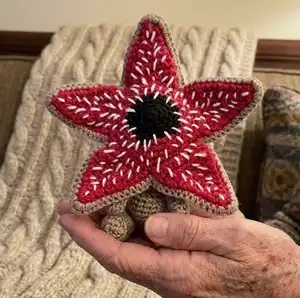
🧢 Beautiful ✨ Detailed πŸ’ Adorable

Demodog Amigurumi Pattern

Demodog Amigurumi Pattern
4.3β˜… Rating
5-7 Hours Time Needed
1.2K Made This
βœ‚οΈ

Intermediate Level

Ideal for those with basic crochet experience, featuring slightly more advanced stitches and techniques to expand your skills.

⏱️

Weekend Treat

Takes 5-7 hours, making it an enjoyable project to finish over a couple of days.

🧸

Cute Companion

An adorable friend to cherish, handcrafted with love to bring comfort and joy for years to come.

About This Demodog Amigurumi Pattern

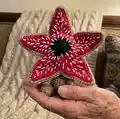
This pattern makes a small Demodog amigurumi with a star-shaped mouth that opens and closes, a tiny heart, and a posable mouth armature. It uses fingering weight yarn and simple shaping techniques to form the flaps and body. You will work rounds, flat rows for the mouth flaps, and assemble all parts with clear joining instructions.

Demodog Amigurumi Pattern crochet pattern - detailed view of completed project

Detailed stitch counts, shaping rows, and assembly steps are included so you can follow along easily. Perfect for crafters who enjoy character amigurumi with a slightly spooky twist.

Why You'll Love This Demodog Amigurumi Pattern

I absolutely love this pattern because it combines playful amigurumi construction with a unique star-shaped mouth that opens to reveal a tiny heart. I enjoyed designing the flap shaping and the small details like the embroidered teeth and dangling threads on the heart. The use of a wire armature makes the mouth poseable and adds a fun interactive element. Working this pattern taught me new ways to join two pieces and trap an armature between layers, and I'm excited to share those techniques with you.

Demodog Amigurumi Pattern step 1 - construction progress Demodog Amigurumi Pattern step 2 - assembly progress Demodog Amigurumi Pattern step 3 - details and accessories Demodog Amigurumi Pattern step 4 - final assembly and finishing

Switch Things Up

I love customizing this Demodog by changing colors; try pastel shades for a whimsical version or neon for a modern twist.

To make a bigger or smaller version, change your yarn weight and hook size β€” bulky yarn with a larger hook creates a chunky, cuddly creature, while thin yarn and a smaller hook makes a tiny keychain version.

I often add embroidered scars or different tooth lengths to change the personality of the mouth; experiment with white embroidery or contrasting thread colors.

You can omit the wire armature for a soft, floppy star mouth, or use thinner, more flexible wire if you want a gentler bend and less chance of breakage.

Consider making a set of accessories like tiny crocheted bows, a miniature collar, or different shaped hearts to give each Demodog its own story.

Want a standing display piece? Sew a small felt base into the body bottom or add a subtle wire inside the body to adjust posture for display.

Use safety eyes or embroider eyes behind the heart for a different expression, or hide the eyes completely for a more mysterious look.

I sometimes mix yarn brands for texture β€” pairing a slightly fuzzy fingering with a smooth cotton gives interesting contrast on the flaps.

Try stitching beads or tiny sequins inside the mouth for a shiny, otherworldly effect, being careful they’re secured safely if the toy is for a child.

Finally, I recommend making one sample mouth first to practice joining the armature and flaps before committing to the full project; it makes assembly much smoother.

Common Mistakes & How to Fix Them

βœ— Skipping the running stitch marker when switching to rounds can make it hard to find the start of the round; place a marker after the slst that becomes the new end of the round to track your rounds correctly. βœ— Not stuffing the head before closing the last flap can prevent the head from forming its shape; stuff the head firmly but avoid stuffing the flaps so they remain flexible. βœ— Failing to secure the wire armature ends can lead to poking hazards; twist wire ends together and wrap with tape before placing inside the mouth flaps to avoid pointy ends sticking out. βœ— Ignoring stitch counts when making the mouth flaps will cause uneven flaps; count the stitches carefully and follow the increase/decrease sequence exactly for symmetrical points. βœ— Using inconsistent tension when crocheting flaps versus the rest of the head will create mismatched edges; try to maintain similar tension and practice yarn-under/yarn-over technique used in this pattern for straighter lines.

Demodog Amigurumi Pattern

Create a creepy-cute Demodog amigurumi with this detailed crochet pattern. You will craft a star-shaped mouth, articulated flaps with wire armature, and a tiny ripped heart β€” perfect for collectors and gifts. The pattern uses fingering weight yarn and includes full step-by-step rounds and assembly notes. Follow each round carefully and enjoy bringing this little monster to life.

Intermediate 5-7 Hours

Materials Needed for Demodog Amigurumi Pattern

β€” Main Fabric

  • 01
    Fingering weight yarn (4 ply) - Body: Katia Capri 82126 Kaki (used for main body and head)
  • 02
    Fingering weight yarn (4 ply) - Mouth (black): Katia Capri 82056 Black (center of mouth)
  • 03
    Fingering weight yarn (4 ply) - Mouth (scarlet): Scheepjes Catona 192 Scarlet (mouth red area)
  • 04
    Fingering weight yarn (4 ply) - Teeth: Katia Capri 82050 White (embroidery for teeth)
  • 05
    Fingering weight yarn (4 ply) - Heart: Katia Capri 82059 Red (small heart accessory)

β€” Tools Required

  • 01
    Crochet hook size 2.5 mm
  • 02
    Sewing needle
  • 03
    Scissors
  • 04
    Wire Β±1 mm / 18 or 19 Gauge
  • 05
    Pliers (for cutting and bending wire)
  • 06
    Pins
  • 07
    Stitch markers and running stitch markers (scrap piece of yarn)
  • 08
    Fiber fill
  • 09
    Tape for wrapping wire ends

Progress Tracker

0% Complete

β€” Mouth :

Rnd 1 :

B MR 5 (5)

Rnd 2 :

B (inc) x5 (10)

Rnd 3 :

B (1sc, inc) x5 (15)

Rnd 4 :

B (2sc, inc) x5 (20)

Rnd 5 :

B (3sc, inc) x5 (25)

Info :

Change color to scarlet

Rnd 6 :

S (4sc, inc) x5 (30)

Rnd 7 :

S (5sc, inc) x5 (35)

Rnd 8 :

S (6sc, inc) x5 (40)

Rnd 9 :

S 8sc, ch1, turn. 7sc, inc, ch1, turn. 8sc, inc, ch1, turn. 8sc, dec, ch1, turn. 7sc, dec, ch1, turn. 6sc, dec, ch1, turn. 5sc, dec, ch1, turn. 4sc, dec, ch1, turn. 3sc, dec, ch1, turn. 2sc, dec, ch1, turn. 1sc, dec, ch1, turn. dec (12 rows)

Info :

FO, cut off yarn. Repeat round 9 x4. Start with new thread in next stitch in round 9 (slst, ch1 - start 1st stitch in the same stitch). Work away tail in the next 3 stitches as you go.

Info :

When you reach the last flap, don't cut the thread, ch1, turn, and 12 sc down the flap. When you reach the starting point of the flap, sc into the last (a) and first (b) flap-stitch of round 9. These stitches will now contain 2 sc's, 1 for the flap, and 1 for the border.

Info :

NOTE! When you reach the next flap (the first flap you made in rnd 9), it will have only 12 stitches on the right side, first sc on the flap will be an inc to make 13 (c). The next 4 flaps will need no increases here. Including the first stitch of rnd 9, you will have 13 stitches along the side of each flap (d).

Info :

When you reach the top stitch (the point of the flap), sc 1 extra. So total of 3 stitches on top (rightside st. / middle st / leftside st.). Sc all around the flaps. (135 st. total) Finish off and work away thread.

β€” Teeth :

Info :

WHITE. Embroider teeth using white thread. They can be a bit messy, some short, some a little longer, but have them facing inward a bit. It doesn't matter if the backside looks messy, you won't see it when the head is finished.

β€” Head :

Rnd 1 :

MR 5 (5)

Rnd 2 :

(inc) x5 (10)

Rnd 3 :

(1sc, inc) x5 (15)

Rnd 4 :

(2sc, inc) x5 (20)

Rnd 5 :

(3sc, inc) x5 (25)

Rnd 6 :

(4sc, inc) x5 (30)

Rnd 7 :

(5sc, inc) x5 (35)

Rnd 8 :

(6sc, inc) x5 (40)

Rnd 9 to 14 :

40 sc (40) 6 rounds

Rnd 15 :

8sc, ch1, turn. inc, 7sc, ch1, turn. inc, 8sc, ch1, turn. dec, 8sc, ch1, turn. dec, 7sc, ch1, turn. dec, 6sc, ch1, turn. dec, 5sc, ch1, turn. dec, 4sc, ch1, turn. dec, 3sc, ch1, turn. dec, 2sc, ch1, turn. dec, 1sc, ch1, turn. dec (12 rows)

Info :

FO, cut off yarn. Repeat rnd 15 for each flap. Start with new thread (slst, ch1) in next stitch in round 14. The first sc will be in the same stitch as the slst, ch1. Work away tail in the next 3 stitches as you go.

Info :

When you reach the last flap, don't cut the thread, ch1, turn and 12 sc down the flap. When you reach the starting point of the flap, sc into the last and first flap-stitch of round 14. These stitches will now contain 2 sc's, 1 for the flap, and 1 for the border.

Info :

Including this first stitch of rnd 14, you will have 13 stitches along the side of each flap. NOTE! When you reach the next flap (the first flap you made in rnd 14), it will have only 12 stitches on the right side, first sc on the flap will be an inc to fix this. The next 4 flaps will need no increases here.

Info :

When you reach the top stitch (the point of the flaps), sc 1 extra. So total of 3 stitches on top (rightside st. / middle st / leftside st.). Sc all around all remaining flaps. (155 st. total) Don't cut thread!

Info :

Using iron wire, make armature for flaps. You can use pliers to bend them into the star shape. Try to make the armature as similar to the mouth shape as possible. Twist the ends and wrap around with tape, to avoid pointy ends sticking out.

Info :

To avoid breaking from bending, you can tape the bends in the wire. If it bends a lot, in time the wire might break from usage.

Info :

Now we start to sc all around the mouth, together with the head, and have the armature trapped inside. Continue with the thread of the head. Sandwich the armature between the head and the mouth.

Info :

1. Push the hook through the next head stitch - underneath the armature - through the corresponding mouth stitch. 2. Pull up yarn, now you have 2 loops on the hook. 3. Pull up yarn over the armature and 4. Finish the stitch.

Info :

When reaching the 3 top stitches of the 5 points of the flaps: inc, 3inc, inc. You should have 7 top stitches in total. Make sure the wire ends are inside the head. Continue this all around. (155 st. total)

Info :

Make sure to stuff the head before closing the last flap. Don't fill the flaps with fiberfill. Finish off. Cut off yarn and work away thread.

β€” Arms x2 :

Rnd 1 :

MR 8 (8)

Rnd 2 to 6 :

8sc (8) 5 rounds

Info :

FO, slst, work away yarn, don't fill up yet!

β€” Body :

Info :

KAKI. For the Body, we start with an oval shape. You will be going down one side of the chain and back around the other side.

Rnd 1 :

ch6, sc in 2nd ch. from the hook and work down the chain, 3sc, 3inc, now work on the other side of the chain, 3sc, inc (12)

Info :

Make 1 slst into the 1st st. of the next round. Treat this slst as the new end of the round, and place your running stitch marker after this slst. The next stitch you crochet is the 1st st of the new round.

Rnd 2 :

3sc, (inc) x3, 3sc, (inc)x3 (18)

Rnd 3 :

3sc, (1sc, inc)x3, 3sc, (1sc, inc)x3 (24)

Rnd 4 to 6 :

24sc (24) 3 rounds

Rnd 7 :

3sc, (1sc, dec)x3, 12sc (21)

Rnd 8 :

3sc, (dec)x3, 12sc (18)

Rnd 9 :

8sc on 1st arm, continue with body, 2sc, (dec)x3, 2sc, 8sc on 2nd arm, continue with body, 3sc, dec, 3sc (30)

Info :

We'll be attaching the arms in the next round. Start sc on the first arm. NOTE! To avoid a gap in the armpit, you can either sew the hole shut. Or after you finish stitching 8sc around the arm, you can do an extra stitch sewing the first stitch of the arm together with the last used stitch of the body again. In the next round, this stitch is to be ignored.

Rnd 10 :

(3sc, dec)x6 (24)

Rnd 11 :

(2sc, dec)x6 (18)

Rnd 12 :

(1sc, dec)x6 (12)

Info :

Slst, FO, Leave long tail. It may seem a little off just now, but when you start stuffing firmly, it'll get into shape. The big bulge is it's booty. Add wire for the arms, bend the ends (to avoid poking out) and wrap the pointy ends with tape. Place it in the arms.

β€” Legs x2 :

Rnd 1 :

ch4, sc in 2nd ch. from the hook and work down the chain, 1sc, 3inc, now work on the other side of the chain, 1sc, inc, slst (8)

Info :

Make 1 slst into the 1st st. of the next round. Treat this slst as the new end of the round, and place your running stitch marker after this slst. The next stitch you crochet is the 1st st of the new round.

Rnd 2 :

1sc, (inc) x3, 1sc, (inc)x3 (14)

Rnd 3 :

14sc (14)

Rnd 4 :

1sc, (dec)x3, 7sc (11)

Rnd 5 :

1sc, 3dec (single crochet 3 stitches in front loops together), 7sc (9)

Rnd 6 :

1sc, inc, 7sc (10)

Rnd 7 :

2sc, inc, 7sc (11)

Rnd 8 :

2sc, inc, 8sc (12)

Rnd 9 :

3sc, inc, 8sc (13)

Rnd 10 :

3sc, inc, 9sc (14)

Rnd 11 :

14sc (14)

Rnd 12 :

(dec)x7 (7)

Info :

Slst, FO, leave long tail for sewing. Stuff the feet firmly, legs very lightly. Sew shut. Sew legs 6 stitches apart, (from bum). Counting from the last row of the leg, sew into 5 stitches of leg to attach to the body, also sew the inside of the leg of the 5th row to the body. Make sure the outside of the leg isn't stitched to body and can still bulge. It's best to place the body on a flat service and pin the legs first, to see if he can sit up properly.

β€” Tail :

Rnd 1 :

MR 4 (4)

Rnd 2 :

3sc, inc (5)

Rnd 3 :

4sc, inc (6)

Rnd 4 :

5sc, inc (7)

Rnd 5 :

6sc, inc (8)

Rnd 6 :

7sc, inc (9)

Rnd 7 :

8sc, inc (10)

Info :

Slst, FO, leave long tail for sewing. Stuff lightly. Place 10 pins, as to where the tail will be place. (red pin is starting point.) Sew tail to body.

β€” Attaching body to head :

Info :

Place 12 pins in head, as to where the body will be placed. Red pin is starting point. Use 3 stitches directly under flaps; in the middle / 3 stitches to the sides / 3 stitches for back of body. Now you can sew the body to the head.

Info :

I've designed the Demodog using Fingering weight yarn. Should you want to make him in a heavier weight yarn, you might want to sew a few extra stitches at the back of the head, to keep him from falling over, as his head will be heavier. The body should be stuffed very firmly, to form a stable base for the head.

β€” Heart :

Rnd 1 :

MR 6 (6)

Rnd 2 :

(inc)x6 (12)

Rnd 3 :

12sc (12)

Info :

FO and work away yarn. Make another part just like the previous one by repeating rounds 1-3. Do not cut the yarn as we will continue using the yarn of the second part.

Rnd 4 :

Crochet the parts together, 12sc on part 1, and 11sc on part 2, we finish this round 1st earlier (23)

Rnd 5 :

24sc (24)

Rnd 6 :

(dec, 6sc)x3 (21)

Rnd 7 :

(dec, 5sc)x3 (18)

Rnd 8 :

(dec, 4sc)x3 (15)

Rnd 9 :

(dec, 3sc)x3 (12) Stuff firmly.

Rnd 10 :

(dec)x6 (6)

Info :

FO, sew shut. Have a few threads dangling from heart, different colors. As if resembling veins - it's a ripped out heart :)

Assembly Instructions

  • Sandwich the wire armature between the head and mouth when joining: push the hook through the next head stitch underneath the armature, then through corresponding mouth stitch and finish the stitch so the armature is trapped inside.
  • Attach arms in round 9 of the body: start sc on the first arm, work 8sc around the 1st arm, continue body rounds, then repeat for the 2nd arm as instructed before closing the round.
  • Sew legs to the body 6 stitches apart from the bum; counting from the last row of the leg, sew into 5 stitches of leg and attach to the body ensuring the outside of the leg is free to bulge.
  • Place 12 pins on the head to mark the attachment points for the body, using 3 stitches under flaps, 3 stitches to each side and 3 stitches for the back; then sew body to head firmly.
  • Insert the wire for the mouth armature and tape the ends; make sure wire ends are inside the head and not poking out before closing the last flap.
  • Sew the heart to the inside of the mouth or position it as desired; leave a few dangling yarn threads to simulate veins or ripped threads if you prefer the original look.

Important Notes

  • πŸ’‘Use a running stitch marker after the slst that marks the new end of the round to identify the first stitch of the next round.
  • πŸ’‘Do not stuff the mouth flaps; only stuff the head and body firmly to create the correct shape and a stable base for the head.
  • πŸ’‘Wrap and tape any exposed wire ends to avoid sharp points; twist ends together and cover with tape for safety.
  • πŸ’‘Work away tails as you go in the next few stitches to keep seams tidy and avoid bulky knots inside the pieces.
  • πŸ’‘When using heavier yarn than fingering, consider adding extra stitches at the back of the head to balance weight and prevent tipping.

This Demodog amigurumi pattern blends spooky charm with crafty detail, creating a tiny collectible full of personality and surprises. The poseable mouth and little ripped heart give it character, perfect for unique gifts or shelf display. Grab your fingering yarn and wire, and make your own Demodog today! 🧢❀️

You ask,

we answer.

FAQs

What size will the finished piece be?

The finished Demodog measures approximately 5 inches (13 cm) tall with the mouth opened and about 4 inches (10 cm) with the mouth closed when using recommended fingering yarn and a 2.5 mm hook.

Can I use a different yarn weight?

Yes, you can use different yarn weights, but the final size and proportions will change; if using a heavier yarn you may need to add extra stitches when attaching the body to the head to keep the amigurumi stable.

Do I need to use wire for the mouth flaps?

The wire armature is recommended for poseability and to hold the star shape; you can omit it for a softer, non-pos able mouth but the flaps will be less structured.

Is this pattern suitable for beginners?

This pattern is rated intermediate because it includes shaping, flat row flap construction, joining two pieces with trapped armature, and assembly; basic crochet experience is recommended.

How long does it take to complete?

Most crafters will finish this project in about 5-7 hours depending on experience, assembly time, and how much time you spend on details like embroidering the teeth.