๐Ÿงถ Beautiful โœจ Detailed ๐Ÿ’ Adorable

WALL-E Amigurumi Pattern

WALL-E Amigurumi Pattern
4.3โ˜… Rating
5-7 Hours Time Needed
1.7K Made This
โœ‚๏ธ

Intermediate Level

Ideal for those with basic crochet experience, featuring slightly more advanced stitches and techniques to expand your skills.

โฑ๏ธ

Weekend Treat

Takes 5-7 hours, making it an enjoyable project to finish over a couple of days.

๐Ÿงธ

Cute Companion

An adorable friend to cherish, handcrafted with love to bring comfort and joy for years to come.

About This WALL-E Amigurumi Pattern

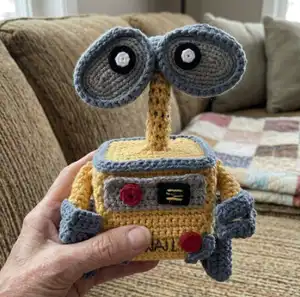
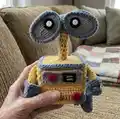
This pattern guides you through crocheting a miniature WALL-E amigurumi using cotton yarn and simple shaping techniques. It includes body panels, arms, neck, eyes, glasses and wheels with clear photos to guide assembly. You will create felt/cardboard eyes and assemble layered wheel parts for stability. The final toy measures approximately 15 cm tall when made as shown.

WALL-E Amigurumi Pattern crochet pattern - detailed view of completed project

The pattern uses single crochet in spirals and worked-in-rows panels to form the boxy body. Detailed steps for joining parts, inserting wire into the neck, and attaching the eyes are included.

Why You'll Love This WALL-E Amigurumi Pattern

I absolutely love this pattern because it turns a beloved robot into a small, handmade keepsake you can crochet in a weekend. I enjoy how the design mixes simple rectangular panels with small 3D parts to create a surprisingly detailed result. The eye construction using felt and cardboard makes the expression really pop, and adding wire to the neck gives it a fun poseable feature. Sewing the small parts together feels rewarding and the finished WALL-E looks delightful perched on a shelf.

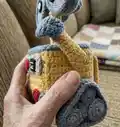
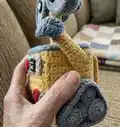
WALL-E Amigurumi Pattern step 1 - construction progress WALL-E Amigurumi Pattern step 2 - assembly progress WALL-E Amigurumi Pattern step 3 - details and accessories WALL-E Amigurumi Pattern step 4 - final assembly and finishing

Switch Things Up

I love how easy it is to customize this WALL-E pattern by changing yarn colors; try pastel tones for a soft, toy-like look.

If you want a larger WALL-E, use bulkier yarn and a larger hook โ€” the whole model scales up nicely.

For a tiny keychain version, use thinner yarn and a smaller hook, and skip the internal wire in the neck for safety.

I often add embroidered details or felt accessories like tiny crates or badges to personalize each model.

You can replace the cardboard eye cores with craft foam for a softer feel but still maintain structure.

Try adding a small loop of yarn on the back to hang your WALL-E as an ornament or use a split ring for a keychain.

I sometimes stitch on small patches of different yarn textures to create weathering effects for a more realistic robot look.

Consider using safety eyes instead of felt for a glossier pupil โ€” but glue felt backs to keep the look consistent with the pattern.

Make a set with matching robots by varying the wheel colors and trim for a coordinated display.

Finally, if you like sewing more than glue, stitch the felt pieces to the cardboard before gluing into the lens for extra durability.

Common Mistakes & How to Fix Them

โœ— Skipping stitch markers during panels will cause misaligned rows; place markers at the edges and count rows frequently to maintain alignment. โœ— Overstuffing eyes or wheels makes assembly difficult and distorts shape; apply a small amount of stuffing and glue to retain the intended profile. โœ— Not taping wire ends will allow the wire to poke through the neck; wrap the exposed wire tip with tape before inserting it into the crocheted neck. โœ— Forgetting to leave long tails when fastening off prevents neat sewing and joining; always leave long tails for assembly and weaving in after positioning pieces.

WALL-E Amigurumi Pattern

Make a tiny, adorable WALL-E amigurumi with clear step-by-step instructions and photo guidance. This pattern uses cotton yarn and small felt/cardboard pieces to create the signature eyes and wheels. You will enjoy assembling the panels, sewing the arms and adding charming details. Perfect for gifting or keeping as a handmade collectible.

Intermediate 5-7 Hours

Materials Needed for WALL-E Amigurumi Pattern

โ€” Main Fabric

  • 01
    Cotton yarn 3mm - Mustard (Mostaza 05) - main body color (small skeins)
  • 02
    Cotton yarn 3mm - Grey (Gris 91) - light grey for details and wheels
  • 03
    Cotton yarn 3mm - Dark gray (Gris Oscuro 92) - darker grey for eyes and trim
  • 04
    A small piece of red yarn/felt (Rojo 40) for button detail

โ€” Tools Required

  • 01
    Crochet hook size 2.5 mm
  • 02
    Felt black
  • 03
    Felt red
  • 04
    Felt grey
  • 05
    Felt white
  • 06
    Paperboard/cardboard for eye and wheel cores
  • 07
    Needle
  • 08
    Scissors
  • 09
    Fabric adhesive or craft glue
  • 10
    Fiber fill (polyester stuffing)
  • 11
    Tape measure
  • 12
    Wire (for neck internal support)
  • 13
    Tape to wrap wire
  • 14
    Stitch markers
  • 15
    Yarn needle for sewing pieces

Progress Tracker

0% Complete

โ€” Body Panels :

Large Panel (Make 4 of these) :

Use mustard yarn

Round 1 :

18 ch, start from the 2nd stitch from the hook, 17 sc,1 ch and turn, star from the 2th stitch from the hook(17)

Round 2-13 :

17 sc, 1 Ch,and turn, start from the 2nd stitch from the hook (17)

Round 14 :

17 sc, fasten off. (17)

Small Panel (Make 2 of these) :

Use mustard yarn

Round 1 :

16 ch, start from the 2nd stitch from the hook, 15 sc,1 ch and turn, start from the 2nd stitch from the hook(15)

Round 2-13 :

15 sc, 1 Ch,and turn, start from the 2nd stitch from the hook (17)

Round 14 :

15 sc, fasten off. (17)

โ€” Arm :

The arm is divided into two parts :

Make the shoulder and the arm part as separate pieces then join.

First part (shoulder)(make 2) :

1. MR 7sc (7)

Round 2-3 :

7 sc, fasten off and leave a long tail (7)

Second part (arm) (make 2) :

1. MR 7sc (7)

Round 2-11 :

7 sc (7)

Info :

*FILL THE ARMS A LITTLE BIT

Round 12 :

Flatten the arm and make 3 slst, Fasten off and leave a long tail.

Arm Union :

take the first and second part With the long tail that we left on the arm, we will join it to what will be the shoulder so that it looks like this.

โ€” Fingers :

Round 1 :

10 ch, start from the 2nd stitch from the hook, 9 sc,1 ch, and turn star from the 2nd stitch from the hook. (9)

Round 2 :

9 sc, fasten off.

โ€” Neck :

Round 1 :

MR 6 sc (6)

Round 2-15 :

6 sc (6) fasten off and leave a long tail

Info :

Cut a piece of wire that is 2 cm longer than the neck.

Info :

Cover your wire with tape on the top, so that it does not come out of the neck

Info :

Introduce the wire to the neck, the part that does not have a tape, will help us secure the neck inside the body

Info :

*FILL THE NECK A LITTLE BIT

โ€” Eyes :

Info :

For the eyes we will use this mold, we make 2 of cardboard and 2 of gray felt (the cardboard helps the eye to be firm)

Info :

Size: 4.3 cm. x 2.8 cm.

Front Part - Round 1 :

MR 6sc(6)

Round 2 :

6inc (12)

Round 3 :

(1 sc, 1 inc) x6 (18)

Round 4 :

(2 sc, 1 inc) x6 (24)

Round 5 :

(3 sc, 1 inc) x6 (30)

Round 6 :

30 sc BLO

Round 7-9 :

30 sc, fasten off.

Back Part - Round 1 :

MR 6 SC (6)

Round 2 :

6 inc (12)

Round 3 :

(1 sc, 1 inc) x6 (18)

Round 4 :

18 sc BLO

Round 5-8 :

18 sc fasten off and cut the yarn leaving a long tail

Middle Part - Round 1 :

MR 7 sc (7)

Round 2-7 :

7 sc (7)

Info :

Stuff with fiber and fasten off.

Glasses Chain :

1. 40 Ch Fasten off , and cut the yarn leaving a long tail for assembly.

Eye Assembly :

I recommend you follow the steps as indicated. Insert the chain in the middle of the back and secure it on the inside.

Info :

You can secure yourself inside with a very large knot

Info :

do the same with the other eye

Eyes - Filling :

Fill the eyes a little bit. Put glue first and then the filling.

Info :

Glue the lenses to the inside edge, then glue felt pupil and white highlight.

โ€” Wheels :

Strip - Round 1 :

40 ch, start from the 2nd stitch from the hook, 39 sc,1 ch and turn, star from the 2nd stitch from the hook (39)

Round 2 :

39 sc, 1 Ch,and turn, start from the 2nd stitch from the hook (39)

Round 3 :

39 sc, fasten off and leave a long tail. (39)

Large Parts X 2 - Round 1 :

MR 6 sc (6)

Round 2 :

6 inc (12)

Round 3 :

12 sc BLO(12)

Round 4 :

6 Dec (6)

Info :

Fasten off

Small Parts X 4 - Round 1 :

MR 8 sc (8)

Round 2 :

8 sc BLO (8)

Round 3 :

4 Dec (4)

Info :

Fasten off

Wheelset :

cut 3 rectangles out of cardboard and 3 out of felt. Join both and then glue them to what will be your wheel (guide yourself by the image)

Info :

Rectangles are approximately 4 cm x 1 cm. With the tail of your wheel you will join the edge forming a triangle, inside the wheel glue 2 small parts and 1 large

โ€” Details :

Small Front Panel :

1. 17 ch, start from the 2nd stitch from the hook, 16 sc,1 ch and turn, start from the 2nd stitch from the hook(16)

Round 2-3 :

16 sc, 1 Ch,and turn, start from the 2nd stitch from the hook (16)

Round 4 :

16 sc, fasten off. (16)

Lower Corners X4 :

1. 8 ch, start from the 2nd stitch from the hook, 3sc , skip 1 ch, 3sc . Fasten off

Upper Edge :

1. 61 ch ,start from the 2nd stitch from the hook, 60 sc (60) fasten off.

โ€” Body assembly :

Arms :

the arms will be sewn to the small panels

Info :

use this image as a guide, it should be sewn 3 rounds down

Neck :

take 1 large panel and sew the neck the wire that you left at the beginning in the neck, insert it into the panel

Info :

Position it 3 rows down and as centered as you can

Info :

Bend the wire tip this way, this will help the neck to be better secured

Assembly Instructions

  • Sew the neck into the center of one large panel: insert the taped wire end through the panel opening, position the neck about 3 rows down from the top, then secure and bend the wire tip to prevent slippage.
  • Attach the arms to the small side panels: position each arm and sew them in place approximately 3 rounds down from the top edge for a natural orientation.
  • Glue and assemble the eyes: glue the grey felt to the cardboard, add the black pupil and white highlight, then glue the crocheted lens to the inner edge and secure the back chain inside with a knot.
  • Create and build the wheels: sew the crocheted strip into a triangular track, glue cardboard/felt rectangles inside, then glue two small circular parts and one large circular part into each wheel before attaching to the body.
  • Sew the small front panel and details to the front of the body: center the small front panel on one of the large panels, sew securely, then add lower corner pieces and upper edge trim as shown.
  • Assemble the body by joining four large panels and two small panels: align edges and seam panels neatly, then insert the neck and secure wheels and arms before finishing final embroidery or button details.

Important Notes

  • ๐Ÿ’กWork with tight tension for best results; loose stitches will make panels and shapes floppy.
  • ๐Ÿ’กUse stitch markers at the ends of rows and for counting rounds in spirals to avoid mistakes.
  • ๐Ÿ’กWrap and tape the exposed wire tip before inserting it into the neck for safety and to prevent it coming through the crochet.

This little WALL-E amigurumi is a sweet project that combines simple crochet with fun assembly details. It uses felt and cardboard for firm eyes and layered wheel parts for a realistic look. Make one for a gift or to brighten your workspace โ€” enjoy the process and show off your handmade robot! ๐Ÿค–๐Ÿงถ

You ask,

we answer.

FAQs

What size will the finished piece be?

The finished amigurumi measures approximately 15 cm tall when using the recommended cotton yarn and 2.5 mm hook.

Can I use different yarn weights for this pattern?

Yes, you can use different yarn weights but this will change the final size and detail. If using a thicker yarn, increase hook size and expect a chunkier toy.

Do I need any special tools for the neck?

You will need a short length of wire and tape to reinforce the neck; wrap the taped end before inserting to prevent it from poking out.

How long does this project take to complete?

Most crocheters finish this project in 5-7 hours, though time will vary depending on experience and how much assembly is required.