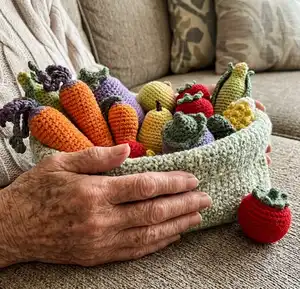
Create a charming set of miniature crocheted vegetables — tomato, carrot, corn cob, eggplant and radish — perfect for play, display, or gift-giving. The pattern uses simple amigurumi shaping techniques, back loop work and a few decrease methods so you can practice shaping and finishing. Clear round-by-round instructions guide you through each piece so you can make one or a whole basket of veggies your way.
Progress Tracker
0% Complete
— Notes :
Info :
Size 4 mm (U.S. G or 6) crochet hook or size needed to obtain gauge. Polyester stuffing.
Info :
GAUGE 15 sc and 16 rows = 4 ins [10 cm].
Info :
ABBREVIATIONS www.sugarncream.com/glossary Sc2(3)tog = Draw up a loop in each of next 2 (3) sc. Yoh and draw through all loops on hook.
— Tomato :
Round 1 :
6 sc in 2nd ch from hook. Join with sl st to first sc. 6 sc.
Round 2 :
Ch 1. 2 sc in same sp as last sl st. 2 sc in each sc around. Join with sl st in first sc. 12 sc.
Round 3 :
Ch 1. 2 sc in same sp as last sl st. *1 sc in next sc. 2 sc in next sc. Rep from * to last sc. 1 sc in last sc. Join with sl st in first sc. 18 sc.
Round 4 :
Ch 1. 2 sc in same sp as last sl st. *1 sc in each of next 2 sc. 2 sc in next sc. Rep from * to last 2 sc. 1 sc in each of last 2 sc. Join with sl st in first sc. 24 sc.
Round 5 :
Ch 1. 1 sc in each sc around. Join with sl st to first sc.
Round 6 :
Ch 1. 2 sc in same sp as last sl st. *1 sc in each of next 3 sc. 2 sc in next sc. Rep from * to last 3 sc. 1 sc in each of last 3 sc. Join with sl st in first sc. 30 sc.
Round 9 :
Ch 1. *Draw up a loop in each of next 2 sc. Yoh and draw through all loops on hook - sc2tog made. 1 sc in each of next 4 sc. Rep from * 4 times more. Join with sl st to first sc. 25 sc.
Round 11 :
Ch 1. *Sc2tog over next 2 sts. 1 sc in each of next 3 sc. Rep from * 4 times more. Join with sl st to first sc. 20 sc.
Round 12 :
Ch 1. 1 sc in each sc around. Join MC with sl st to first sc. Break A. Stuff tomato.
Round 13 :
With MC, ch 1. *Sc2tog over next 2 sts. 1 sc in each of next 2 sc. Rep from * 4 times more. Join with sl st to first sc. 15 sc.
Round 14 :
Ch 1. Working in back loop only of each st, *Sc2tog over next 2 sts. 1 sc in next sc. Rep from * 4 times more. Join with sl st to first sc. 10 sc.
Round 15 :
Ch 1. (Sc2tog over next 2 sts) 5 times. Join with sl st to first sc. 5 sc. Fasten off leaving a long end. Thread end onto tapestry needle and draw through final 5 sc tightly. Using same end, ch 4. Sl st in 2nd ch from hook and each of next 2 ch. Sl st in same sp as where ch originated. Fasten off.
Leaves (P1) :
With RS facing, join MC in any rem loop of 13th rnd. Ch 3. Sl st back into same sc as first sl st. *Sl st in each of next 2 loops. Ch 3. Sl st back into same sc as last sl st. Rep from * around. Join with sl st in first loop. Fasten off.
— Carrot :
Round 1 :
6 sc in 2nd ch from hook. Join with sl st to first sc. 6 sc.
Round 2 :
Ch 1. 2 sc in same sp as last sl st. 2 sc in each sc around. Join B with sl st in first sc. 12 sc.
Round 3 :
Working in back loop only of each sc, ch 1. 1 sc in same sp as last sl st. 1 sc in each of next 2 sc. (2 sc in next sc. 1 sc in each of next 3 sc) twice. 2 sc in last sc. Join with sl st to first sc. 15 sc.
Round 4-7 :
Ch 1. 1 sc in each sc around. Join with sl st to first sc.
Round 8 :
Ch 1. 1 sc in same sp as last sl st. 1 sc in each of next 2 sc. (Draw up a loop in each of next 2 sc. Yoh and draw through all loops on hook - Sc2tog made. 1 sc in each of next 3 sc) twice. Sc2togs over next 2 sts. Join with sl st to first sc. 12 sc.
Round 9-14 :
Ch 1. 1 sc in each sc around. Join with sl st to first sc.
Info :
Stuff top end of Carrot. Cont stuffing as you work to end.
Round 15 :
Ch 1. 1 sc in same sp as last sl st. 1 sc in each of next 6 sc. (Sc2tog. 1 sc in each of next 2 sc) twice. Sc2tog over next 2 sts. Join with sl st to first sc. 9 sc.
Round 16-20 :
Ch 1. 1 sc in each sc around. Join with sl st to first sc.
Round 21 :
Ch 1. 1 sc in same sp as last sl st. (Sc2tog over next 2 sts. 1 sc in next sc) twice. Sc2tog over next 2 sts. Join with sl st to first sc. 6 sc.
Round 22-24 :
Ch 1. 1 sc in each sc around. Join with sl st to first sc.
Round 25 :
Ch 1. (Draw up a loop in each of next 3 sc. Yoh and draw through all loops on hook - Sc3tog made) twice. Join with sl st in first st. Fasten off.
Leaves (P1) :
With MC, ch 13. Sl st in 2nd ch from hook and each of next 6 ch, placing a marker on last ch. Ch 10. Sl st in 2nd ch from hook and each of next 8 ch. Sl st in marked ch. Ch 7. Sl st in 2nd ch from hook and each of next 5 ch. Sl st in marked ch. Sl st in each of last 5 ch. Fasten off. Sew leaves to top of carrot.
— Corn Cob :
1st row :
(WS). 1 sc in 2nd ch from hook. 1 sc in each ch to end. 19 sc. Turn.
2nd row :
Ch 1. Sl st in first sc. *1 tr in next sc. Sl st in next sc. Rep from * across. Turn.
3rd row :
Ch 1. 1 sc in each sc across. Turn.
Info :
Rep last 2 rows 5 times more, then 2nd row once. Fasten off leaving a long end.
Info :
Sew foundation row to final row. Thread end onto tapestry needle and weave tightly through one end of Cob and fasten securely. Stuff Cob. Weave yarn tightly through opposite end and fasten securely.
Leaves (make 3) :
With MC, ch 25. 1st row: 1 sc in 2nd ch from hook. 1 sc in each of next 2 ch. 1 hdc in next ch. 1 dc in each of next 2 ch. 1 tr in each of next 12 ch. 1 dc in each of next 2 ch. 1 hdc in next ch. 1 sc in each of last 3 ch. Fasten off. Sew leaves to corn cob.
— Eggplant :
Round 1 :
6 sc in 2nd ch from hook. Join with sl st to first sc. 6 sc.
Round 2 :
Ch 1. 2 sc in same sp as last sl st. 2 sc in each sc around. Join with sl st in first sc. 12 sc.
Round 3 :
Ch 1. 2 sc in same sp as last sl st. *1 sc in next sc. 2 sc in next sc. Rep from * to last sc. 1 sc in last sc. Join with sl st to first sc. 18 sc.
Round 4 :
Ch 1. 2 sc in same sp as last sl st. *1 sc in each of next 2 sc. 2 sc in next sc. Rep from * to last 2 sc. 1 sc in each of last 2 sc. Join with sl st to first sc. 24 sc.
Round 5 :
Ch 1. 1 sc in each sc around. Join with sl st to first sc.
Round 6 :
Ch 1. 2 sc in same sp as last sl st. *1 sc in each of next 5 sc. 2 sc in next sc. Rep from * to last 5 sc. 1 sc in each of last 5 sc. Join with sl st in first sc. 28 sc.
Round 8 :
Ch 1. 2 sc in same sp as last sl st. *1 sc in each of next 6 sc. 2 sc in next sc. Rep from * to last 6 sc. 1 sc in each of last 6 sc. Join with sl st to first sc. 32 sc.
Round 10 :
Ch 1. 2 sc in same sp as last sl st. *1 sc in each of next 7 sc. 2 sc in next sc. Rep from * to last 7 sc. 1 sc in each of last 7 sc. Join with sl st to first sc. 36 sc.
Round 15 :
Ch 1. 1 sc in same sp as last sl st. 1 sc in each of next 6 sc. (Draw up a loop in each of next 2 sc. Yoh and draw through all loops on hook - Sc2tog made. 1 sc in each of next 7 sc) 3 times. Sc2tog over next 2 sts. Join with sl st to first sc. 32 sc.
Round 17 :
Ch 1. 1 sc in same sp as last sl st. 1 sc in each of next 5 sc. (Sc2tog over next 2 sts. 1 sc in each of next 6 sc) 3 times. Sc2tog over next 2 sts. Join with sl st to first sc. 28 sc.
Round 19 :
Ch 1. 1 sc in same sp as last sl st. 1 sc in each of next 4 sc. (Sc2tog over next 2 sts. 1 sc in each of next 5 sc) 3 times. Sc2tog over next 2 sts. Join with sl st to first sc. 24 sc.
Round 25 :
Ch 1. 1 sc in same sp as last sl st. 1 sc in each of next 3 sc. (Sc2tog over next 2 sts. 1 sc in each of next 4 sc) twice. Sc2tog over next 2 sts. Join with sl st to first sc. 20 sc.
Round 26 :
As 5th rnd. Join MC with sl st in first sc. Break D.
Round 27 :
With MC, as 5th rnd. Stuff eggplant.
Round 28 :
Ch 1. Working in back loop only of each st, 1 sc in same sp as last sl st. 1 sc in each of next 2 sc. (Sc2tog over next 2 sts. 1 sc in each of next 3 sc) 3 times. Sc2tog over next 2 sts. Join with sl st to first sc. 16 sc.
Round 30 :
Ch 1. 1 sc in same sp as last sl st. 1 sc in next sc. (Sc2tog over next 2 sts. 1 sc in each of next 2 sc) twice. Sc2tog over next 2 sts. Join with sl st to first sc. 12 sc.
Round 31 :
Ch 1. (Sc2tog over next 2 sts) 6 times. Join with sl st to first sc. 6 sc. Fasten off leaving a long end. Thread end onto tapestry needle and draw through final 6 sc tightly. Using same end, ch 5. Sl st in 2nd ch from hook and each of next 3 ch. Sl st in same sp as where ch originated. Fasten off.
Stem Edging (P1) :
With RS facing, join MC in any rem loop of 28th rnd. Ch 3. 1 dc in same sp. *Miss next sc. Sl st in next sc. Ch 3. 1 dc in same sp. Rep from * around. Join with sl st in first st. Fasten off.
— Radish :
Round 1 :
6 sc in 2nd ch from hook. Join A with sl st to first sc. 6 sc.
Round 2 :
With A, ch 1. 2 sc in each sc around. Join with sl st in first sc. 12 sc.
Round 3-4 :
Ch 1. 1 sc in each sc around. Join with sl st in first sc.
Round 5 :
Ch 1. 1 sc in same sp as last sl st. (Draw up a loop in each of next 2 sc. Yoh and draw through all loops on hook - sc2tog made. 1 sc in next sc) 3 times. Sc2tog over next 2 sts. Join with sl st in first sc. 8 sc. Stuff radish.
Round 6 :
Ch 1. (Sc2tog over next 2 sts) 4 times. Join with sl st to first sc. 4 sc. Fasten off leaving a long end. Thread end onto tapestry needle and draw through final 4 sc tightly. Using same end, ch 3. Sl st in 2nd ch from hook and next ch. Sl st in same sp as where ch originated. Fasten off.
Leaves (make 2) :
With MC, ch 16. 1st rnd: 1 sc in 2nd ch from hook. 1 hdc in next ch. 1 dc in each of next 3 ch. 1 tr in each of next 4 ch. Ch 4. Sl st back into last ch. Sl st in next ch. Ch 3. 1 dc in each of next 2 ch. 1 hdc in next ch. 1 sc in next ch. 3 sc in last ch (placing a marker on center sc). Working along opposite side of ch into rem loops, 1 sc in next ch. 1 hdc in next ch. 1 dc in each of next 2 ch. Ch 3. Sl st back into last ch. Sl st in next ch. Ch 4. 1 tr in same sp. 1 tr in each of next 3 ch. 1 dc in each of next 3 ch. 1 hdc in next ch. 1 sc in last ch. Join with sl st to first sc. Fasten off.
Stem :
Join MC with sl st in marked sc. Ch 8. Sl st in top of Radish. Sl st in each ch back to Leaf. Fasten off.
This set of tiny veggies is a delightful way to practice amigurumi shaping and finishing techniques. Make a single piece or crochet the whole garden for a playful display or sweet handmade gift. Each vegetable is small, quick to make, and full of character — perfect for gifting or playtime. 🧶🍅🥕