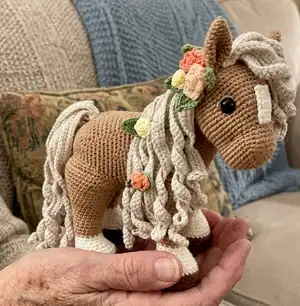
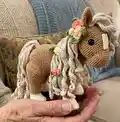
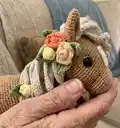
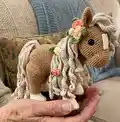
Create a charming hand-crocheted Summer Horse amigurumi that stands about 20" tall using medium weight yarn. This pattern gives you full step-by-step rounds, shaping, mane/tail strips, and floral embellishments so you can make a beautiful realistic horse. You will learn assembly tips, inserting pellets for stable hooves, and finishing techniques for a polished handmade toy. Perfect for gifting or keeping as a whimsical decor piece.
Progress Tracker
0% Complete
— Head :
Round 3 :
(sc 2, 3 sc in next) x 4 (20)
Round 4 :
sc 3, 3 sc in next, (sc 4, 3 sc in next) x 3, sc (28)
Round 5 :
sc 4, 3 sc in next, (sc 6, 3 sc in next) x 3, sc 2 (36)
Round 6-10 :
sc around, 5 rnds (36)
Round 11 :
sc 24, (inc, sc 2) x 4 (40)
Round 13 :
sc 25, (inc, sc 2) x 4, sc 3 (44)
Round 15 :
sc 6, (inc, sc) x 5, inc, sc 12, inc x 3, sc 2, inc x 4, sc 6 (57)
Round 16-21 :
sc around, 6 rnds (57)
Round 22 :
sc 40, (inc, sc 4) x 3, sc 2 (60)
Round 23-25 :
sc around, 3 rnds (60)
Round 26 :
(sc 3, dec) x 8, sc 15, dec, sc 3 (51)
Round 27 :
sc 30, dec, sc 6, dec, sc 9, dec (48)
Round 28 :
(sc 6, dec) x 6 (42)
Round 29 :
(sc 5, dec) x 6 (36)
Round 30 :
(sc 4, dec) x 6 (30)
Round 31 :
(sc 3, dec) x 6 (24)
Info :
Start Stuffing. I used hot glue to attach the eyes after I closed the head, if you'd rather use the safety backs for the eyes, you can follow the instructions for the eyes now. *see below
Round 32 :
(sc 2, dec) x 6 (18)
Round 33 :
(sc, dec) x 6 (12)
Info :
Eye Instructions: To make the divots for the eyes to sit in - Take a piece of yarn (I used crochet thread so you can see it better) and thread it through the head between rnds 17 & 18 and approx 25 sts apart. Thread the yarn back through the head so that you 'grab a stitch'. Make sure the tail comes out in a way so that you will be able to tie a knot around a stitch on the other side and pull on the yarn until you form the divots on both sides. Knot the ends a couple more times & hide the ends inside the head. I used hot glue to secure the eyes in the divots.
— Ears :
Round 2 :
(sc 2, inc) x 2 (8)
Round 3 :
(sc 3, inc) x 2 (10)
Round 5 :
(inc x 2, sc 3) x 2 (14)
Round 6 :
sc, inc x 2, sc 5, inc x 2, sc 4 (18)
Round 7 :
sc 2, inc x 2, sc 7, inc x 2, sc 5 (22)
Round 8-10 :
sc around, 3 rnds (22)
Round 11 :
sc 2, dec x 2, sc 7, dec x 2, sc 5 (18)
Round 12 :
sc, dec x 2, sc 5, dec x 2, sc 4 (14)
Info :
Sc 2 more times to get to the edge of the ear and ch 1, hold the bottom edges together, make 7 sc through both sides to close the opening. Finish off, leaving a long tail. Pinch the bottom of the ear together and make a few sts to secure. Sew the ears to the head at approx. rnds 25-27. *See photo on page 4 for reference.
— Nose Strip :
Info :
With Ivory~ Ch 9, starting in second ch from the hook
Round 1-2 :
sc across, ch 1 & turn (8)
Info :
Finish Off, leaving a long tail. Sew the strip to the middle of the horse's nose.
— Neck :
Info :
Start with a long beginning tail, you will use this to sew the head to the neck. Ch 36, slst into the first ch to join, ch 1
Round 1-2 :
sc around, 2 rnds (36)
Round 3 :
sc 10, (inc, sc 2) x 6, sc 8 (42)
Round 4-5 :
sc around, 2 rnds (42)
Round 6 :
sc 18, (inc, sc 2) x 3, sc 15 (45)
Round 8 :
sc 17, inc, sc 3, (inc, sc 2) x 2, (inc, sc 3) x 2, sc 10 (50)
Round 9-12 :
sc around, 4 rnds (50)
Round 13 :
(sc 2, inc) x 4, sc 12, (inc, sc 2) x 4, sc 10, inc, sc 2, inc (60)
Round 15 :
sc 25, (dec, sc 2) x 5, sc 15 (55)
Info :
Finish Off, leaving a long tail.
— Body :
Round 3 :
(sc, inc) x 6 (18)
Round 4 :
(sc 2, inc) x 6 (24)
Round 5 :
(sc 3, inc) x 6 (30)
Round 6 :
(sc 4, inc) x 6 (36)
Round 7 :
(sc 5, inc) x 6 (42)
Round 8 :
(sc 6, inc) x 6 (48)
Round 9 :
(sc 7, inc) x 6 (54)
Round 10 :
(sc 8, inc) x 6 (60)
Round 11-38 :
sc around, 28 rnds (60)
Round 39 :
(sc 8, dec) x 6 (54)
Round 40 :
(sc 7, dec) x 6 (48)
Round 41 :
(sc 6, dec) x 6 (42)
Round 42 :
(sc 5, dec) x 6 (36)
Round 43 :
(sc 4, dec) x 6 (30)
Round 44 :
(sc 3, dec) x 6 (24)
Round 45 :
(sc 2, dec) x 6 (18)
Round 46 :
(sc, dec) x 6 (12)
Info :
Assembly: Place the front of the neck at approx. rnd 4 of the body, the back of the neck will reach to approx. rnd 23. Stuff the neck firmly, then sew the head to the top of the neck. I sewed the head at an angle so it looks like the horse is looking off to the side but you can sew it straight on, or however you like. Add additional stuffing before closing up the last few stitches to make sure the neck is nice and firm and can support the head.
— Legs :
Info :
The bottom portion of all the legs will be made the same, however, each leg will have different instructions towards the top. Each leg will have a partial 'flap' at the top which will be sewn up onto the sides of the body, while the rest of the leg is sewn to the bottom of the horse. This helps with placement and the look of the legs.
— Right Front Leg :
Round 3 :
(sc, inc) x 6 (18)
Round 4 :
(sc 2, inc) x 6 (24)
Round 5 :
(sc 3, inc) x 6 (30)
Round 6 :
(sc 4, inc) x 6 (36)
Round 7 :
BLO, sc 10, (inc, sc 2) x 6, sc 8 (42)
Round 8-9 :
sc around, 2 rnds (42)
Round 10 :
sc 10, (dec, sc 2) x 6, sc 8 (36)
Round 12 :
sc 11, (dec, sc 2) x 4, sc 9 (32)
Round 13-14 :
sc around, 2 rnds (32)
Round 15 :
sc 12, (dec, sc 2) x 3, sc 8 (29)
Info :
Insert nylon with poly-pellets *see page 3
Round 17 :
sc 10, (dec, sc 2) x 3, sc 7 (26)
Round 19 :
sc 11, dec x4, sc 7 (22)
Info :
Change to Body Color
Round 21-24 :
sc around, 4 rnds (22)
Round 25 :
sc, inc x 2, sc 10, inc x 3, sc 6 (27)
Round 26-30 :
sc around, 5 rnds (27)
Round 31 :
sc 4, inc x 2, sc 11, inc x 3, sc 7 (32)
Round 32-37 :
sc around, 6 rnds (32)
Info :
Here is where we will begin working back & forth to create the flap.
Round 38 :
sc 5, ch 1 & turn, hdc in same st as ch & in the next 16 (17) ch 1 & turn
Round 39 :
hdc 17, ch 1 & turn (17)
Round 40 :
hdc 3, dc 11, hdc 3 (17)
Info :
Finish Off, leaving a long tail. Make sure the leg is stuffed firmly so it can support the body.
— Left Front Leg :
Info :
Follow the same instructions as the right front leg through rnd 37
Round 38 :
sc 10, hdc 17, ch 1 & turn
Round 39 :
hdc in same as ch & in the next 16, ch 1, turn (17)
Round 40 :
hdc 3, dc 11, hdc 3 (17)
Info :
Finish Off, leaving a long tail. Stuff firmly.
— Right Rear Leg :
Info :
Follow the same instructions as right front leg through rnd 33
Round 34 :
sc 6, inc x 2, sc 15, inc x 3, sc 6 (37)
Round 36 :
sc 8, inc x 3, sc 26 (40)
Round 38 :
sc 20, ch 1 & turn, hdc in same as ch & in next 24, ch 1, turn
Round 39 :
hdc 25 (25) ch 2 & turn
Round 40 :
dc in same as ch & in the next 17, hdc 7 (25) ch 1 & turn
Round 41 :
sc 7, hdc 18 (25) ch 1 & turn
Round 42 :
sc 6, hdc 12, sc 7 (25)
Info :
Finish Off, leaving a long tail. Stuff Firmly.
— Left Rear Leg :
Info :
Follow the same instructions as the Right REAR Leg through rnd 37
Round 38 :
sc 32, ch 1 & turn, hdc in same as ch & in next 24 (25) ch 1 & turn
Round 39 :
hdc 25 (25) ch 1 & turn
Round 40 :
hdc 7, dc 18 (25) ch 1 & turn
Round 41 :
hdc 18, sc 7 (25) ch 1 & turn
Round 42 :
sc 7, hdc 12, sc 6 (25)
Info :
Finish Off, leaving a long tail. Stuff Firmly.
Info :
Assembly: Sew the legs to the body, add stuffing before closing up the last few stitches to insure the bottom of the legs are firm. Add some lighter stuffing to fill in the flap area, making sure the stuffing doesn't pull gaps in the hdc/dc stitches.
— Mane & Tail :
Info :
The mane and tail are made up of 2 strips that are joined together at the top, forming what we will refer to as a 'Section'. Each strip begins with a starting ch. You will start by working in the 2nd chain from the hook and sc into the back bumps of the starting ch. You will work a total of 3 rows of sc, then, without finishing off, begin a new starting ch for the second strip. After working 3 rows of sc on the second strip, you ch 1, fold the strips together and sc across the top to join, forming a Section.
Info :
I will write out the instructions for the first Section, then you will repeat the same technique for each section, changing only the length of the chains.
Info :
You will have a total of 3 separate sections and 1 individual strip for the part of the mane that goes between the ears~ *see photo on next page for placement.
— Front mane - Section 1 :
Info :
With Mane/Tail Color~ Ch 42, starting in 2nd ch from the hook & working in back bump
Round 1-2 :
sc across, ch 1 & turn (41)
Round 1-2 :
sc across, ch 1 & turn (35)
Info :
Ch 1 and fold the 2 strips together, sc across to join. Finish Off, leaving a long tail. This section will go next to the inside of the left ear.
Info :
Front mane - Section 2: Strip 1: ch 21; Strip 2: ch 31. This goes next to Section 1, in the middle.
Info :
Front mane - Section 3: Strip 1: ch 42; Strip 2: ch 26. This section is sewn directly behind Section 2 and lays over the top of Section 2.
Info :
Now, we will make a single strip that is 31 ch long. This piece goes next to the right ear and is angled so it lays across the other sections.
Info :
*see picture on page 10 for a different angle.
Info :
Side mane - Next, we will make the part of the mane that goes down the back of the horse's head and neck. For this piece I made 5 continuous sections. I made 2 strips and joined them together but instead of finishing off, I made the next starting ch, making my next 2 strips and joined those 2 strips together and so on. You will have 5 sections total that are all connected. Then I just single crocheted across the top of all five sections for a cleaner look and to make the piece easier to attach. Every strip will start with a ch of 58.
Info :
For the tail we will make 2 continuous sections (total of 4 strips). After single crocheting across the top of the 2nd section, ch 1, fold one section over the top of the other and sc across the top to join. (you'll have 4 strips stacked one on top of the other). Fold the 2 sections together and sc across the top (there will be 4 strips layered). Finish off, leaving a long tail. Repeat these instructions 2 more times so that you have a total of 3 pieces with 2 sections each. Sew the first piece to approx. rnd 38 of the horse's body. Sew the next 2 pieces directly above the first.
— Tail - Section 1 :
Info :
Strip 1: Ch 55; Strip 2: ch 61
— Tail - Section 2 :
Info :
Strip 1: ch 57; Strip 2: ch 64
— Flowers & Leaves :
Info :
I made 3 roses in each color and 3 rosebuds in each color. I also made 7 leaves. You can make as many flowers and leaves as you wish, adding some to the tail as well if you like.
Rose :
Ch 27, 3hdc in 2nd ch from the hook, slst, (3hdc in next st, slst) x 12. Finish off, leaving a long tail. Roll the petals into a rose shape and secure with a few stitches through the bottom.
Rosebud :
ch 18, dc in 3rd ch from the hook & in the next 15. Finish off, leaving a long tail. Roll up and secure with a few stitches through the bottom.
Leaf :
Leave a long starting tail for sewing the leaves to the roses: Ch 8, starting in 2nd ch from the hook, slst, sc, hdc, dc 3, 5 dc in next st, (Now begin working down the opposite side of the ch) dc 3, hdc, sc, slst, ch 2, slst into the first slst on side 1. Finish Off.
Info :
Reference photos on the next page for placement of the flowers.
This Summer Horse amigurumi pattern blends realistic shaping with playful floral details to create a sweet companion you can cherish. Sew the mane, add delicate roses, and watch your creation come to life with personality and charm. Perfect for gifting or as a special handmade keepsake — happy crocheting! 🧶🌸