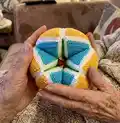
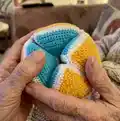
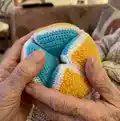
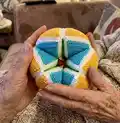
About This Crochet Flexagon Pattern
This pattern creates a colorful crochet flexagon — a small, hand-held toy made from 24 equilateral triangles joined into 6 soft pyramids. You will crochet triangles in four bright colors and finish each triangle with a neat white edge before assembling pyramids and sewing them into a flexing toy.
Techniques used include chains, single crochet, single crochet decreases, edge finishing with single crochet and joining by hand sewing. The finished toy from the indicated materials measures approximately 15 cm and makes a great fidget or gift.
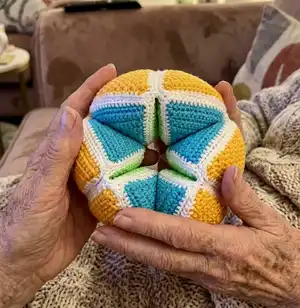
The pattern includes a complete materials list, abbreviations and step-by-step row instructions for each triangle, plus clear assembly guidance. Photos and sewing tips are provided to help you align seams and achieve a smooth final flexagon.
Why You'll Love This Crochet Flexagon Pattern
I absolutely love this pattern because it turns simple crochet triangles into a playful, interactive toy that invites fidgeting and discovery. I enjoy the bright color combinations and the satisfying symmetry when the pyramids are sewn together. The finishing row (white edge) gives a crisp, professional look that I find especially rewarding. Sewing the pyramids and assembling the flexagon is meditative and makes the whole project feel like a creative puzzle that comes to life in your hands.
Switch Things Up
I love to experiment with colors — try pastel shades for a soft, calming flexagon or neon brights for high-contrast visuals that really pop.
If you want a larger flexagon, use a bulkier yarn and a larger hook; conversely, use finer yarn and a smaller hook for a tiny keychain-sized version.
I sometimes skip the white edge and use a contrasting color edge for a bolder look; the edge color completely changes the toy's character.
Try embroidering small motifs on each triangle before assembly to personalize each face of the flexagon.
For a baby-safe version, use cotton yarn and secure all tails and seams more heavily; avoid small decorations and ensure stuffing is firmly enclosed.
I also like to add a small bell or rattle inside one pyramid for an auditory surprise when the flexagon is moved.
Experiment with different seam styles: a whipstitch gives a different visible finish than the recommended half-cross seam — choose the look you prefer.
To make matching sets, create several flexagons in the same color family and vary only the edge color for a cohesive stack of toys.
I often change the order of colors when assembling pyramids to create asymmetric patterns that reveal interesting color sequences when folded.
If you enjoy mixed media, try combining a cotton front triangle and a slightly stretchy acrylic back triangle for subtle texture contrast.
Common Mistakes & How to Fix Them
✗ Skipping the chain at the start of a row can throw off your stitch count; always work the chain and count stitches after each row to stay accurate.
✗ Inconsistent tension during the triangle rows leads to uneven edges and misshapen pyramids; keep a steady, moderate tension and correct immediately if rows look loose or tight.
✗ Forgetting to fasten off and leave a tail for sewing makes finishing difficult; always leave a 10-15 cm tail when you cut the thread to sew edges securely.
✗ Not stuffing the pyramids enough causes floppy shapes and a poor final flexagon; add polyester filler gradually and check shape before closing the seam to ensure a firm result.
✗ Rushing the edge finishing row results in messy corners at triangle tips; attach the white yarn carefully and place 3 sc at each triangle top for neat, rounded corners.