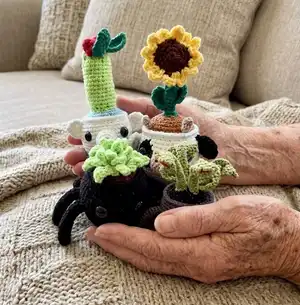
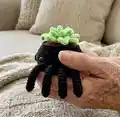
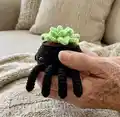
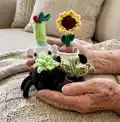
Make adorable planter amigurumi with interchangeable plants and charming faces. This pattern guides you through pots, animals (cow, polar bear, spider), and plant tops like sunflowers, succulents, and a Venus fly trap. Clear step-by-step rounds and accessory pieces let you customize each planter for a unique gift or home accent. Perfect for expanding your amigurumi skills while creating a playful handcrafted piece.
Progress Tracker
0% Complete
— Pot :
Info :
Crocheted from bottom to top. For the spider, if you want to attach the legs as you work, make the legs first(pg. 4). The cow color changes are located below.
Round 1 :
Make 8 sc into a magic ring= 8
Round 2 :
Increase in each st around= 16
Round 3 :
(sc, inc) x 8= 24
Round 4 :
(3 sc, inc) x 6= 30
Round 5 :
(4 sc, inc) x 6= 36
Round 6 :
BLO sc in each st around
Round 7 :
sc in each st around
Round 8 :
(5 sc, inc) x 6= 42
Round 9 :
sc in each st around
Round 10 :
(6 sc, inc) x 6= 48
Info :
*for the spider, The no sew version: Round 14: 2 sc, (work 3 sc on the leg and pot, sc) x 4, 11 sc, (work 3 sc on the leg and pot, sc) x 4, 3 sc
Round 11-16 :
sc in each st around
Info :
For spiders: Place eyes between rounds 14 and 15, leaving 8 holes apart
Info :
For Cow: Place eyes between rounds 14 and 15, leaving 10 holes apart
Info :
For Polar Bear: Place eyes between rounds 14 and 15, leaving 10 holes apart
Round 17 :
(6 sc, dec) x 6= 42
Round 18 :
(5 sc, dec) x 6= 36
Round 19 :
sc in each st around
Round 20 :
FLO ch 1, hdc in each st around
— Cow Pot :
Round 12 :
White: 20 sc, Black: 3 sc, White: 25 sc
Round 13 :
White: 19 sc, Black: 7 sc, White: 22 sc
Round 14 :
White: 19 sc, Black: 7 sc, White: 22 sc
Round 15 :
White: 19 sc, Black: 6 sc, White: 23 sc
Round 16 :
White: 20 sc, Black: 5 sc, White: 23 sc
Round 17 :
White: (6 sc, dec) x 2, 5 sc, Black: sc, dec, White: (6 sc, dec) x 3= 42
— Spider Legs (Make 8) :
Round 1 :
Make 7 sc into a magic ring= 7
Round 2-12 :
sc in each st around
Info :
Do not stuff the legs (if you want, add a pipe cleaner into the legs for some shaping)
Info :
Fold the legs in half and sc the opening closed.
Info :
F/O and leave a long tail for sewing if you did not want to make the no sew version
— Polar Bear Ears (Make 2) :
Round 1 :
Make 6 sc into a magic ring- 6
Round 2 :
Increase in each st around= 12
Round 3 :
(sc, inc) x 6= 18
Round 4 :
sc in each st around
Round 5 :
(sc, dec) x 6= 12
Info :
Do not stuff the ears. Fold the ears in half and sc the opening closed. F/O and leave a long tail for sewing
— Dirt on Pot :
Info :
Attach dirt colored yarn to back loops of round 20
Round 1 :
(4 sc, dec) x 6= 30
Info :
*for the cow the round will make the horns:
Info :
1. Dirt color: 4 sc, dec, 3 sc, Horn Color: Ch 4, inc3 in 2nd ch from hook, hdc in next ch, dc in next ch, Dirt Color: sc, dec, 4 sc, dec, 2 sc, Work a horn, Dirt color: 2 sc, dec, (4 sc, dec) x 2= 30
Round 2 :
(3 sc, dec) x 6= 24
Round 3 :
(2 sc, dec) x 6= 18
Round 4 :
(sc, dec) x 6= 12
Info :
If you are making the cow, do not F/O! If you are not making the cow, F/O and sew the hole closed
Round 1-18 :
sc in each st around
Info :
Insert a wooden dowel or something similar inside the stem. F/O and sew the hole closed.
— Polar Bear Nose :
Round 1 :
Make 6 sc into a magic ring= 6
Round 2 :
Increase in each st around= 12
Round 3 :
(sc, inc) x 6= 18
Round 4-5 :
sc in each st around
Info :
Place 18 mm nose between rounds 1 and 2.
Info :
F/O and leave a long tail for sewing
— Cow Ears (Make 2) :
Round 1 :
Make 6 sc into a magic ring= 6
Round 2 :
Increase in each st around= 12
Round 3 :
(sc, inc) x 6= 18
Info :
Skip 4 st, sl st in next st
Info :
Sl st across the top to give the ear a pinched look. F/O and leave a long tail for sewing
— Cow Nose :
Round 1 :
inc in 2nd ch from hook, sc, inc3, Working on the opposite side of the chain: 3 sc= 9
Round 2 :
inc x 2, 2 sc, inc x 3, sc, inc= 15
Round 3 :
(sc, inc) x 2, 2 sc, (sc, inc) x 3, 2 sc, inc= 21
Round 4-5 :
sc in each st around
Info :
F/O and leave a long tail for sewing
— Sunflower :
Round 1 :
Make 5 sc into a magic ring= 5
Round 2 :
Increase in each st around= 10
Round 3 :
(sc, inc) x 5= 15
Round 4 :
(2 sc, inc) x 5= 20
Round 5 :
(3 sc, inc) x 5= 25
Round 6 :
(Ch 5, sc in 2nd ch from hook, hdc in next ch, dc in next ch, tr in next ch, Sl st in next 2 st)around
Info :
F/O and leave a long tail for sewing
— Sunflower Leaf #1 :
Info :
Dc + tr in 3rd ch from hook
Info :
F/O and leave a long tail for sewing
— Sunflower Leaf #2 :
Round 1 :
Sc in 3rd ch from hook
Round 5 :
tr + dc in last ch
Info :
F/O and leave a long tail for sewing
— Spider Succulent :
Info :
Attach green yarn with a sl st in between rounds 2 and 3.
Round 1 :
sl st in 2nd ch from hook, sc in next ch, hdc in next ch, dc in next 2 chains, tr in next ch, sl st in next 2 stitches.
Info :
Repeat from * to * around until you get to the middle of the pot.
— Venus Fly Trap :
Info :
Stem(make 4): With Green:
Round 1 :
Make 6 sc into a magic ring= 6
Round 2-16 :
sc in each st around
Info :
Do not stuff the stems. If you want, place a cake dowel in the stem.
Info :
F/O and leave a long tail for sewing
Info :
Trap(Make 4 in red, 4 in green): Starting with Red:
Round 1 :
Make 6 sc into a magic ring= 6
Round 2 :
Increase in each st around= 12
Info :
Do not F/O the green!
Info :
Place back sides of green and red pieces together.
Round 3 :
With green: (sc, inc) x 6= 18
Round 4 :
(2 sc, inc) x 6= 24
Round 5 :
(ch 3, sl st in same st, sl in next 2 st) around
Info :
F/O and leave a long tail for sewing
Info :
Leaves(Make 3): Ch 15
Round 1 :
sc in 2nd ch from hook, 2 hdc, 2 dc, 4 tr, 2 dc, 2 hdc, inc in last ch,
Info :
Working on the opposite side of the chain: sc, 2 hdc, 2 dc, 4 tr, 2 dc, 2 hdc, sc
Info :
F/O and leave a long tail for sewing
— Polar Bear Cactus :
Round 1 :
sc in 2nd ch from hook and across= 19
Round 2-16 :
BLO Ch 1, turn, sc in each st across
Info :
F/O and leave a very long tail for sewing
Info :
Holly Leaves(Make 2): With green: Ch 10
Round 1 :
sc in 2nd ch from hook, sc, hdc, dc, dc-inc, dc, hdc, sc, inc3 in last ch,
Info :
Working on the opposite side of the chain: sc, hdc, dc, dc-inc, dc, hdc, sc, sl in last st
Round 2 :
sc, *ch 3, sl st in same st*, 4 sc, * to*, 4 sc, * to *, 2 sc, * to *, 4 sc, * to *, 3 sc, sl st to 1st st
Info :
F/O and leave a long tail for sewing
Info :
Berries(Make 2): With red:
Round 1 :
Make 6 sc into a magic ring= 6
Round 2 :
Sc in each st around
Info :
Sew the berry closed. F/O and leave a long tail for sewing
— Assembly :
Head :
1. Pin the cow nose onto the front of the pot between the eyes. Sew the nose onto the pot. Embroider 2 nostrils.
Head :
2. Pin the ears onto the side of the pot. Sew the ears onto the pot.
Head :
3. Pin the polar bear nose onto the front of the pot. Sew the nose onto the pot.
Head :
4. Pin the ears onto the side of the polar bear pot. Sew the ears onto the pot.
Spider :
1. If you chose not to work the spider legs into the pot. Pin the legs onto the side of the spider pot.
Spider :
2. Sew the legs onto the side of the pot.
Spider :
3. Embroider the face onto the spider if you would like.
Plants :
1. For the cow: Pin the leaves onto the bottom of the stem. Sew the leaves onto the stem.
Plants :
2. Pin the flower onto the top of the stem. Sew the flower onto the stem.
Plants :
3. Sew the cactus together in a tube. Stuff the cactus. Sew the top of the cactus together.
Plants :
4. Sew the cactus onto the top of the pot. Sew the holly berry onto the top of the cactus.
Plants :
5. For the venus fly trap: Sew the stems onto the top of the pot. Fold the trap in half and sew the back to give it a closed look. Sew the trap onto the top of the stem. Sew the leaves onto the top of the pot.
This planner pattern brings tiny, happy planters to life with playful faces and charming plants. Customize colors and plant tops to make each one uniquely yours. Perfect for gifts or a cheerful shelf display — create a little garden of amigurumi friends today! 🧶🌱