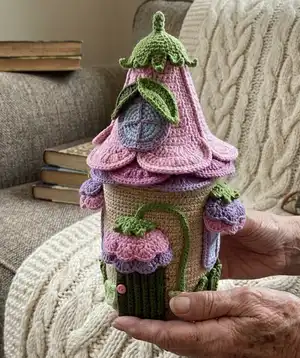
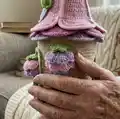
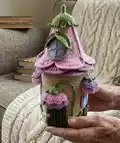
Create a charming floral fairy house that doubles as whimsical decor or a playful toy. This pattern walks you through constructing a reinforced crocheted cylinder, layered petal roof, windows and a working door with clear step-by-step instructions. You will learn to combine plastic canvas and crochet for structure and use fishing line to make a rigid, durable roof.
Progress Tracker
0% Complete
— Bottom (base circle) :
Info :
Start crocheting from house bottom with beige yarn. Use a marking thread of contrast color to mark the beginning and the end of the rounds.
Round 2 :
inc*6=12 sc (12)
Round 3 :
(1 sc, inc)*6=18 sc (18)
Round 4 :
1 sc, inc, (2 sc, inc)*5, 1 sc=24 sc (24)
Round 5 :
(3 sc, inc)*6=30 sc (30)
Round 6 :
2 sc, inc, (4 sc, inc)*5, 2 sc=36 sc (36)
Round 7 :
(5 sc, inc)*6=42 sc (42)
Round 8 :
3 sc, inc, (6 sc, inc)*5, 3 sc=48 sc (48)
Round 9 :
(7 sc, inc)*6=54 sc (54)
Round 10 :
4 sc, inc, (8 sc, inc)*5, 4 sc=60 sc (60)
Round 11 :
(9 sc, inc)*6=66 sc (66)
Round 12 :
5 sc, inc, (10 sc, inc)*5, 5 sc=72 sc (72)
Round 13 :
(11 sc, inc)*6=78 sc (78)
Round 14 :
6 sc, inc, (12 sc, inc)*5, 6 sc=84 sc (84)
Round 15 :
(13 sc, inc)*6=90 sc (90)
Info :
To make the completion of the circle more accurate, after the last increase, crochet another 1 sc and then 1 sl st. Leave a long end of the thread.
— Plastic canvas bottom & layered circles :
Info :
Cut a circle from the canvas with a diameter slightly smaller than crocheted. Sew the canvas to the circle with small stitches.
Info :
Crochet the second circle in the same way. Put 3 layers together and sew over the edge. Stitch several times through the center.
— Canvas strip and cylinder (wall core) :
Info :
Cut a strip along the entire length (33 cm) 15 cm wide from a sheet of canvas. Roll it into a cylinder - my diameter clearly coincided with the diameter of the bottom. If cylinder diameter is not perfect, trim or leave overlap as noted.
Info :
If the overlap is about 3 cm - leave it like that. If the cylinder diameter is not enough - leave it as is; we will cover it with additional strip during assembly.
— Walls (crocheted panel) :
Instruction :
Crochet the walls of the house with beige yarn. Chain 91 and crochet back-and-forth rows 90 sc in a row.
Info :
Crochet half the height of the canvas; I got 21 rows. Next crochet only from one side in a height of 38 sc to the end of the canvas. Cut the thread.
Instruction :
Skip 14 loops in the middle of the canvas and crochet from the other side also 38 sc to the end of the canvas.
Info :
This will be the inside of the house. Because inner diameter is always smaller, the crocheted canvas will bubble. Attach the finished part to the canvas and stitch vertical lines at 1.5-2 cm distances to flatten. On short side retreat 3 cm on both sides.
Instruction :
Carefully cut out the door opening. Do not discard the cut piece.
Instruction :
Crochet the second piece for the outer side in the same way.
Instruction :
Fold the wall with the plastic canvas outward and sew the edges of the crocheted canvas end-to-end. Then join edges of the canvas end-to-end and sew through the crocheted fabric.
Instruction :
Cut a strip about 4 cm wide from the canvas and overlap the seam with it. Sew the strip on both sides through the crocheted fabric.
Instruction :
Sew the second piece outside. Better start from the door opening, sew over the edge. Then sew vertical seam on the back side of the house.
Instruction :
Sew the top and the bottom sides over the edge. Sew the bottom to the wall. When stitching, it is not necessary to grab the canvas; it is enough to grab only the edge of the crocheted fabric with a needle.
— Roof base (cone) with fishing line :
Info :
Crochet the base of the roof with fishing line. The color of the base can be any, not contradicting the main color of the house. Before starting work, burn the end of the fishing line with a lighter so that a ball forms at the end. It will not let the fishing line slip out of crocheting.
Round 2 :
inc*6=12 sc (12)
Round 4 :
(1 sc, inc)*6=18 sc (18)
Round 6 :
(2 sc, inc)*6=24 sc (24)
Round 8 :
(3 sc, inc)*6=30 sc (30)
Round 10 :
(4 sc, inc)*6=36 sc (36)
Round 12 :
(5 sc, inc)*6=42 sc (42)
Round 14 :
(6 sc, inc)*6=48 sc (48)
Round 16 :
(7 sc, inc)*6=54 sc (54)
Round 18 :
(8 sc, inc)*6=60 sc (60)
Round 20 :
(9 sc, inc)*6=66 sc (66)
Round 22 :
(10 sc, inc)*6=72 sc (72)
Round 24 :
(11 sc, inc)*6=78 sc (78)
Round 26 :
(12 sc, inc)*6=84 sc (84)
Round 28 :
(13 sc, inc)*6=90 sc (90)
Round 29 :
90 sc. Cut the fishing line leaving a short end. (90)
Info :
Gently melt the end of the fishing line, protruding it from crocheting, and quickly press it to crocheting. The melted fishing line will stick to the yarn. Crochet a few more sc to close the line, finish with a sl st and cut the thread.
— Roof petals (make multiple petals in three shades) :
Info :
Crochet roof petals with a lilac yarn. Make 5 petals in each of three shades (total 15 petals, 5 per shade). Petals are worked back-and-forth with turning chains except the very small starting rounds.
Petal Round 1 :
3 sc in AR. Adjust the ring and then crochet back and forth rows with turning ch. (3)
Petal Round 4 :
1 sc, inc, 1 sc = 4 sc (4)
Petal Round 7 :
2 sc, inc, 1 sc = 5 sc (5)
Petal Round 10 :
2 sc, inc, 2 sc = 6 sc (6)
Petal Round 13 :
2 sc, inc, 3 sc = 7 sc (7)
Petal Round 16 :
2 sc, inc, 4 sc = 8 sc (8)
Petal Round 19 :
2 sc, inc, 5 sc = 9 sc (9)
Petal Round 22 :
2 sc, inc, 6 sc = 10 sc (10)
Petal Round 23 :
10 sc (10)
Petal Round 24 :
10 sc (10)
Petal Round 25 :
1 sc, 2 htr, (2 dc in every st)*4, 2 htr, 1 sc (scalloped end row)
Info :
Sc along the straight sides. Make 3 inc at the narrow end for shaping. Along the wide end: 2 ch, 2 dc in every st, (1 dc, 2 ch, sl st) in the last st. Cut the yarn after finishing edge.
Instruction :
Join yarn to the narrow end and sc around without increases, adding a fishing line under the stitches for extra stiffness. Make 5 petals per shade.
— Roof assembly :
Instruction :
Fasten the petals to the base of the roof using a thin line of glue in the center of each petal and glue one at a time. About the 25th row of petals should fall on the edge of the roof base.
Instruction :
Gently lift the edges of each petal and glue completely. Glue the second layer of petals in the same way, placing them a little higher and offset relative to the first row. Glue the third row. Thanks to fishing line and glue, the roof will be very hard and durable.
— Roof sepal (green crown) :
Info :
Crochet a sepal with green yarn to sit on the top of the roof. The roof is not attached to the house and is simply put on top; sew or glue the sepal to the top of the roof.
Round 1-4 :
6 sc in AR, then 3 rounds of 6 sc (6 each round)
Round 5 :
inc*6=12 sc (12)
Round 6 :
(1 sc, inc)*6=18 sc (18)
Round 7 :
(2 sc, inc)*6=24 sc (24)
Round 8 :
(3 sc, inc)*6=30 sc (30)
Round 9-10 :
2 rounds of 30 sc (30)
Instruction :
Crochet an angle: 7 ch, 2 sl st, 1 sc, 1 htr, 2 dc, skip 2 st of the base, 1 sl st. Repeat around to create pointed sepal edges. Repeat around until all angles placed.
— Door & door leaf (canvas + crochet) :
Info :
Put off the roof and take the door. Cut the door leaf so that it is 5 mm smaller than the opening in height and width. With dark green yarn crochet a rectangle to cover the door from 2 sides; number of sc and rows depend on your crocheting density.
Instruction :
Sew the door along 3 sides over the edge. Sew the door to the opening making several stitches through the canvas in 2 points.
Instruction :
Sew a small button or a bead for the doorknob. The pattern used two mini buttons put together.
— Door visor (light roof over door) :
Instruction :
Crochet a visor over the door with lilac yarn.
Visor Round 1 :
6 sc in AR (6)
Visor Round 2 :
inc*6=12 sc (12)
Visor Round 3 :
(1 sc, inc)*6=18 sc (18)
Visor Round 4 :
(2 sc, inc)*6=24 sc (24)
Visor Round 5 :
(3 sc, inc)*6=30 sc (30)
Visor Round 6 :
(4 sc, inc)*6=36 sc (36)
Visor Round 7 :
(5 sc, inc)*6=42 sc (42)
Visor Round 8-9 :
2 rounds of 42 sc (42)
Instruction :
Crochet shells along the edge: skip 1 st, 6 dc in 1 st, skip 1 st, 1 sc. Make 10 such shells. Because there are 42 sc in the circle, 2 st will be excess; in 2 places skip 2 st instead of one. Leave a long end of the thread.
Instruction :
Fold the part in half, aligning the shells, and glue inside to give the shape of a dome. Sew over the edge with the end of the thread.
— Visor second layer (pink) :
Instruction :
Crochet the second layer of the visor with pink yarn. Work in the round or back-and-forth as noted: 1. 3 sc in AR. Then crochet back and forth rows with a turning ch, not spiral rounds.
Round 3 :
(1 sc, inc)*3=9 sc (9)
Round 4 :
(2 sc, inc)*3=12 sc (12)
Round 5 :
(3 sc, inc)*3=15 sc (15)
Round 6 :
(4 sc, inc)*3=18 sc (18)
Round 7 :
(5 sc, inc)*3=21 sc (21)
Instruction :
Crochet 5 shells of 5 dc along the edge. Skip 2 st before the first shell instead of 1, because 1 st will be excess. Apply glue to the fold of the lilac visor and glue the pink layer over it. Do not fasten too low so it does not interfere with the door. Additionally sew the visor to the wall with sewing thread.
— Windows :
Instruction :
Crochet windows with light blue yarn. Crochet a rectangle 10 sc wide and 12 rows high. Attach to canvas opening as desired and add cross decoration if desired.
— Sepal details & angles (small green leaves) :
Instruction :
Crochet sepal with green yarn for the top of the roof: 1-4. 6 sc in AR, then 3 rounds of 6 sc. 5. inc*6=12 sc. 6. (1 sc, inc)*6=18 sc. 7. (2 sc, inc)*6=24 sc. 8. (3 sc, inc)*6=30 sc. 9-10. 2 rounds of 30 sc.
Instruction :
Crochet angles (little leaf points): 4 ch, 1 sl st, 2 sc down the chain, sl st in the next st. Make a total of 5 angles. Repeat around to form the sepal crown and sew or glue to top of roof.
— Sepal for visor (small sepal for door) :
Instruction :
Crochet sepal with green yarn for the visor: 1. 3 sc in AR. Then crochet back-and-forth rows with a turning ch. 2. inc*3=6 sc. 3. (1 sc, inc)*3=9 sc. 4. Continue shaping as needed. Crochet angles: 4 ch, 1 sl st, 2 sc down the chain, sl st in next st. Make 5 angles. Glue the sepal to the visor.
— Final assembly & finishing :
Instruction :
Attach the canvas-reinforced bottom to the wall by sewing only the edge of the crocheted fabric to the wall edge, securing evenly around. Insert bottom into cylinder and stitch evenly.
Instruction :
Place the roof on top of the finished walls. The roof is not permanently attached unless you want to sew it — it is designed to be removable. Glue or sew any small decorative elements (windows, leaves, vines, beads) as desired.
Info :
Use hot glue to fasten petals to the roof base, and use melted fishing line ends pressed under stitches to secure the fishing line core. Leave all long ends to weave or hide under layers during assembly.
This Floral Fairy House Pattern brings a little bit of handmade magic to your shelf or gift table. The design combines crochet with plastic canvas and fishing line to create a sturdy, whimsical miniature home full of charming details ❤️🌸. Build one in pastel shades for a sweet nursery accent, or try bold colors for a playful display. Happy crafting and may your tiny fairies find a cozy new home! 🧶✨