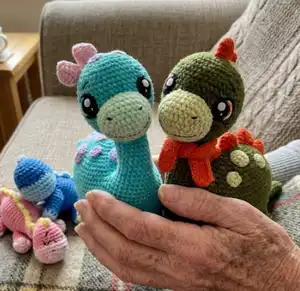
🧢 Beautiful ✨ Detailed πŸ’ Adorable

Dino Family Amigurumi Pattern

Dino Family Amigurumi Pattern
4.5β˜… Rating
8-10 Hours Time Needed
2.2K Made This
βœ‚οΈ

Intermediate Level

Ideal for those with basic crochet experience, featuring slightly more advanced stitches and techniques to expand your skills.

⏱️

All-Day Adventure

Requires 8-10 hours, ideal for a full day of immersive crocheting.

🧸

Cute Companion

An adorable friend to cherish, handcrafted with love to bring comfort and joy for years to come.

About This Dino Family Amigurumi Pattern

This pattern creates a soft plush dinosaur using plush (Dolphin Baby / YarnArt Dolce) and semi-cotton yarns. It features in-process attachment of legs and tail, a reinforced neck tube, and embroidered eyes for expressive detail. Clear round-by-round instructions help you shape each part and assemble confidently.

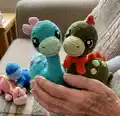
Dino Family Amigurumi Pattern crochet pattern - detailed view of completed project

Perfect for making a 30 cm tall cuddly dino with a strong neck support and detailed face. Includes yarn suggestions, hook sizes, and stuffing/assembly tips.

Why You'll Love This Dino Family Amigurumi Pattern

I absolutely love this pattern because it blends plush texture with classic amigurumi shaping to make a friendly, squeezable dinosaur. I enjoy how the in-process attachment of legs and tail keeps the shape seamless and sturdy without awkward sewing. The reinforced sintepon tube in the neck gives great support and lets the head sit nicely β€” this detail really elevates the finished toy. I also love the embroidered eye technique which adds so much personality without using safety eyes.

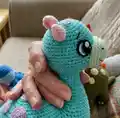
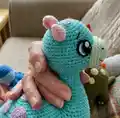
Dino Family Amigurumi Pattern step 1 - construction progress Dino Family Amigurumi Pattern step 2 - assembly progress Dino Family Amigurumi Pattern step 3 - details and accessories Dino Family Amigurumi Pattern step 4 - final assembly and finishing

Switch Things Up

I love how easy it is to customize this dino: change the plush yarn color to create a family of dinosaurs in coordinating shades.

Try pastel colors for a softer baby-dino look, or bold jewel tones for a playful display in your craft room.

I often swap the plush yarn for semi-cotton and use a wire core in the neck for a posable neck β€” just insulate the wire with a fabric patch first.

Make mini keychain versions by using a smaller hook and thinner yarn; reduce rounds proportionally and add a keyring at the tail base.

Embellish with tiny crocheted accessories: a mini scarf, bow, or felt spikes for seasonal variations.

You can change the eye style: either use embroidered eyes as shown, or add safety eyes (use a smaller hook for tighter stitches to hide stuffing).

I sometimes add texture by using back-loop-only rounds for a rib effect or alternating puff stitches for a scalloped back.

For a different silhouette, increase or decrease the number of head rounds before shaping to make a longer or shorter neck.

If you want a sturdier toy for young children, reinforce internal areas with extra stuffing and sew seams with a stronger tapestry needle.

I recommend experimenting with yarn weights and hook sizes on a small swatch to see how the stitch density affects the final look before committing to a full project.

Common Mistakes & How to Fix Them

βœ— Skipping stitch markers when attaching legs and tail can cause misplacement; place markers at each attachment point and recount before stitching. βœ— Forgetting to stuff progressively leads to lumps and gaps; stuff gradually during shaping, especially at transitions between body and neck. βœ— Using too large a hook for the plush yarn makes stitches loose and filling visible; use recommended hook sizes and adjust to maintain tight gauge. βœ— Pulling the yarn too tightly when closing the head hole can distort shape; tighten gradually and hide the tail inside the head neatly after securing. βœ— Not reinforcing the neck leads to a floppy head; insert a sintepon/fabric tube or fleece core as instructed and stuff around it firmly.

Dino Family Amigurumi Pattern

Make a charming handmade dino from plush and cotton yarn with detailed step-by-step instructions you can follow at home. This pattern guides you through crocheting the tail, legs, body, neck, head, muzzle and embroidered eyes with clear rounds and useful tips. You will learn how to attach parts in-process, use a sintepon tube for a strong neck, and finish an expressive face for a lovable toy.

Intermediate 8-10 Hours

Materials Needed for Dino Family Amigurumi Pattern

β€” Main Fabric

  • 01
    Plush yarn (Himalaya Dolphin Baby / YarnArt Dolce) 120 m/100 g (131 yds/3.5 oz) - Main color consumption approximately 1.5-2 skeins for body
  • 02
    Dark green (Himalaya color reference shown) - less than 2 skeins for details if using plush yarn
  • 03
    Light green (sole, tummy, muzzle, spots) - small amount, less than a skein
  • 04
    Orange (spikes/accents) - small amount
  • 05
    White/Ivory (claws and small details) - small amount
  • 06
    Cotton/semi-cotton yarn (~330 m/100 g) (YarnArt Jeans, Alize Cotton Gold etc.) - for eye details and embroidery: orange, black, white - small amounts

β€” Tools Required

  • 01
    Crochet hook 3.5 mm (for the body) - use 3.5-4 mm depending on yarn
  • 02
    Crochet hook 2 mm (for the eyes and small details) β€” 2-2.5 mm recommended for eye work
  • 03
    Yarn needle / large sewing needle for finishing and sewing details
  • 04
    Stitch markers to mark rounds and attachment points
  • 05
    Pins with large head for holding parts during assembly
  • 06
    Scissors
  • 07
    Polyester stuffing / fiber filling
  • 08
    Synthetic insulation (sintepon) or dense fabric to strengthen the neck; cut and roll as a tube
  • 09
    Fabric patch to fix the sintepon tube
  • 10
    Small box of pins and clips for assembly
  • 11
    Optional: small amount of wire if you want a poseable neck (wrap in fabric)

Progress Tracker

0% Complete

β€” Tail :

Info :

*dark green yarn

Round 1 :

6 SC in MR;

Round 2-3 :

2 rounds 6 SC;

Round 4 :

2 SC, 2 INC, 2 SC (8);

Round 5 :

DEC, SC, 2 INC, SC, DEC (8);

Round 6 :

3 SC, 2 INC, 3 SC (10);

Round 7 :

DEC, 2 SC, 2 INC, 2 SC, DEC (10);

Round 8 :

4 SC, 2 INC, 4 SC (12);

Round 9 :

DEC, 3 SC, 2 INC, 3 SC, DEC (12);

Round 10 :

3 SC, (SC, INC)*3, 3 SC (15);

Round 11 :

15 SC;

Round 12 :

3 SC, (2 SC, INC)*3, 3 SC (18);

Round 13 :

18 SC;

Info :

- if the beginning of the round shifts strongly to the right, then work a shifting stitch (align the beginning of the round (stitch marker) in the middle);

Round 14 :

3 SC, (3 SC, INC)*3, 3 SC (21);

Round 15 :

21 SC;

Round 16 :

3 SC, (4 SC, INC)*3, 3 SC (24);

Info :

- fix and cut the thread.

β€” Legs :

Info :

*crochet 4 details. *start with light green yarn

Round 1 :

7 SC in MR;

Round 2 :

7 INC (14);

Round 3 :

(SC, INC)*7 (21);

Info :

- change color to dark green;

Round 4 :

BLO: 7 SC, (change color to white, PS, change color to dark green, 2 SC)*3, 5 SC (21);

Round 5 :

5 SC, (DEC, 2 SC)*2, DEC, 6 SC (18);

Round 6-8 :

3 rounds 18 SC;

Info :

- fix and cut the thread.

β€” Body-Head :

Info :

*start with light green yarn *legs and tail are going to be attached in the process *stuff in process

Round 0 :

Chain 23; work in spiral (without a turning CH and SS) as in all amigurumi toys (oval-shape detail);

Round 1 :

start in the 2nd chain from the hook: 21 SC, 3 SC into the last chain from the hook, on the other side: 20 SC, INC (46);

Round 2 :

INC, 20 SC, 3 INC, 20 SC, 2 INC (52);

Round 3 :

SC, INC, 20 SC, (SC, INC)*3, 20 SC, (SC, INC)*2 (58);

Infos :

- in Round 4 we attach the legs; - place stitch marker right in the middle on the top of the oval; - mark the place of attaching on the oval: 4 areas of 6 SC at a distance of 11 SC on the sides and of 6 SC on the tops of the oval;

Round 4 :

3 SC, 6 SC with the leg, 11 SC, 6 SC with the leg, 6 SC, 6 SC with the leg, 11 SC, 6 SC with the leg, 3 SC (58);

Info :

- change color to dark green;

Round 5 :

3 SC, 12 SC on the outer leg contour, 11 SC, 12 SC on the outer leg contour, 6 SC, 12 SC on the outer leg contour, 11 SC, 12 SC on the outer leg contour, 3 SC (82);

Info :

*in order to avoid gaps when shifting from the body to the outer leg contour, I work the already worked SC in Round 4 on the inner attaching leg side with the first SC on the outer leg contour in Round 5 as a DEC; *You can simply sew these gaps on the wrong side of the body;

Round 6-8 :

3 rounds 82 SC;

Info :

- in Round 9 the tail is attached; - mark the area of tail attaching: 6 SC exactly in the middle behind, between the legs; - move stitch marker (red) in the next SC from the left marker of the tail attaching area;

Round 9 :

76 SC, 6 SC with the tail (82);

Round 10 :

76 SC, 18 SC on the outer tail contour (94);

Round 11-12 :

2 rounds 94 SC;

Round 13 :

76 SC, (DEC, 6 SC)*2, DEC (91);

Round 14 :

91 SC;

Round 15 :

76 SC, DEC, 5 SC, DEC, 4 SC, DEC (88);

Round 16 :

88 SC;

Round 17 :

76 SC, (DEC, 3 SC)*2, DEC (85);

Round 18 :

85 SC;

Round 19 :

76 SC, DEC, 2 SC, DEC, SC, DEC (82);

Infos :

- mark 18 SC in the front in the middle (neck area); - count 32 SC from the right marker and put the stitch marker in the 32nd SC;

Round 20 :

6 SC, DEC, 24 SC, 6 CH, skip 18 SC (neck area with markers), 22 SC, DEC, 6 SC, DEC (61+6 CH);

Round 20 (alt) :

18 SC on the body, SC in the loop-transition from body to chain, 6 SC on the chain, SC in the loop-transition from body to chain (26);

Round 21 :

5 SC, DEC, 24 SC, 6 SC on the chain, 21 SC, DEC, 5 SC, DEC (64);

Info :

- if required, move stitch marker 1 SC to the left of the middle of the back, so that the last DEC in the round is in the middle of the back; - don't forget to stuff legs, tail and body in process;

Round 22 :

5 SC, DEC, 11 SC, (5 SC, DEC)*3, 11 SC, (5 SC, DEC)*2 (58);

Round 23 :

4 SC, DEC, 11 SC, (4 SC, DEC)*3, 11 SC, (4 SC, DEC)*2 (52);

Round 24 :

3 SC, DEC, 11 SC, (3 SC, DEC)*3, 11 SC, (3 SC, DEC)*2 (46);

Round 25 :

2 SC, DEC, 11 SC, (2 SC, DEC)*3, 11 SC, (2 SC, DEC)*2 (40);

Round 26 :

SC, DEC, 11 SC, (SC, DEC)*3, 11 SC, (SC, DEC)*2 (34);

Round 27 :

17 DEC (17);

Round 28 :

8 DEC, don’t work the last SC (9); - tighten the hole, fix the thread and hide the end inside.

Info :

- return to Round 19, to the neck hole; - attach the thread to the left stitch marker as shown in the photo, leave a long thread end at the beginning to sew the gap on the side later; - don’t stuff the neck yet;

Round 20 (neck top) :

18 SC on the body, SC in the loop-transition from body to chain, 6 SC on the chain, SC in the loop-transition from body to chain (26);

Round 21 (neck top) :

16 SC, 5 DEC (21);

Info :

- sew the hole on the side, if required, fix and hide the thread inside;

Round 22-33 (neck tube preparation) :

12 rounds 21 SC (for a girl I work 11 rounds);

Infos :

- cut a square of sintepon/synthetic insulation of one and a half neck length; - wrap a tube and fix it with a fabric patch; - stuff well the area of neck base and insert the sintepon tube into the neck so that it goes slightly below the neck and goes beyond the last round of the neck about half the length of the future head; - stuff additionally the area around the tube so that the neck and its base are tightly stuffed and keep the future head well; - sintepon can be replaced by fleece or felt; - if you made a toy of semi-cotton yarn, then a wire frame insulated with a fabric patch can be inserted into the neck;

Info :

- move stitch marker in the middle of the neck behind;

Round 34 :

4 SC, 12 INC, 5 SC (33);

Round 35 :

4 SC, (SC, INC)*12, 5 SC (45);

Round 36 :

17 SC, (2 SC, INC)*3, 19 SC (48);

Round 37-48 :

12 rounds 48 SC; - stuff well the area of transition from the neck to the head, continue stuffing in the process;

Round 49 :

(6 SC, DEC)*6 (42);

Round 50 :

(5 SC, DEC)*6 (36);

Round 51 :

(4 SC, DEC)*6 (30);

Round 52 :

(3 SC, DEC)*6 (24);

Round 53 :

(2 SC, DEC)*6 (18);

Round 54 :

(SC, DEC)*6 (12);

Round 55 :

6 DEC (6); - tighten the hole, fix the thread and hide the end inside the head.

β€” Muzzle :

Info :

*light green yarn

Round 0 :

Chain 6; - work in spiral (without a turning CH and SS);

Round 1 :

start in the 2nd chain from the hook: 4 SC, 3 SC into the last chain from the hook, on the other side: 3 SC, INC (12);

Round 2 :

INC, 3 SC, 3 INC, 3 SC, 2 INC (18);

Round 3 :

SC, INC, 3 SC, (SC, INC)*3, 3 SC, (SC, INC)*2 (24);

Round 4 :

2 SC, INC, 3 SC, (2 SC, INC)*3, 3 SC, (2 SC, INC)*2 (30);

Round 5 :

3 SC, INC, 3 SC, (3 SC, INC)*3, 3 SC, (3 SC, INC)*2 (36);

Round 6-7 :

2 rounds 36 SC; - fix the thread and leave a long end to sew; - stuff the detail; - sew it in the area of Rounds 34-42.

β€” Eyes :

Info :

*start with black semi-cotton yarn, 2 mm hook

Round 1 :

6 SC in MR;

Round 2 :

6 INC (12);

Round 3 :

(SC, INC)*6 (18);

Round 4 :

(2 SC, INC)*4, change color to orange, DON’T cut the black thread, (2 SC, INC)*2 (24);

Info :

- work SS, or finish with straight line as shown in the advice box on page 9; - cut the orange thread, withdraw it to the wrong side and fix it; - attach the white thread to the first orange SC and work:

Left eye :

3 CH, DC in the same St, DC, 2 HDC, 4 SC, SS (or finish with straight line instead of working the last SS);

Right eye :

SS, 4 SC, 2 HDC, 2 DC, 3 CH, SS in the same St;

Info :

- cut the white thread, withdraw to the wrong side and fix it; - attach the black thread to the last black SC and crochet the detail around with SC; work 3 SC in one St in the two lower corners of the eye; - fix the thread and leave a long end to sew;

Eye glairs :

- crochet 2 eye glares of white semi-cotton yarn: 6 SC in MR; - join the round and leave a long thread end to sew; - sew glare on the eye and embroider additional small glare.

Assembly Info :

- sew the eyes on the head in the area of Rounds 41-45 at a distance of 10 SC between them;

Assembly Instructions

  • Attach each leg into the body in Round 4 by crocheting the leg into the body chain: position legs in four marked areas (4 areas of 6 SC) and secure by working the leg SC into the body as instructed.
  • Attach the tail in Round 9: mark 6 SC exactly in the middle behind between the legs and crochet the tail into those 6 stitches so the bend faces up.
  • Insert the sintepon/fabric tube into the neck before building the head: stuff the neck base well, insert the tube so it extends slightly below the neck and beyond the last neck round about half the length of the future head, then stuff around the tube to hold it tightly.
  • Sew the muzzle onto the head area over Rounds 34-42 using the long sewing tail; stuff the muzzle before final attachment to ensure correct shape.
  • Sew eyes onto the head at Rounds 41-45 with 10 SC between them; add glares and embroidered details after pinning to ensure correct placement.
  • Close any small gaps on the wrong side by sewing or by working designated decreases when shifting contours; weave in and hide thread ends inside the body after tightening closure.

Important Notes

  • πŸ’‘Use stitch markers to mark attachment points, the beginning of rounds, and the neck center for accurate shaping.
  • πŸ’‘Stuff progressively and firmly around the sintepon neck tube so the neck and head hold their shape without gaps or lumps.
  • πŸ’‘Follow hook size suggestions closely: use a slightly smaller hook if your stitches are loose to avoid stuffing showing through.
  • πŸ’‘Place and check leg and tail positions before attaching; pin or clip parts to ensure symmetry and even spacing.
  • πŸ’‘Weave in ends and hide thread tails inside the stuffing to secure them and keep the wrong side neat.

This Dino Family pattern brings plush texture and classic amigurumi shaping together for a sweet, huggable dinosaur. The pattern includes in-process attachment for legs and tail, a reinforced sintepon neck tube for a sturdy head, and embroidered eyes full of personality. Perfect as a gift or a special handmade keepsake β€” enjoy creating your new dino friend! 🧢 🐾

You ask,

we answer.

FAQs

What size will the finished piece be?

The finished dinosaur measures approximately 30 cm (11.8") tall when using the recommended plush yarn and hook sizes.

Can I use different yarn weights for this pattern?

Yes, but the finished size and texture will change; using thicker yarn and a larger hook makes a chunkier toy, while thinner yarn makes a smaller, more detailed version β€” adjust hook size accordingly.

Do I need prior crochet experience for this pattern?

This pattern is rated Intermediate; basic knowledge of amigurumi techniques (magic ring, SC, INC, DEC, working in spiral) and experience with small detail work is recommended.

How long does this project typically take to complete?

Most crocheters complete this project in 8-10 hours depending on experience, assembly time, and whether you crochet eye details by hand.