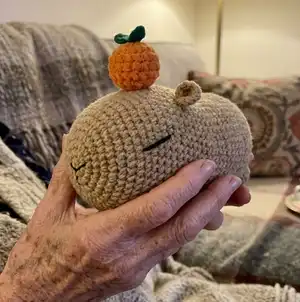
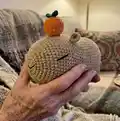
🧢 Beautiful ✨ Detailed πŸ’ Adorable

Capybara Amigurumi Pattern

Capybara Amigurumi Pattern
4.7β˜… Rating
1.5-2 Hours Time Needed
1.7K Made This
βœ‚οΈ

Intermediate Level

Ideal for those with basic crochet experience, featuring slightly more advanced stitches and techniques to expand your skills.

⏱️

Quick Make

Complete in under 2 hoursβ€”lightning fast fun for instant gratification and quick gifts.

🧸

Cute Companion

An adorable friend to cherish, handcrafted with love to bring comfort and joy for years to come.

About This Capybara Amigurumi Pattern

This pattern creates a plush capybara amigurumi crocheted in super-bulky plush yarn. The head and body are worked as one piece while the legs are attached during construction for a clean finish. Clear photos and step-by-step round instructions help you place ears, legs and facial features accurately.

Capybara Amigurumi Pattern crochet pattern - detailed view of completed project

Includes small accessories: a tiny tangerine and leaves to sew to the head. Embroidery directions for expressive eyes and nose are included for a finished, charming look.

Why You'll Love This Capybara Amigurumi Pattern

I absolutely love this pattern because it turns simple rounds into a charming, huggable capybara with personality. I enjoy how the legs are attached as you crochet the body β€” it keeps assembly minimal and neat. The tiny tangerine topper is a playful detail I always smile at when a finished toy sits on my shelf. Working with plush yarn gives such a soft result that I find it impossible to put down once I start stuffing it.

Capybara Amigurumi Pattern step 1 - construction progress Capybara Amigurumi Pattern step 2 - assembly progress Capybara Amigurumi Pattern step 3 - details and accessories Capybara Amigurumi Pattern step 4 - final assembly and finishing

Switch Things Up

I love how versatile this pattern is β€” you can change the yarn color to create different capybara personalities, from warm beige to playful pastels.

If you want a smaller or larger capybara, change your yarn weight and hook size: thicker yarn and a larger hook will give you a chunkier, squishier toy while thinner yarn will produce a mini version.

I often substitute safety eyes instead of embroidering for a glossier look; just be sure to position them before stuffing and secure safety backs firmly.

Try different small toppers instead of the tangerine β€” a leaf, tiny hat, or flower can make a themed gift for holidays or birthdays.

For a more realistic look, embroider nostrils or add a tiny felt tongue for expression β€” use the same placement rules from the pattern for symmetry.

You can make the legs posable by threading a short piece of wire inside each leg before stuffing, then secure the ends inside the body so little paws can be posed.

To make a set, vary the yarn colors slightly to create a family of capybaras β€” mother, father and baby in coordinating shades.

Swap the plush yarn for a velvet or chenille yarn for a sleeker finish; remember to adjust hook size and stuffing to suit the new yarn's drape.

I sometimes surface-embroider subtle fur texture around the face with a needle and matching yarn to emphasize cheeks and a snout.

Want a keychain version? Use thinner yarn, a smaller hook, and omit stuffing to create a tiny flat charm, then attach a split ring through the top.

Common Mistakes & How to Fix Them

βœ— Skipping stitch markers during the leg attachment can misplace legs and ruin symmetry; place markers at the start of rounds and where each leg will attach to keep even spacing. βœ— Not stuffing gradually will give you a lumpy final shape; stuff little by little as you progress and shape the form evenly with your fingers. βœ— Forgetting to count stitches after each round leads to incorrect shaping later; count your stitches after every round, especially after increases/decreases and leg attachments. βœ— Pulling your yarn too tight while using plush yarn makes stitches hard to work and changes gauge; maintain a relaxed tension and use the recommended hook to get the correct size and flexibility.

Capybara Amigurumi Pattern

Make a sleepy capybara plush with this clear, photo-backed crochet pattern. You will crochet the head and body as one piece, attach four legs as you go, and add a tiny tangerine topper for charm. The pattern uses plush super-bulky yarn and gives step-by-step shaping, placement and embroidery details so you can finish a cuddly capybara quickly.

Intermediate 1.5-2 Hours

Materials Needed for Capybara Amigurumi Pattern

β€” Main Fabric

  • 01
    Super bulky plush yarn (Himalaya Dolphin Baby or similar) 120m/100g (approx 131 yds/100g) - Beige main color, ~1 skein (color example 80317)
  • 02
    Small amount orange yarn for tangerine (super bulky plush) - a little skein or scraps
  • 03
    Small amount green yarn for leaves (super bulky plush) - a little skein or scraps
  • 04
    Black fine yarn (e.g., YarnArt Begonia black color 0999) for embroidering eyes and nose
  • 05
    Polyester stuffing for body and tangerine

β€” Tools Required

  • 01
    Crochet hook 4.5 mm (H-7 US)
  • 02
    Scissors
  • 03
    Big and small yarn needle for sewing and weaving ends
  • 04
    Stitch markers
  • 05
    Polyester stuffing
  • 06
    Optional: pins for assembly

Progress Tracker

0% Complete

β€” Leg (x 4) :

Round 1 :

crochet a MR with 6 Sc (6)

Round 2 :

Inc around (12)

Round 3 :

Sc around (12)

Info :

Fasten off. Leave a small tail.

β€” Ear (x 2) :

Round 1 :

crochet a MR with 6 Sc (6)

Info :

Don`t close the ring, turn, Ch

Round 2 :

(Inc, Sc) x 3 (9)

Info :

Fasten off.

Info :

Sew the corners together. Leave sewing tail.

β€” Head-body :

Round 1 :

crochet a MR with 8 Sc (8)

Round 2 :

Inc around (16)

Round 3 :

(Sc 1, inc) x 8 (24)

Round 4 :

(Sc 2, inc) x 8 (32)

Round 5 :

(Sc 3, inc) x 8 (40)

Round 6 :

(Sc 4, inc) x 8 (48)

Round 7 :

Sc around (48)

Round 8 :

Sc 19, Inc, Sc 8, Inc, Sc 19 (50)

Round 9 :

Sc around (50)

Round 10 :

Sc 21, Inc, Sc 6, Inc, Sc 21 (52)

Round 11-13 :

Sc around (52) 3 Rnds

Round 14 :

Sc 23, Inc, Sc 4, Inc, Sc 23 (54)

Round 15-17 :

Sc around (54) 3 Rnds

Info :

In the next round we will mark the approximate position of the ears.

Round 18 :

Sc 6, Dec, Sc 4, Dec, Sc 9, Sc 1 (mark this St), Sc 9, Sc 1 (mark this St), Sc 10, Dec, Sc 4, Dec, Sc 2 (50)

Round 19 :

Sc 4, Dec, Sc 2, Dec, Sc 34, Dec, Sc 2, Dec (46)

Info :

Next, we will attach the legs. Start attaching from the stitch of the leg, as shown on the photo.

Round 20 :

Inc, Sc 2, Inc, Sc 2, Inc, Sc 33, Sc 6 together with 1st leg (49)

Info :

We shifted one stitch. Now from here we will count the beginning of the round. We continue to crochet.

Round 21 :

Sc, Inc, Sc, Sc 6 together with 2nd leg, Sc 13, Dec, Sc 4, Dec, Sc 13, Sc 6 of 1st leg (48)

Info :

First we attach the legs here for these 6 stitches (see photo).

Round 22 :

Sc 4, Sc 6 of the 2nd leg, Sc 12, Dec, Sc 4, Dec, Sc 18 (46)

Round 23 :

Sc 9, Dec, Sc 28, Dec, Sc 5 (44)

Round 24 :

Sc 19, Dec, Sc 6, Dec, Sc 15 (42)

Round 25 :

Sc around (42)

Round 26 :

(Sc 6, Inc) x 6 (48)

Round 27-30 :

Sc around (48) 4 Rnds

Round 31 :

Sc 43, Sc 6 together with 3rd leg (48)

Info :

We shifted one stitch again. Now from here we will count the beginning of the round. We continue to crochet.

Round 32 :

Sc 4, Sc 6 together with 4th leg, Sc 32, Sc 6 of 3rd leg (48)

Round 33 :

Sc 4, Sc 6 of 4th leg, Sc 38 (48)

Info :

After R32

Info :

Sc 6 of the 4th leg (placement shown in photo).

Info :

Stuff with filler.

Round 34 :

(Sc 4, Dec) x 8 (40)

Round 35 :

(Sc 3, Dec) x 8 (32)

Round 36 :

(Sc 2, Dec) x 8 (24)

Round 37 :

(Sc, Dec) x 8 (16)

Info :

Stuff firmly.

Round 38 :

Dec 8 (8)

Info :

Tighten the hole, hide the thread inside.

Info :

With threads from the legs, sew up the holes.

β€” Embroidery :

Info :

Since everyone has a different crocheting style and yarn thickness, a slight shift of stitches is possible. See if the markers are positioned equally from the center. Adjust the position if necessary. Sew the ears in place of the markers at a distance of approximately 10 stitches.

Info :

Left eye. From the left ear down 3 rounds, then to the left 5 stitches - here is the 1st dot of the eye.

Info :

From this dot down 5 stitches and to the left 1 stitch - here is the 2nd dot of the eye.

Info :

Embroider the eye with a thin black thread connecting these two dots. I used one long thread to embroider the eyes and nose. You can fix the thread as shown in the photo. Make 2 stitches to make the eye more expressive.

Info :

Right eye. From the right ear down 3 rounds, then to the right 5 stitches - here is the 1st dot of the eye.

Info :

From this dot down 5 stitches and to the right 1 stitch - here is the 2nd dot of the eye.

Info :

Embroider the second eye in the same way as the first.

Info :

Embroider the NOSE.

Info :

Place points for the nose and stitch a small Y-shape connecting them with thin black thread (see photos for placement). Tie a knot and hide the threads inside.

β€” Tangerine :

Round 1 :

crochet a MR with 6 Sc (6)

Round 2 :

Inc around (12)

Round 3 :

(Sc 1, Inc) x 6 (18)

Round 4-6 :

Sc around (18) 3 Rnds

Round 7 :

(Sc 1, Dec) x 6 (12)

Info :

Stuff

Round 8 :

Dec around (6)

Info :

Fasten off, tighten the hole, leave the thread for sewing.

β€” Leaves :

Info :

Ch 4, Sl St in 1st Ch, Ch 4, Sl St in 1st Ch. Fasten off, wrap the center with thread and tie a knot.

Info :

Sew the leaves to the tangerine, hide the threads inside. Sew a tangerine to the head. Hide the threads inside.

Assembly Instructions

  • Attach each leg by crocheting the 6 stitches of the leg together with the body in the rounds indicated (R20 attach 1st leg, R21 attach 2nd leg, R31 attach 3rd leg, R32 attach 4th leg) following the photos for exact placement.
  • Sew ears in place at the marked stitches from R18; adjust so the ears are approximately 10 stitches apart from the center and secure with sewing tail.
  • Embroider eyes using the placement method: from each ear down 3 rounds then 5 stitches outward for the first dot, then down 5 stitches and one stitch outward for the second dot, then connect with thin black thread.
  • Sew the tangerine on top of the head and attach the leaves to the tangerine, hiding and securing all threads inside the toy.
  • Use the threads left from the leg attachment to close and sew up the small holes where the legs were attached for a neat finish.
  • Hide all ends inside the toy and make final shaping adjustments by evenly stuffing and smoothing the surface.

Important Notes

  • πŸ’‘Use stitch markers to mark the start of rounds and the ear placement from R18 to ensure accurate positioning and symmetry.
  • πŸ’‘Stuff gradually and firmly but not overstuffed; overfilling can distort the shape and make seaming difficult.
  • πŸ’‘When attaching legs, follow picture placement and count stitches carefully after each leg attachment to maintain correct stitch count.
  • πŸ’‘Weave and hide threads inside the body after embroidering the face and sewing accessories to avoid loose ends and improve durability.

This sweet capybara is a quick, satisfying make with a playful tangerine topper and cuddly plush texture. Perfect for gifting or keeping as a cozy desktop companion. Finish it in an afternoon and enjoy a handmade friend that brings instant smiles. 🧢🍊

You ask,

we answer.

FAQs

What size will the finished piece be?

The finished amigurumi measures approximately 8.7 x 4.7 x 4.7 inches (22 x 12 x 12 cm) when made with the recommended super-bulky plush yarn and 4.5 mm hook.

Can I use different yarn weights for this pattern?

Yes, you can use different yarn weights, but it will change the finished size and texture; choose an appropriate hook and expect variations in stitch count or gauge when switching weights.

Do I need prior crochet experience for this pattern?

This pattern is rated intermediate; basic amigurumi skills (magic ring, single crochet, increase, decrease) and experience in working in rounds are recommended for best results.

How long does this project typically take to complete?

Most crocheters complete this project in about 1.5-2 hours, though time may vary based on experience level, yarn choice, and how much time you spend on embroidery and finishing.