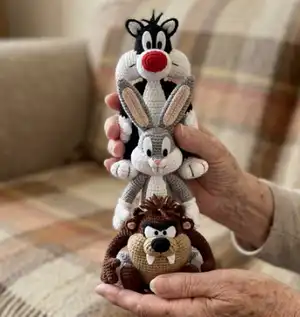
Bring classic Looney Tunes characters to life with these charming crochet patterns. You will enjoy making Tweety, Sylvester and friends using worsted weight yarn and simple shaping techniques. The patterns include step-by-step rounds, finishing notes, and felt eye templates so you can create lovable, display-ready toys.
Progress Tracker
0% Complete
— Tweety :
Finished Size :
10" (25.5 cm)
Materials :
Worsted Weight Yarn: Yellow - 2-1/2 ounces, 140 yards (70 grams, 128 meters). Orange - 1-1/2 ounces, 85 yards (40 grams, 77.5 meters). Black - 2 yards (2 meters). Crochet hook, size F (3.75 mm) or size needed for gauge. Polyester fiberfill. Small amounts of Black, Lt Blue and White felt. Clear-drying craft glue. Yarn needle.
Gauge :
16 sc and 16 rows = 4" (10 cm)
Gauge Swatch :
4" (10 cm) square With Yellow, ch 17. Row 1: Sc in second ch from hook and in each ch across: 16 sc. Rows 2-16: Ch 1, turn; sc in each sc across. Finish off.
— Body :
Rnd 1 :
(Right side): With Yellow, ch 2, 8 sc in second ch from hook; do not join, place marker (see Markers, page 35): 8 sc.
Rnd 2 :
2 Sc in each sc around: 16 sc.
Rnd 3 :
(Sc in next sc, 2 sc in next sc) around: 24 sc.
Rnd 4 :
(Sc in next 11 sc, 2 sc in next sc) twice: 26 sc.
Rnds 5-9 :
Sc in each sc around.
Rnd 10 :
[Decrease (see Sc Decrease, page 35), sc in next 11 sc] twice: 24 sc.
Rnd 11 :
Sc in next 5 sc, decrease, sc in next 10 sc, decrease, sc in next 5 sc: 22 sc.
Rnd 12 :
(Decrease, sc in next 9 sc) twice: 20 sc.
Rnd 13 :
Sc in next 3 sc, decrease, sc in next 8 sc, decrease, sc in next 5 sc: 18 sc.
Rnd 14 :
(Sc in next 7 sc, decrease) twice: 16 sc.
Rnd 15 :
Sc in next 4 sc, decrease, sc in next 6 sc, decrease, sc in next 2 sc: 14 sc.
Rnd 16 :
(Decrease, sc in next 5 sc) twice; slip st in next sc, finish off: 12 sts.
— Head :
Rnd 1 :
(Right side): Sc in second ch from hook and in next 2 chs, 3 sc in last ch; working in free loops of beginning ch (Fig. 1, page 35), sc in next 2 chs, 2 sc in next ch; do not join, place marker: 10 sc.
Rnd 2 :
2 Sc in next sc, sc in next 2 sc, 2 sc in each of next 3 sc, sc in next 2 sc, 2 sc in each of next 2 sc: 16 sc.
Rnd 3 :
2 Sc in next sc, sc in next 4 sc, 2 sc in each of next 4 sc, sc in next 4 sc, 2 sc in each of next 3 sc: 24 sc.
Rnd 4 :
Sc in next sc, 2 sc in next sc, sc in next 4 sc, (2 sc in next sc, sc in next sc) 3 times, 2 sc in next sc, sc in next 5 sc, (2 sc in next sc, sc in next sc) 3 times: 32 sc.
Rnd 5 :
Sc in next 6 sc, loop a short piece of contrasting color yarn around last sc made to mark front of Head, sc in next 4 sc, (2 sc in next sc, sc in next 2 sc) twice, (2 sc in next sc, sc in next 3 sc) 3 times, 2 sc in next sc, sc in next 2 sc, 2 sc in next sc: 39 sc.
Rnd 6 :
Sc in next 12 sc, (2 sc in next sc, sc in next 2 sc) around: 48 sc.
Rnds 7-9 :
Sc in each sc around.
Rnd 10 :
(Decrease, sc in next 14 sc) around: 45 sc.
Rnd 11 :
Sc in next 5 sc, decrease, (sc in next 13 sc, decrease) twice, sc in next 8 sc: 42 sc.
Rnd 12 :
(Sc in next 12 sc, decrease) around: 39 sc.
Rnd 13 :
Sc in next 6 sc, decrease, (sc in next 11 sc, decrease) twice, sc in next 5 sc: 36 sc.
Rnd 14 :
(Decrease, sc in next 10 sc) around: 33 sc.
Rnd 15 :
Sc in next 2 sc, decrease, (sc in next 9 sc, decrease) twice, sc in next 7 sc: 30 sc.
Rnd 16 :
(Decrease, sc in next 8 sc) around: 27 sc.
Rnd 17 :
Sc in next 4 sc, decrease, (sc in next 7 sc, decrease) twice, sc in next 3 sc: 24 sc.
Rnds 18-21 :
Sc in each sc around.
Rnd 22 :
Decrease around; slip st in next sc, finish off leaving a long end for sewing: 12 sts.
Info :
Stuff Head firmly with polyester fiberfill, making front of Head flat and back more rounded.
Info :
Stuff Body firmly with polyester fiberfill, adding extra stuffing to "bottom" area.
Info :
Sew Head to Body, adding extra polyester fiberfill before closing to make neck firm.
— Cheek (Make 2) :
Rnd 1 :
(Right side): With Yellow, ch 2, 8 sc in second ch from hook; do not join, place marker.
Rnd 2 :
2 Sc in each sc around: 16 sc.
Rnd 3 :
(2 Sc in next sc, sc in next 3 sc) around; slip st in next sc, finish off leaving a long end for sewing: 20 sts.
Info :
Using photo as a guide for placement, sew Cheeks to Rnds 18-21 of Head, leaving 3 sts between Cheeks and adding polyester fiberfill before closing.
— Beak :
Rnd 1 :
Sc in second ch from hook and in next 2 chs, 5 sc in last ch; working in free loops of beginning ch, sc in next 3 chs, 2 sc in last ch; join with slip st to first sc, finish off: 13 sc.
Info :
Fold Beak in half widthwise with wider end on top. Sew Beak to Head between Cheeks.
— Foot and Leg (Make 2) :
Sole - With Orange, ch 3 :
Row 1 :
Sc in second ch from hook and in last ch: 2 sc.
Rows 2 and 3 :
Ch 1, turn; sc in each sc.
Row 4 :
Ch 1, turn; 2 sc in each sc: 4 sc.
Rows 5 and 6 :
Ch 1, turn; sc in each sc across.
Row 7 :
Ch 1, turn; 2 sc in first sc, sc in next 2 sc, 2 sc in last sc: 6 sc.
Row 8 :
Ch 1, turn; sc in each sc across.
Row 9 :
Ch 1, turn; decrease 3 times; do not finish off: 3 sc.
Sides Rnd 1 :
(Right side): Ch 1, turn; sc in first sc, 2 sc in next sc, sc in last sc; work 8 sc evenly spaced across end of rows; working in free loops of beginning ch, sc in next 2 chs; work 8 sc evenly spaced across end of rows; join with slip st to first sc: 22 sc.
Rnd 2 :
Ch 1, do not turn; hdc in first sc, 2 hdc in each of next 2 sc, hdc in next 4 sc, sc in next 12 sc, hdc in last 3 sc; join with slip st to first hdc: 24 sts.
Rnd 3 :
Ch 1, hdc in first 9 hdc, sc in next 12 sc, hdc in last 3 hdc; join with slip st to first hdc; do not finish off.
Instep Row 1 :
Ch 1, hdc in first hdc, * (YO, insert hook in next hdc, YO and pull up a loop) twice, YO and draw through all 5 loops on hook; repeat from * once more, hdc in next hdc, slip st in next 2 hdc, leave remaining 16 sts unworked: 6 sts.
Rows 2-5 :
Ch 1, turn; skip first 2 slip sts, sc in next 4 sts, slip st in next 2 sts on Sides: 6 sts.
Row 6 :
Ch 1, turn; skip first 2 slip sts, decrease twice, slip st in next 2 sts on Sides; do not finish off: 4 sts.
Rnd 6 (thumb):
Pull up a loop in next 5 dc, YO and draw through all 6 loops on hook (thumb made), sc in next 7 sc: 8 sts.
Rnd 7 :
Decrease 4 times; slip st in next st, finish off leaving a long end for sewing.
Info :
Sew remaining sts closed. Stuff Arm with polyester fiberfill. Flatten Arm, having thumbs at side, and sew across beginning ch to close; sew Arm to Body with thumbs pointing upward.
ARM (Make 2) - With Yellow :
leave a long end for sewing, ch 8; join with slip st to form a ring.
Rnd 1 :
(Right side): Ch 1, sc in each ch around; do not join, place marker: 8 sc.
Rnds 2-4 :
Sc in each sc around.
Rnd 5 :
5 Dc in next sc, sc in next 7 sc: 12 sts.
Info :
Instructions continued on next pages for remaining arms, hands, tail and finishing details including cutting lengths of black yarn for hair tufts and felt eye assembly.
— Tail :
With Yellow, ch 6 :
join with slip st to form a ring.
Rnd 1 :
(Right side): Ch 1, sc in each ch around; do not join, place marker: 6 sc.
Rnds 2 and 3 :
Sc in each sc around.
Rnd 4 :
(Decrease, sc in next sc) twice; slip st in next sc, finish off leaving a long end for sewing.
Info :
Sew remaining sts closed, forming a point. Using photo as a guide, flatten Tail and sew beginning ch to Body at center back of Rnd 8.
Eye Patterns :
Trace eye patterns and cut 2 pieces of each pattern from felt. Using photo as a guide, glue White Eyes to face, placing bottom just to the outside of halfway point between Cheek and beak and top curve angling outward slightly. Glue the Lt Blue pieces to the White pieces and the Black pieces to the Lt Blue pieces.
Finishing :
For hair, cut one 10" (25.5 cm) length and one 5" (12.5 cm) length of Black. Tie the short length in a knot around the other length, about 2-1/2" (6.5 cm) from one end. Trim the ends of the short length to about 1-1/2" (4 cm) and 2" (5 cm). Thread yarn needle with the long end. Insert needle around st at center of Rnd 2 at front of Head and secure yarn at the knot. Insert the needle inside the Head and push it out the back so the yarn does not show; cut the end close to the Head. Cut a 16" (40.5 cm) length of Black and separate plies in half. Thread needle with 2 ply and add eyelashes using 3 straight stitches and eyebrows using one straight stitch for each eye.
Assembly Instructions
- Sew Cheeks to Rnds 18-21 of Head, leaving 3 sts between Cheeks and adding polyester fiberfill before closing to keep the cheeks rounded.
- Place and sew the Beak between the Cheeks, aligning the wider end on top and lining up bottom curve with the base of the Cheeks.
- Attach Head to Body with extra stuffing in the neck area to make the neck firm; sew securely through the last rounds and into the body.
- Flatten the Arm with the thumb at the side, sew across the beginning ch to close, and attach Arms to the Body with thumbs pointing upward.
- Sew Tail to the Body at the center back of Round 8, flattening the tail and securing the starting chain to the body.
- Glue felt eye layers in order: White base, Light Blue middle, Black pupil, positioning per photo guidance for correct expression.
Important Notes
- 💡Use stitch markers to mark the beginning of each round when working in continuous rounds to avoid losing your place.
- 💡Stuff parts firmly but incrementally; add stuffing as you go to avoid lumps and to shape the head and body correctly.
- 💡Pin pieces in place before sewing to check symmetry and ensure correct alignment of eyes, cheeks and limbs.
- 💡Weave in yarn ends securely and cut close to the work; use glue where needed under felt pieces for extra hold.
These charming Looney Tunes pals are a joy to crochet and a wonderful way to practice shaping and finishing techniques. Each character comes to life with felt eyes, embroidered whiskers and careful stuffing for the perfect silhouette. Make a set for display or give one as a playful, handmade gift that sparks smiles. 🧶😊✨