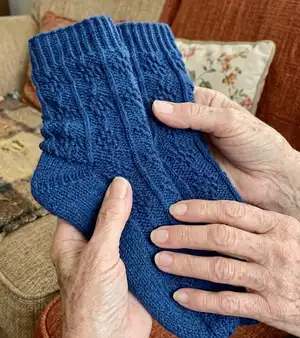
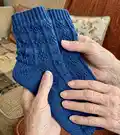
This clear, practical sock guide walks you through knitting comfortable, well-fitting socks from cuff to toe. Youll learn ribbing, two heel options (short rows and cap-and-gusset), foot shaping, and toe finishing. The pattern includes size charts for 4-ply, 6-ply and 8-ply sock yarns and tension notes so you can adapt it to your yarn. Perfect for making cozy handmade socks for yourself or thoughtful gifts.
Progress Tracker
0% Complete
— Strickanleitung für Socken :
Info :
(Beispiel: Hot Socks 4-fach, Schuhgröße 42/43)
Info :
Bund und Schaft: Schlagen Sie die angegebene Maschenzahl (siehe Tabelle: 64 M) für die gewünschte Größe an und verteilen Sie diese gleichmäßig auf 4 Nadeln (pro Nadel 16 Maschen). Arbeiten Sie in Runden, der Rundenanfang ist die rückwärtige Mitte des Sockens.
Info :
Bundmuster: 1 Masche rechts, 1 Masche links oder 2 Maschen rechts, 2 Maschen links im Wechsel stricken.
Info :
Schaft: rechte Maschen. Stricken Sie insgesamt ca. 20 cm.
Section A :
Ferse mit 2 Varianten
Section A1 :
A) Ferse mit verkürzten Reihen: Die Ferse wird über die Maschen der 1. und 4. Nadel (32 Maschen), glatt rechts in Reihen gestrickt. Nehmen Sie dabei die Maschen auf eine Nadel.
Row 1 :
Alle Maschen rechts stricken, wenden.
Row 2 :
Erste Masche als doppelte Masche arbeiten: Faden vor die Arbeit legen, von rechts in die Masche einstechen, dann die Masche mit dem Faden abheben und den Faden fest nach hinten ziehen, die Masche liegt dann doppelt auf der Nadel. Nun die restlichen Maschen links abstricken, wenden.
Row 3 :
Erste Masche als doppelte Masche arbeiten, restliche Maschen bis zur doppelten Masche rechts stricken, wenden (die doppelten Maschen bleiben ungestrickt).
Row 4 :
Erste Masche als doppelte Masche arbeiten, restliche Maschen bis zur doppelten Masche links stricken, wenden.
Info :
3. und 4. Reihe stets wiederholen, bis die erste und letzte Masche des mittleren Drittels, der Fersenmaschen als doppelte Maschen gearbeitet sind (seitlich je 12 doppelte Maschen, in der Mitte 8 einfache Maschen). Jetzt 2 Runden über die Maschen aller 4 Nadeln arbeiten, dabei die doppelten Maschen zusammen, als eine Masche abstricken. In der 2. Runde bis zum Ende der 3. Nadel stricken. Danach wieder in Reihen über die Fersenmaschen in Reihen weiterarbeiten (32 Maschen).
Row 1 :
Die Maschen des seitlichen Drittels (siehe Tabelle: 11 Maschen) und die Maschen des mittleren Drittels der Fersenmaschen (siehe Tabelle: 10 Maschen) rechts stricken, wenden.
Row 2 :
1. Masche als doppelte Masche arbeiten, restliche Maschen, bis einschließlich der letzten Masche des mittleren Drittels, links stricken, wenden.
Row 3 :
1. Masche als doppelte Masche arbeiten, alle Maschen bis zur doppelten Masche rechts stricken, diese als eine Masche rechts abstricken, dann die folgende Masche des seitlichen Drittels rechts stricken, wenden.
Row 4 :
1. Masche als doppelte Masche arbeiten, alle Maschen bis zur doppelten Masche links stricken, diese als eine Masche links zusammenstricken und wenden.
Info :
3. und 4. Reihe stets wiederholen, bis alle Maschen des Seite aufgebraucht und nur noch die Käppchenmaschen übrig sind (10 Maschen). Nun weiter in Runden arbeiten, der Rundenanfang liegt in der Mitte der Käppchenmaschen.
Info :
1. Nadel: Hälfte der Käppchenmaschen (5 Maschen) + angegebene Maschenanzahl (siehe Tabelle: 16 Maschen) aus dem seitlichen Rand der Ferse auf der 1. Nadel aufnehmen.
Info :
2. + 3. Nadel: Maschen rechts stricken.
Info :
4. Nadel: Angegebene Maschenanzahl aus dem seitlichen Rand der Ferse aufnehmen (16 Maschen) + Hälfte der Käppchenmaschen (5 Maschen).
Info :
Danach den Zwickel wie folgt arbeiten: Auf der 1. und 4. Nadel befinden sich nun mehr Maschen als auf der 2. und 3. Nadel. Diese zusätzlichen Maschen werden für die Zwickelabnahmen benötigt.
Info :
In der 3. Runde auf der 1. Nadel die 2. und 3. Masche rechts zusammenstricken und die letzte Masche rechts stricken. Auf der 4. Nadel: 1 Masche rechts, dann 1 Masche wie zum rechts abheben, 1 Masche rechts, danach die abgehobene Masche überziehen. Die Abnahmen in jeder 3. Runde wiederholen, bis auf allen 4 Nadeln wieder gleich viel Maschen vorhanden sind.
Section :
Fuß- und Bandspitze: Ab der in der Tabelle angegebenen Fußlänge (= 22 cm) die Bandspitze beginnen. Dazu bei der 1. und 3. Nadel jeweils die zweit- und drittletzte Masche rechts zusammenstricken und bei der 2. und 4. Nadel jeweils die 1. Masche rechts stricken, 2. Masche rechts abheben, 3. Masche rechts stricken und die abgehobene Masche darüberziehen.
Info :
Die Abnahmen laut Tabelle wiederholen. Die restlichen Maschen mit doppelten Faden fest zusammenziehen und vernähen.
Info :
Maschenprobe: Um mit den Modellmaßen übereinzustimmen, muss vor Beginn eine Maschenprobe gestrickt werden. Diese mit der in der Anleitung angegebenen Maschenprobe vergleichen und evtl. die Nadelstärke ändern. Nur dann entsprechen Angaben (cm), Reihen, Maschen- und Materialverbrauch.
— Instructions for Socks :
Info :
(Example: Hot Socks 4-ply, shoe size 42/43)
Info :
Ribbing and leg: Cast on the amount of stitches as indicated in the chart for the size needed (for example 64 stitches) and divide the stitches evenly amongst the 4 double pointed needles (16 per needle). Work in rounds with the beginning of each round at the centre back of the sock.
Info :
Ribbing: Knit 1, purl 1 or knit 2, purl 2; rep to end of round. Continue this round until desired ribbing height is achieved.
Info :
Leg: knit all stitches. Work ribbing and leg to approximately 20 cm in height.
Section :
Heel with 2 variations
Section A :
A) Heel with short rows: The heel is worked in stockinette stitch over the stitches on the 1st and 4th needle (32 stitches). Place these stitches on one needle and work in rows.
Row 1 :
knit all sts to end. Turn.
Row 2 :
work 1st st as a wrap stitch: with yarn in front, insert needle from the right into the next stitch knit-wise then slip stitch with the yarn together and pull stitch tight taking the yarn to the back of work. This forms a wrap stitch. Purl rest of row. Turn.
Row 3 :
Work 1st st as a wrap stitch, knit to end of row until wrapped stitch. Turn. (The wrapped stitches remain unworked on the needle).
Row 4 :
Work 1st st as a wrap stitch, purl all sts to wrapped stitch. Turn.
Info :
These last two rows establish the pattern. Work continuously until only the centre third remains. (Each side 12 wrapped stitches and 8 sts in the centre). Next round: Now work 2 rounds over all stitches on all needles working both parts of the wrapped stitches as for one stitch. Next round: knit to end of 3rd needle. Then continue only over the heel stitches in rows. (32 stitches)
Row 1 :
Knit the sts of the side third panel (see chart: 11 stitches) and the stitches for the centre third panel (see chart: 10 stitches). Turn.
Row 2 :
Work a wrap stitch, purl following stitches to last stitch of panel. Turn.
Row 3 :
Work a wrap stitch, knit all sts to wrap stitches and work 1 wrap stitch as a knit stitch. Knit remaining side third panel. Turn.
Row 4 :
Work a wrap stitch, now purl all stitches until the wrap stitch and work 1 wrap stitch as a purl stitch. Purl remaining panel. Turn.
Info :
Repeat rows 3-4 continuously until all stitches are working. Then work foot in rounds until beginning of toe.
Section B :
B) Heel with cap and gusset: The heel is worked over the 4th and 1st needle (32 stitches) in rows in stockinette stitch (right-side rows knit all stitches and wrong-side rows purl all stitches). Place all stitches for the heel on one needle and knit the 2nd and 3rd stitch as well as the 2nd and 3rd last stitch in each row. The stitches on the 2nd and 3rd needle remain unworked. Work the number of rows as given in chart (30 rows). Then divide the stitches for the gusset in 3 (see chart). In our example 11 stitches on each edge and 10 stitches in the centre for the cap.
Info :
Next right-side row: knit the 11 outer stitches and the 9 cap stitches. * Slip the last cap stitch knit-wise, knit the 1st stitch from the outer part and slip the stitch over the cap stitch and turn.
Info :
Next row: Now slip the cap stitch purl-wise with yarn in front and purl all stitches to the last cap stitch. Purl this last stitch with the following stitch on the outer panel together. Turn. Slip the 1st cap stitch knit-wise and knit all cap stitches to end of row. Turn.
Info :
Continue from * until all stitches have been worked and only the centre cap stitches (10 stitches) remain. Continue in rounds over all stitches. The beginning of the round is in the centre of the cap stitches.
Info :
1st Needle: With right side facing, pick up half of the number of cap stitches (5 stitches) plus the amount given in chart (16 stitches) along the side edge of the heel.
Info :
2nd and 3rd Needles: knit all stitches.
Info :
4th Needle: pick up half the number of cap stitches as given in chart (16 stitches) plus half of the cap stitches (5 stitches).
Info :
Then work the gusset as follows: The 1st and 4th needles have more stitches than on the 2nd and 3rd needles. These extra stitches are needed for the gusset decreases.
Info :
In the 3rd round on the 1st needle knit the 2nd and 3rd last stitches together and knit the last stitch. On the 4th needle: knit 1, slip one knit-wise, knit 1 then slip the slipped stitch over.
Info :
Continue these decreases every third row until the same amount of stitches remains on each of the 4 needles.
Section :
Foot and toe shaping: Work foot in rounds until length as given in chart is reached (= 22 cm) then begin with the toe.
Info :
1st and 3rd needles: Knit the 2nd and 3rd last stitches together and
Info :
2nd and 4th needles: Knit 1, slip one knit-wise, knit 1 then slip the slipped stitch over.
Info :
Continue these decreases as given in chart.
Info :
Break yarn and thread through the remaining stitches twice and pull tight. Weave in ends.
Info :
Swatch: To achieve the measurements in the patterns, it is very important to check your tension before starting your work. Make a swatch of at least 12 cm x 12 cm and double check the stitches and rows to make sure you have the same tension as stated in the pattern and if necessary change the needle size accordingly. This is the only way your work will be the size shown and the measurements, rows, stitches and yarn requirements will be correct.
This Basic Sock Guide makes knitting comfortable, well-fitting socks approachable and enjoyable for makers of many levels. Whether you choose the short-row heel for a seamless fit or the cap-and-gusset for structure, youll get dependable results with the included size charts and swatch advice. Knit cozy handmade socks for yourself or as thoughtful gifts — happy knitting! 🧶🧦