🧢 Beautiful ✨ Detailed πŸ’ Adorable

Tree of Life Leather Bag Pattern

Tree of Life Leather Bag Pattern
3.9β˜… Rating
12-15 Hours Time Needed
3.0K Made This
βœ‚οΈ

Intermediate Level

Ideal for those with basic crochet experience, featuring slightly more advanced stitches and techniques to expand your skills.

⏱️

Multi-Day Project

A rewarding 12+ hour journeyβ€”perfect for dedicated crafters who love detailed work.

✨

Stylish Touch

An elegant detail to elevate any look, combining traditional techniques with contemporary design sensibilities.

About This Tree of Life Leather Bag Pattern

This PDF provides full-size pattern templates and assembly diagrams for a Tree of Life leather shoulder bag. It includes a calibration page for accurate printing, outlines of the flap with tree motif, front and back panels, gusset, shoulder straps and D-ring straps. The templates show perforation/punching points to guide stitching and rivet placement.
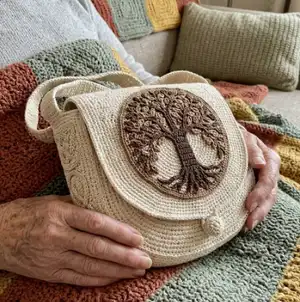
Tree of Life Leather Bag Pattern crochet pattern - detailed view of completed project

The pattern is ideal for leatherworkers who want a detailed decorative flap and sturdy construction. Use vegetable-tanned leather and follow the assembly diagrams to attach reinforcements, straps, and hardware.

Why You'll Love This Tree of Life Leather Bag Pattern

I absolutely love this pattern because the Tree of Life motif gives the bag a classic, handcrafted feel that stands out. I enjoy how the templates include perforation guides so stitching and assembly are precise and straightforward. The design balances decorative detailing with practical construction β€” the reinforced flap and strap layouts make a bag that is both beautiful and durable. It inspires me to create variations with different leather finishes, tooling, or dyeing to personalize each piece.

Tree of Life Leather Bag Pattern step 1 - construction progress Tree of Life Leather Bag Pattern step 2 - assembly progress Tree of Life Leather Bag Pattern step 3 - details and accessories Tree of Life Leather Bag Pattern step 4 - final assembly and finishing

Switch Things Up

I like to experiment with different leather finishes to change the overall character of the bag; try a natural vegetable-tanned hide for tooling or a smooth aniline for a sleek look.

For a more rustic vibe, I often add hand-stitching in contrasting waxed thread, using long saddle stitch runs along the gusset and flap edge.

Consider tooling or carving the Tree of Life motif deeper for a three-dimensional effect, or dyeing only the motif area to make it pop against a lighter background.

If you want a lighter bag, choose thinner leather for the gusset and body and reinforce stress points with the flap reinforcement template.

To make the bag larger or smaller, scale the gusset width and strap lengths proportionally before cutting, but always reprint the calibration page to confirm scale.

I sometimes add an inner pocket by cutting an additional small rectangle and stitching it to the back panel interior, aligning with the hole guides so it integrates cleanly.

Try metal hardware variations: brass D-rings and rivets lend a warm vintage look, while nickel or black hardware gives a modern appearance.

For a softer edge finish, bevel and burnish the edges then apply a thin coat of edge paint; experiment on scrap leather to find the perfect color and sheen.

I recommend practicing punching and stitching on a scrap piece first; it helps you test hole spacing and thread thickness for the final assembly.

Finally, personalize the straps with added decorative punch patterns or small stamped initials to make each bag uniquely yours.

Common Mistakes & How to Fix Them

βœ— Using leather that is too thin for structural pieces causes a floppy bag; choose 3-4 oz (1.2-1.6 mm) vegetable-tanned leather for panels and a slightly thicker weight for the gusset and straps. βœ— Skipping the calibration square before printing templates can lead to incorrect pattern scale; always print the calibration page and measure the 5 cm and 2 inch squares before cutting. βœ— Punching holes without marking or spacing can make stitching uneven and misaligned; use the perforation guides shown on the templates and measure carefully before punching. βœ— Attaching straps without reinforcing can stress the leather and hardware; add the flap reinforcement and use rivets or stitched reinforcement at strap attachment points to prevent tearing.


Tree of Life Leather Bag Pattern

Make a beautiful Tree of Life leather crossbody bag using these full-size templates and assembly illustrations. This pattern includes calibrated printing squares, pattern pieces for flap, front and back panels, gusset, straps and reinforcement pieces to help you cut and punch holes accurately. Follow the diagrams to create a handcrafted leather accessory that highlights a carved or stamped tree motif.

Intermediate 12-15 Hours

Materials Needed for Tree of Life Leather Bag Pattern

β€” Main Fabric

  • 01
    Vegetable-tanned leather 3-4 oz (1.2-1.6 mm) for front and back panels, approximately 0.5-1 square meter depending on layout
  • 02
    Leather for gusset and strap decoration, 3-4 oz for gusset and 4-6 oz for shoulder straps (thicker for strength) approximately 0.3-0.6 square meter
  • 03
    Flap reinforcement leather piece (same or heavier leather) 1 piece
  • 04
    Waxed thread for stitching, heavy-duty (0.6-0.8 mm) 10-20 m
  • 05
    D-rings, rivets and snap/button hardware (1 snap, 2 D-rings, rivets as required)
  • 06
    Optional edge paint or dye 1 small bottle

β€” Tools Required

  • 01
    Leather cutting knife or rotary cutter
  • 02
    Cutting mat
  • 03
    Stitching awl or pricking iron
  • 04
    Wing divider or edge groover
  • 05
    Hole punch set for stitching holes and rivets
  • 06
    Mallet for setting rivets
  • 07
    Snap setter or snap-setting tool
  • 08
    Rivets and D-rings (hardware set)
  • 09
    Edge beveler and burnisher
  • 10
    Ruler and measuring tape (cm and inch)
  • 11
    Printer capable of printing full-size templates
  • 12
    Scissors
  • 13
    Beeswax or burnishing gum (optional)

Progress Tracker

0% Complete

β€” Calibration Page :

Info :

Calibration Page shows two printed squares for verifying scale: left square labeled '5 cm' and right square labeled '2 inch'.

β€” Assembly Instructions :

back panel+ flap (P1) :

Large combined back panel and flap template with Tree of Life motif printed on the flap area; template includes perimeter perforation/punch hole guides and a marked snap hole on the flap.

flap :

Flap template showing full Tree of Life decorative motif with multiple inner cut or stamping details and perimeter punch hole guides and single snap hole near top center.

FLAP REINFORCEMENT :

Reinforcement template matches the inner shape of the flap with punched hole guide for stitching; intended to be attached beneath the flap exterior for strength.

D ring straps :

Two small rectangular strap pieces labeled 'D ring straps' with perforation hole guides that wrap around D-rings for attachment to the bag body.

front panel :

Front panel template showing perimeter punch hole guides and a marked snap mate hole positioned to correspond with the flap snap.

BACK PANEL :

Back panel template shows the main back piece shape with perimeter punch hole guides to join gusset and bottom edges; labelled 'BACK PANEL'.

FRONT PANEL :

Front panel template shows corresponding front piece shape with perimeter punch hole guides; labeled 'FRONT PANEL'.

shoulder straps :

Shoulder straps templates display two strap lengths with indicated hole arrays and decoration; one strap segment labeled '50 cm / 20 inch' and another labeled '110 cm / 43 inch'.

GUSSET :

Gusset template shows long rectangular strip with decorative Celtic knot motif and perforation hole guides along both long edges for stitching to front and back panels.

SHOULDER STRAPS :

Detailed shoulder strap pieces include smaller decorated strap ends, hole patterns for rivets or stitching and centre strap lengths with measurement indicators '50 cm / 20 inch' and '110 cm / 43 inch'.

GUSSET (detail) :

Gusset detail page contains a long decorative strip labeled 'GUSSET' with a repeated Celtic knot motif and evenly spaced hole guide patterns; this side panel attaches to front and back with stitching following punches.

FLAP (detail) :

Close-up of the flap showing the Tree of Life motif and two concentric rows of perforation holes around the edge; central snap hole is indicated.

FLAP REINFORCEMENT (detail) :

Reinforcement template mirrors flap curvature and shows inner row of perforation holes for stitching to flap prior to final assembly.

D RING STRAPS (detail) :

Detail drawing shows two short strap pieces with multiple holes for rivet placement to secure D-rings to bag body.

BACK PANEL (detail) :

Back panel close-up showing full perimeter hole pattern for stitching to gusset and flap area alignment marking 'A' at top center.

FRONT PANEL (detail) :

Front panel close-up with perimeter punching pattern and snap hole location to match flap snap; labeled 'FRONT PANEL' centric.

SHOULDER STRAPS (measurements) :

Shoulder strap sheet shows two strap widths and two lengths: short adjustable section and long body strap, measurements printed as '50 cm / 20 inch' and '110 cm / 43 inch'.

GUSSET (layout) :

Gusset layout sheet shows full-length strip with decoration and a staggered hole guide column to align with front and back panel holes; labeled 'GUSSET'.

Info :

All templates include dotted perimeter guides indicating punch/stitch locations; align printed calibration squares before cutting and confirm measurements in both cm and inches.

Assembly Instructions

  • Print the Calibration Page and measure the 5 cm and 2 inch squares to confirm your printer output is to scale before cutting any pattern pieces.
  • Cut out the flap, flap reinforcement, front panel, back panel, gusset and strap templates; transfer hole positions and center snap location to your leather using an awl or template marker.
  • Attach flap reinforcement to the underside of the flap by aligning the perforation guides and stitching or gluing in place, then punch and stitch through both layers following the hole pattern.
  • Stitch the gusset to the front panel first along the long edge using the printed punch guides, then stitch the back panel to the other side of the gusset to form the bag body.
  • Prepare and attach the D-ring straps and shoulder strap assembly using rivets and stitched reinforcement points shown on the templates; install the snap on the flap and corresponding snap on the front panel.

Important Notes

  • πŸ’‘Always print and verify the calibration squares before cutting templates to ensure accurate scale and fit.
  • πŸ’‘Use the perforation guides on the templates to mark holes; consistent hole spacing is critical for even stitching.
  • πŸ’‘Edge finish and burnishing improve durability and appearance; bevel, sand and burnish edges after assembly.

This Tree of Life leather bag pattern gives you full-size templates and clear assembly diagrams to craft a timeless accessory.🌳 Use vegetable-tanned leather and enjoy tooling, dyeing or leaving a natural finish to suit your style.πŸ‘œ Follow the calibration page and punch guides for precise stitching and a professional result.✨

You ask,

we answer.

FAQs

What size will the finished bag be?

Finished size depends on how you cut and assemble the gusset and panels, but the pattern pieces are scaled for a medium crossbody approximately similar to the sample photographed; verify dimensions using the calibration squares before cutting.

Do I need special leatherworking experience to use this pattern?

This pattern is intermediate: basic leatherworking skills like cutting, punching, stitching and setting hardware are recommended for best results.

Can I change the strap length?

Yes, the shoulder straps include two length indicators (50 cm/20 inch and 110 cm/43 inch) and you can trim or extend strap pieces to customize fit as shown on the strap templates.

Are holes pre-marked on the templates?

Yes, the PDF templates include perforation/punch guides around the perimeters of panels, the flap, gusset and strap pieces to assist consistent hole placement for stitching and rivets.