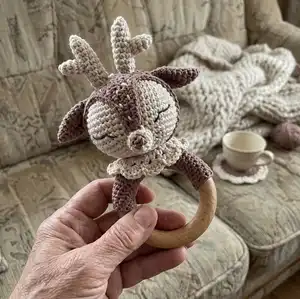
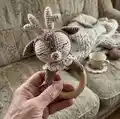
Make a charming rattle deer for babies and gift-giving with clear step-by-step instructions and helpful photos. This pattern teaches you how to crochet the head, ears, horns, nose and attach them to a wooden ring to create a safe, handmade rattle. You will learn working-in-the-round techniques, how to cover a wooden ring, and simple embroidery to create sleepy eyes and facial details. Perfect for making personalized baby gifts or keepsakes.
Progress Tracker
0% Complete
— Notes :
Info :
All pieces worked in a continuous spiral. Do not join to work in the rnd, just work sc in the next st. Place marker or use contrasting color yarn to mark beg of rnd. Use hook 2.5 mm or size matching your yarn and obtaining gauge. When work around the wooden ring, use smaller size hook, it will be easier to work.
— Working around the ring. Option 1 :
Info :
Work around the ring in a continuous spiral. The total number of sts depends on the size of your wooden ring and yarn. For my size ch10 using hook 2.5mm, then work around the ring using hook 2mm.
Round 1 :
Join chain with sl st around the ring. Then sc in each st around. The first rnd is the most difficult.
Round 2 :
Then start to work in a continuous spiral, sc in each st. If it`s still uncomfortable to work, try to use smaller size hook.
Round 3 :
Pay attention to your tension, crochet around the ring tightly. If the fabric is moving loosely, rip it out and start over again with one st less.
Round 4 :
Cont to work until the half or a bit less than half of the ring is covered. End with sl st. The beginning and the end of work should be inside of the ring. Weave in ends.
Info :
Pull the end through the last rnd to tighten the fabric around the ring, and then pull it through the fabric inside the ring.
— Working around the ring. Option 2 :
Info :
If option 1 is too complicated for you, you can crochet a rectangle, working sc. For my ring size, ch20 and work for 9 rows. When the rectangle is finished, fold it over the ring and sew it, the fabric should be tight around the ring. The seam should be inside the ring. Weave in ends using tapestry needle.
— Head :
Round 1 :
With MC work the head. Hereafter, the hook 2.5 mm. Rnd 1 - 6 sc in magic ring = 6 sts
Round 2 :
Rnd 2 - (inc) * 6 times = 12 sts
Round 3 :
Rnd 3 - (inc, sc in next st) * 6 times = 18 sts
Round 4 :
Rnd 4 - (inc, sc in next 2 sts) * 6 times = 24 sts
Round 5 :
Rnd 5 - (inc, sc in next 3 sts) * 6 times = 30 sts
Round 6 :
Rnd 6 - (inc, sc in next 4 sts) * 6 times = 36 sts
Round 7 :
Rnd 7 - (inc, sc in next 5 sts) * 6 times = 42 sts
Round 8 :
Rnd 8 - (inc, sc in next 6 sts) * 6 times = 48 sts
Round 9-15 :
Rnds 9-15 - 48 sc (work even for 7 rnds)
Round 16 :
Rnd 16 - (dec, sc in next 6 sts) * 6 times = 42 sts
Round 17 :
Rnd 17 - (dec, sc in next 5 sts) * 6 times = 36 sts
Round 18 :
Rnd 18 - (dec, sc in next 4 sts) * 6 times = 30 sts
Round 19 :
Rnd 19 - (dec, sc in next 3 sts) * 6 times = 24 sts
Info :
Stuff the head and put rattle inside.
Round 20 :
Rnd 20 - (dec, sc in next 2 sts) * 6 times = 18 sts
Info :
Stuff the head tightly, for your convenience you can use tweezers.
Round 21 :
Rnd 21 - (dec, sc in next st) * 6 times = 12 sts
Round 22 :
Rnd 22 - (dec) * 6 times = 6 sts. Bind off rem 6 sts using a needle. Leave a long tail to sewing around a ring (approx 18-20in/45-50cm). The head is done.
— Upper head piece :
Round 1 :
With CC work the upper head piece. Rnd 1 - 6 sc into magic ring = 6 sts
Round 2 :
Rnd 2 - (inc) * 6 times = 12 sts
Round 3 :
Rnd 3 - (inc, sc in next st) * 6 times = 18 sts
Round 4 :
Rnd 4 - (inc, sc in next 2 sts) * 6 times = 24 sts
Round 5 :
Rnd 5 - (inc, sc in next 3 sts) * 6 times = 30 sts
Round 6 :
Rnd 6 - (inc, sc in next 4 sts) * 6 times = 36 sts
Round 7 :
Rnd 7 - (inc, sc in next 5 sts) * 6 times = 42 sts
Round 8 :
Rnd 8 - (inc, sc in next 6 sts) * 6 times = 48 sts
Round 9-13 :
Rnds 9-13 - sc in every st (work even for 5 rnds) = 48 sts
Round 14 :
Rnd 14 - (dec, sc in next 6 sts) * 6 times = 42 sts
Round 15 :
Rnd 15 - sc in every st (work 1 rnd even) = 42 sts
Info :
Turn the piece and start to work flat.
Round 16 :
Row 16 - ch1, sc in next 6 sts, turn.
Round 17 :
Row 17 - ch1, sc in next 6 sts, turn.
Round 18 :
Row 18 - sc in next 5 sts starting from the 2nd st from the hook, turn.
Round 19 :
Row 19 - sc in next 4 sts starting from the 2nd st from the hook, turn.
Round 20 :
Row 20 - ch1, sc in next 4 sts, turn.
Round 21 :
Row 21 - sc in next 3 sts starting from the 2nd st from the hook, turn.
Round 22 :
Row 22 - sc in next 2 sts starting from the 2nd st from the hook, turn.
Round 23-25 :
Rows 23-25 - ch1, sc in next 2 sts, turn.
Round 26 :
Sc in every st to end of upper head piece.
Round 27 :
Sl st in next st, fasten off leaving a long tail approx 25-27 in (65-70 cm) for sewing to the head.
— Nose :
Round 1 :
Work with MC yarn (beige). Rnd 1 - 5 sc into magic ring = 5 sts
Round 2 :
Rnd 2 - (inc) * 5 times = 10 sts
Round 3-5 :
Rnds 3-5 - sc in next 10 (work even for 3 rnds) = 10 sts
Round 6 :
Sl st in next st, fasten off leaving a tail for sewing.
Round 7 :
With CC yarn (brown) work 6 sc into magic ring for the nose tip, fasten off and sew it to the nose or embroider the tip of the nose using A yarn. Stuff the nose firmly.
— Horn :
Item Name (P1) :
Small horn (Make 2). With MC yarn work as foll: Rnd 1 - 6 sc into magic ring = 6 sts
Round 2 :
Rnd 2 - inc, sc in next 5 sts = 7 sts
Round 3-4 :
Rnds 3-4 - sc in every st (work even for 2 rnds) = 7 sts
Round 5 :
Sl st in next st, fasten off leaving a long tail for sewing. Stuff the horn. Rep for the 2nd horn.
Item Name (P2) :
Large horn (Make 2). With MC yarn work as foll: Rnd 1 - 6 sc into magic ring = 6 sts
Round 6 :
Rnd 2 - (inc, sc in next 2 sts) * 2 times = 8 sts
Round 7-14 :
Rnds 3-10 - sc in every st (work even for 8 rnds) = 8 sts
Round 15 :
Sl st in next st, fasten off leaving a long tail for sewing. Rep the same for the 2nd horn leaving longer tail approx 27 in (70 cm) to embroider the stripes above the nose. Stuff the horns.
— Ears (Make 2) :
Round 1 :
With CC yarn work as foll: Rnd 1 - 6 sc into magic ring = 6 sts
Round 2 :
Rnd 2 - (inc, sc in next 2 sts) * 2 times = 8 sts
Round 3 :
Rnd 3 - (inc, sc in next 3 sts) * 2 times = 10 sts
Round 4 :
Rnd 4 - (inc, sc in next 4 sts) * 2 times = 12 sts
Round 5 :
Rnd 5 - (inc, sc in next 5 sts) * 2 times = 14 sts
Round 6-9 :
Rnds 6-9 - sc in every st (work even for 4 rnds) = 14 sts
Round 10 :
Sl st in next st, fasten off leaving a long tail for sewing to the head. Rep the same for the 2nd ear.
— Assembling :
Info :
Sew the nose to the head at level of row 6 from the last inc, attaching the upper head piece to the head, checking the right place for embroidering the nose. See photo-instructions for sewing the upper head piece and the nose.
Info :
Then outline the eyes and remove the upper head piece. With black embroidery floss or fingering weight yarn embroider sleepy eyes. You can bring the needle from the back side of the head. The upper head piece will hide all the knots, when attaching it. Embroider the eyes as it`s shown on the photo, mirror the 2nd eye. Pay attention to the symmetrical position of the eyes regarding to the nose. For your convenience attach the upper head piece. When eyes are finished, secure the thread on the back of the head and cut it.
Info :
Now sew the upper head piece. Attach it as it`s shown on the photo and sew it to the head around the edge.
Info :
Then sew small horns pieces to the large ones. Sew the horns to the head as it`s shown on the photo. Using a long tail, randomly embroider stripes on the nose. Check photo-instructions.
Info :
Fold ears as it`s shown on the photo and fix them in such position, then sew them to the head counting approx 2 sts from the horns. Mirror the same for the 2nd ear. The head is done.
Info :
With MC yarn tail sew the head to the wooden ring. When you sew the head to the ring, push it slightly, the neck shouldn`t be too thin. The head should be tightly attached to the ring, I recommend to sew it around twice.
— Collar :
Round 1 :
Now make a collar. With MC yarn ch22. Then work flat as foll: Row 1 - sc in 2nd st from the hook, sc in next 20 sts, turn.
Round 2 :
Row 2 - ch4, dc in 1st st, [sk1, dc in next st, ch1, dc in the same st] 10 times, turn.
Round 3 :
Row 3 - ch2, 2 dc in next ch space, sc in next st, [5 dc in next ch space, sc in next st] 10 times, 3 dc in last post. The collar is ready. Sew it as it`s shown on the photo.
Create a treasured handmade rattle your baby will adore — soft, secure, and full of character. 🧶
This Rattle Deer combines simple techniques with charming details to make a thoughtful gift or keepsake. 🧸
Enjoy the relaxing process of stitching, stuffing and assembling this little friend — happy crocheting! ✨