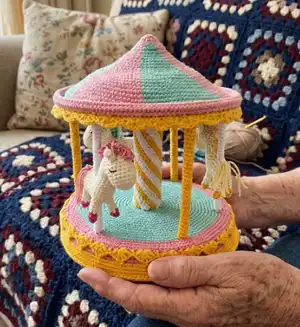
🧢 Beautiful ✨ Detailed πŸ’ Adorable

Merry-go-round Amigurumi Pattern

Merry-go-round Amigurumi Pattern
4.3β˜… Rating
12-15 Hours Time Needed
2.1K Made This
βœ‚οΈ

Intermediate Level

Ideal for those with basic crochet experience, featuring slightly more advanced stitches and techniques to expand your skills.

⏱️

Multi-Day Project

A rewarding 12+ hour journeyβ€”perfect for dedicated crafters who love detailed work.

🧸

Cute Companion

An adorable friend to cherish, handcrafted with love to bring comfort and joy for years to come.

About This Merry-go-round Amigurumi Pattern

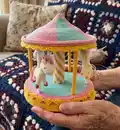
This pattern shows you how to crochet a miniature merry-go-round carousel with three tiny horses, a crocheted base and a conical roof. It includes clear stitch rounds for each horse, step-by-step base construction and instructions for assembling the wooden frame and central post. Youll also get guidance on using fishing line to stabilize the roof and simple hardware assembly for a working rotating base.

Merry-go-round Amigurumi Pattern crochet pattern - detailed view of completed project

The design mixes amigurumi toy techniques with small woodworking and hardware assembly for a sturdy finished piece. Photos throughout help you check shaping, placement and the final assembly steps.

Why You'll Love This Merry-go-round Amigurumi Pattern

I absolutely love this pattern because it blends soft amigurumi crochet with small craft and assembly work, giving you a playful finished piece. I enjoy the way the tiny horses come to life with minimal shaping and simple details like embroidered eyes and tiny manes. The striped central post and conical roof add a joyful, colorful look that makes the carousel feel magical. Creating the rotating wooden base and wrapping the pole adds a satisfying, hands-on step that elevates the project beyond ordinary amigurumi.

Merry-go-round Amigurumi Pattern step 1 - construction progress Merry-go-round Amigurumi Pattern step 2 - assembly progress Merry-go-round Amigurumi Pattern step 3 - details and accessories Merry-go-round Amigurumi Pattern step 4 - final assembly and finishing

Switch Things Up

I love to change the color palette to match a nursery or holiday theme β€” try pastels for a baby gift or metallic yarn accents for a grown-up display.

If you want a bigger carousel, use a thicker yarn and a larger wooden base; increase the number of base rounds to cover the larger disk.

To make a tiny keychain version, use thread-weight yarn and a tiny dowel or rolled cardboard tube for the post; reduce rounds proportionally to keep proportions.

I often swap the wooden beads for small decorative buttons or painted beads to change the look of the base edge and make it more whimsical.

For a musical carousel effect, you could attach a small music box mechanism under the base and route the winding key through the underside for a sweet tune.

Experiment with the roof by changing strip widths or using gradient yarn to create a spiral color effect without alternating colors manually.

Try embroidering different facial expressions on the horses to give each one personality β€” sleepy eyes, winking or small smiles all look great.

If you want extra durability, reinforce the glued pipe joint with a small wood screw through the plywood into the pipe bottom before covering with yarn.

I sometimes add tiny crocheted saddles or flags to the top of the roof for extra detail β€” a little felt or embroidered banner works well too.

Dont be afraid to mix yarn textures: a slightly fuzzy yarn on the mane can make it look plush, while keeping the body in smooth cotton gives tidy shaping.

Common Mistakes & How to Fix Them

βœ— Skipping stitch markers during spiral rounds can make counting increases difficult and cause uneven shaping; place a marker at the start and move it each round to keep consistent counts. βœ— Overstuffing small parts like the muzzle or neck makes seams hard to close neatly; stuff gradually, using small amounts to preserve shape and avoid lumps. βœ— Crocheting too loosely when working the roof with fishing line will let the line slip and distort the cone; maintain a snug tension so stitches hold the fishing line firmly. βœ— Forgetting to leave long yarn tails when finishing pieces prevents easy sewing during assembly; always leave long ends for attaching parts and hiding inside the work. βœ— Not checking the wooden base rotation gap can cause binding during rotation; tighten nuts so there is a 1-2 mm gap so the top circle spins freely while beads prevent sideways fall. βœ— Applying glue carelessly to the screw or nuts can stop the carousel from rotating properly; use glue sparingly and avoid getting adhesive on moving metal parts.

Merry-go-round Amigurumi Pattern

Make a delightful miniature carousel with three tiny amigurumi horses, a wooden rotating base and a striped central post. This pattern walks you through crocheting the horses, base, roof and assembly with clear photos and structural hardware notes. Youll enjoy combining crochet with simple craft supplies to create a charming keepsake. Perfect for gifting or a whimsical nursery accent.

Intermediate 12-15 Hours

Materials Needed for Merry-go-round Amigurumi Pattern

β€” Main Fabric

  • 01
    Yarn Art Jeans (55% cotton, 45% acrylic, 160 m/50 g) - turquoise (76) - small skein
  • 02
    Yarn Art Jeans (55% cotton, 45% acrylic, 160 m/50 g) - pink (78) - small skein
  • 03
    Yarn Art Jeans (55% cotton, 45% acrylic, 160 m/50 g) - white (62) - main for horses - approx 50-100 g
  • 04
    Yarn Art Jeans (55% cotton, 45% acrylic, 160 m/50 g) - yellow (35) - small skein
  • 05
    Small amounts of dark turquoise, light pink and light yellow for manes and hooves - a few grams each
  • 06
    Alize Cotton Gold Hobby (55% cotton, 45% acrylic, 165 m/50 g) - ivory (01) - for horse bodies - approx 50 g
  • 07
    Thin black yarn for embroidering eyes

β€” Tools Required

  • 01
    Crochet hook size 2.25 mm (hook size may vary depending on your crocheting density)
  • 02
    Big-eyed needle for sewing and finishing
  • 03
    Sewing pins for assembly placement
  • 04
    Scissors
  • 05
    Lighter (for melting fishing line tip)
  • 06
    Glue gun (for structural glue on frame) and superglue
  • 07
    Pruner or cutter for trimming hardware
  • 08
    2 round plywood blanks for clocks with a diameter of 20 cm (2 pcs)
  • 09
    Wooden beads diameter 1 cm (8 pcs)
  • 10
    Screw 8 mm x 100 mm (1 pc)
  • 11
    Nuts suitable for 8 mm screw (3 nuts)
  • 12
    Washers (2 large and 1 small)
  • 13
    Plastic pipe couplings 5 pcs x 20 mm inner diameter (or cardboard tube from kitchen stretch film) for frame sleeves
  • 14
    Plastic pipe or cardboard tube for central post (outer diameter approx 28 mm, length about 17.5 cm)
  • 15
    Synthetic fiberfill
  • 16
    Adhesive tape (to join plastic sleeves)
  • 17
    Wooden sticks for manicure 15 cm long (6 pcs) - optional for reinforcing or temporary support
  • 18
    Fishing line diameter 1 mm (for roof reinforcement)
  • 19
    Stitch markers
  • 20
    Pins for assembly
  • 21
    Yarn needle for sewing pieces
  • 22
    Clamps or hairpin to hold fishing line skein

Progress Tracker

0% Complete

β€” Horses :

Info :

For horse body use ivory Alize Cotton Gold Hobby 01. For hooves and mane with a tail, use any bright shades of the same color: darker for the hooves and lighter for the mane and tail. I used 2 shades of pink, 2 shades of blue and 2 shades of yellow. Start crocheting with ivory yarn. Use a piece of yarn of contrasting color as a marker for easier rounds counting.

Round 1 :

6 sc in AR

Round 2 :

inc*6=12 sc

Round 3 :

(1 sc, inc)*6=18 sc

Round 4-6 :

3 rounds of 18 sc. Finish with a sl st, leave a long end. Set aside the detail (this is the muzzle of a horse).

Info :

Chain 7 with ivory yarn for the muzzle base.

Round 1 (muzzle) :

3 sc in the second loop from the hook, 4 sc along the chain, 3 sc in the last loop of the chain. Turn the work and crochet along the bottom side of the chain 4 sc = 14 sc around.

Round 2 :

inc*3, 4 sc, inc*3, 4 sc = 20 sc

Round 3 :

(1 sc, inc)*3, 4 sc, (1 sc, inc)*3, 4 sc = 26 sc

Round 4 :

(1 sc, inc, 1 sc)*3, 4 sc, (1 sc, inc, 1 sc)*3, 4 sc = 32 sc

Round 5-8 :

4 rounds of 32 sc

Round 9 :

Work only 14 sc (shape the neck start)

Round 10-12 :

Do not continue the round, but go right to the first st of the round (the first one after the marker) and work spiral rounds of the 14 sc. Sc 3 rounds up - it should be the neck.

Info :

Thread the end of the yarn from the muzzle into the needle and sew to the neck. To do this sew together 2 sc of the neck (right in the center of the neck front) and 2 sc of the muzzle.

Round 13 :

Work around both parts 28 sc (join muzzle to neck)

Round 14 :

Make a decrease at the junction of the neck with the muzzle on both sides, it turns out 26 sc.

Round 15 :

Make 1 more decrease on both sides in the same place, 24 sc remain.

Round 16 :

24 sc

Round 17 :

(2 sc, dec)*6 = 18 sc. Stuff the neck and the muzzle of the horse.

Round 18 :

(1 sc, dec)*6 = 12 sc

Round 19 :

Dec every st until the opening closes, adding fiberfill if necessary. Cut the yarn and hide the end.

Info :

Stuff the body and sew the opening on the back.

β€” Legs :

Legs (Item) :

Start crocheting with colored yarn: 6 sc in AR, then sc one more round of 6 sc with colored yarn and 4 rounds of ivory yarn. Finish with a sl st. Do not stuff, leave a long end. Make 4 pcs. Sew the legs to the body.

β€” Ears :

Ears (Item) :

For ears crochet small triangles with ivory yarn. Chain 5. 1. 4 sc. 2. Do not make a turning ch, insert the hook right into the second st = 3 sc. 3. Do not make a turning ch, insert the hook right into the second st = 2 sc. 4. Do not make a turning ch, insert the hook right into the second st = 1 sc. Leave a long end. Thread the end of the yarn into the needle and sew together the 2 corners of the triangle. Sew the ear to the horse head. Crochet and sew the second ear in the same way.

β€” Mane and Tail :

Mane :

Crochet the mane with yarn a little lighter than the hooves. Attach the yarn to the forehead of the horse, crochet 3 ch and 2 dc in the same point. Next, crochet along the neck for 3 dc from each point. The hook is simply inserted under the posts along an imaginary line. At the end, crochet 2 dc and 3 ch, finish with a sl st. Cut the yarn and hide the end.

Tail :

For the tail, cut 4 pieces of yarn 10 cm each. Fasten one thread at a time.

Finishing :

Embroider eyes with thin black yarn.

Info :

Crochet 2 more horses in other colors.

β€” Frame & Base Assembly :

Frame Parts :

Lets get to the carousel frame. Glue 5 plastic sleeves together with ordinary tape. Or cut a cardboard tube/plastic pipe with a diameter of 28 mm and a length of about 17.5 cm.

Beads :

Glue 4 beads on one of the wooden circles at the same distance. Glue 4 more beads between them on the other side.

Screw Assembly :

Insert the screw into the hole and fix it with a nut on the reverse side, applying a drop of superglue under the nut. Put washers on the screw in this order: large, small, large. Put a second wooden circle on the screw. Check that it should spin freely without touching the beads. At the same time, the beads will not allow it to fall sideways.

β€” Base Crochet :

Info :

Lets start crocheting the base. Work spiral rounds with turquoise yarn using a marker. I use a contrasting color piece of yarn.

Round 1 :

Chain 12, sl st in the 1st loop.

Round 2 :

(1 sc, inc)*6 = 18 sc

Round 3 :

1 sc, inc, (2 sc, inc)*5, 1 sc = 24 sc

Round 4 :

(3 sc, inc)*6 = 30 sc

Round 5 :

2 sc, inc, (4 sc, inc)*5, 2 sc = 36 sc

Round 6 :

(5 sc, inc)*6 = 42 sc

Round 7 :

3 sc, inc, (6 sc, inc)*5, 3 sc = 48 sc

Round 8 :

(7 sc, inc)*6 = 54 sc

Round 9 :

4 sc, inc, (8 sc, inc)*5, 4 sc = 60 sc

Round 10 :

(9 sc, inc)*6 = 66 sc

Round 11 :

5 sc, inc, (10 sc, inc)*5, 5 sc = 72 sc

Round 12 :

(11 sc, inc)*6 = 78 sc

Round 13 :

6 sc, inc, (12 sc, inc)*5, 6 sc = 84 sc

Round 14 :

(13 sc, inc)*6 = 90 sc

Round 15 :

7 sc, inc, (14 sc, inc)*5, 7 sc = 96 sc

Round 16 :

(15 sc, inc)*6 = 102 sc

Round 17 :

8 sc, inc, (16 sc, inc)*5, 8 sc = 108 sc

Round 18 :

(17 sc, inc)*6 = 114 sc

Round 19 :

9 sc, inc, (18 sc, inc)*5, 9 sc = 120 sc

Round 20 :

(19 sc, inc)*6 = 126 sc

Round 21 :

10 sc, inc, (20 sc, inc)*5, 10 sc = 132 sc

Change Color :

Change yarn to the pink and continue crocheting to the edge of the wooden circle. Keep in mind that due to varying gauges, you may need more or fewer rounds in the base circle.

Round 22 :

(21 sc, inc)*6 = 138 sc

Round 23 :

11 sc, inc, (22 sc, inc)*5, 11 sc = 144 sc

Round 24 :

(23 sc, inc)*6 = 150 sc

Round 25 :

12 sc, inc, (24 sc, inc)*5, 12 sc = 156 sc. Finish with a sl st. Do not fasten off.

Round 26 :

156 sc through the back loops.

Round 27-31 :

3 rounds of 156 sc through both loops. Finish with a sl st. Cut the yarn.

Join Yellow :

Join yellow yarn to the 25th round and work through the front loops: skip 2 st, (3 dc, 1 ch, 3 dc) in the third st. Skip 2 st, 1 sc in the 6th st. Repeat around. Cut the yarn and fix the end.

Yellow Edge :

Join yellow yarn to the end of the last pink round and sc in the pink st capturing the ch loop on the top of the yellow corners. At these points, crochet 2 sc in 1 st. It turns out alternation (5 sc, inc)* until the end of the round.

Finish Base :

Crochet 3 more rounds without inc. Put the crocheted canvas on the base, gluing it to the plywood around the screw by about half the radius.

Hardware Final :

Tighten the 2 nuts in such a way that there is a gap of about 1-2 mm between the floor and the lower nut so that the top circle can rotate. Glue nuts with superglue.

β€” Central Post :

Post Preparation :

Crochet the central post with yellow and white colors. Chain as long as necessary to wrap around the pipe. Sl st in the 1st loop. I got 24 loops. Now we need to calculate the strips pattern. I will have an alternation of 2 yellow and 3 white sc. For even stripes, 25 sc in a round will need. In order for the strips to twist, we need 1 loop less, that is, just 24. If you got a different amount of ch, try another pattern, for example 2 yellow and 2 white sc. Then the number of loops should be a multiple of 4 minus 1 (23 or 27). Or 3 yellow and 3 white, then the number of loops should be a multiple of 6 minus 1 (23 or 29).

Striping :

Crochet 2 yellow sc, 3 white sc. Change the yarn color in this order: leave the second yellow sc incompleted (2 loops on the hook). Finish the yellow st with white yarn and continue crocheting with white.

Spiraling :

Due to the lack of one loop, the colored stripes will shift and spiral. Crochet as high as the pipe is, insert the pipe inside. Cut the yarn and hide the ends.

Attach Pipe :

Glue the lower edge of the pipe to the base with a gun. Be careful not to get glue on the screw and nuts, otherwise it will interfere with the rotation of the carousel. For reliability, also sew the bottom of the pipe to the base, using white and yellow yarn alternately.

β€” Roof :

Info :

Lets crochet the roof. To keep the roof in shape, we will crochet it with fishing line. Need an ordinary fishing line with a diameter of 1 mm. So that the fishing line does not get tangled, clamp the skein with such a hairpin. At the same time, it is easy to open the hairpin and release several turns of fishing line.

Fishing Line Tip :

First, melt the tip of the fishing line with a lighter to form a ball at the end. It will not let the fishing line slip out of crocheting.

Roof Round 1 :

Start crocheting with pink yarn. 1. 6 sc in AR

Roof Round 2 :

inc*6 = 12 sc. Starting from the second round, apply the fishing line to the previous round and crochet so that it passes under the stitches.

Roof Round 3 :

(1 sc, inc)*6 = 18 sc

Roof Round 4 :

Join turquoise yarn and crochet in this order: (pink 2 sc, inc, turq 2 sc, inc)*3 = 24 sc. Do not forget to change the yarn color correctly.

Roof Round 5 :

(pink 3 sc, inc, turq 3 sc, inc)*3 = 30 sc

Roof Round 6 :

(pink 4 sc, inc, turq 4 sc, inc)*3 = 36 sc

Roof Round 7 :

(pink 5 sc, inc, turq 5 sc, inc)*3 = 42 sc

Roof Round 8 :

(pink 6 sc, inc, turq 6 sc, inc)*3 = 48 sc

Important :

The roof scheme corresponds to the usual flat circle. And its shape will depend only on the tension of the fishing line! In the beginning, try to pull the line a little more to get a conical shape. The farther from the middle, the looser the fishing line should lie so that the shape becomes flatter towards the edges. Crocheting should not be too loose, otherwise the fishing line will freely crawl wherever it pleases. The stitches should hold it tightly.

Roof Round 9 :

(pink 7 sc, inc, turq 7 sc, inc)*3 = 54 sc

Roof Round 10 :

(pink 8 sc, inc, turq 8 sc, inc)*3 = 60 sc

Roof Round 11 :

(pink 9 sc, inc, turq 9 sc, inc)*3 = 66 sc

Roof Round 12 :

(pink 10 sc, inc, turq 10 sc, inc)*3 = 72 sc

Roof Round 13 :

(pink 11 sc, inc, turq 11 sc, inc)*3 = 78 sc

Roof Round 14 :

(pink 12 sc, inc, turq 12 sc, inc)*3 = 84 sc

Roof Round 15 :

(pink 13 sc, inc, turq 13 sc, inc)*3 = 90 sc

Roof Round 16 :

(pink 14 sc, inc, turq 14 sc, inc)*3 = 96 sc

Roof Round 17 :

(pink 15 sc, inc, turq 15 sc, inc)*3 = 102 sc

Assembly Instructions

  • Glue the lower edge of the crocheted central pipe cover to the base with a hot glue gun, being careful not to get glue on the screw and nuts so the carousel can rotate freely; additionally sew the bottom of the pipe to the base with alternating white and yellow yarn for extra strength.
  • Insert the screw through the base, add washers in the order large, small, large, then place the top wooden disk and tighten two nuts leaving a 1-2 mm gap so the top disk can rotate; glue the nuts with superglue to lock them in place.
  • Glue wooden beads to both wooden circles (four on each side spaced evenly) before final assembly so they act as guides preventing the top plate from sliding off; secure with glue and allow to dry fully.
  • Center the crocheted base canvas over the plywood disk and glue it around the screw area by about half the radius, ensuring the canvas sits flat and the hole is centered over the screw.
  • Sew the horses legs and ears in place, attach manes and tails, and embroider the eyes with thin black yarn; pin parts first to check placement before sewing permanently.
  • Slide the crocheted roof onto the central post (or attach fishing-line-reinforced roof to the top) and secure any decorative yellow edging; verify the roof is balanced and that the rotating mechanism moves smoothly.

Important Notes

  • πŸ’‘Use stitch markers to keep track of the start of each round when working spiral rounds and increases to maintain even shaping.
  • πŸ’‘Stuff small parts gradually and evenly to avoid lumps and to retain smooth seams during sewing and assembly.
  • πŸ’‘Keep the fishing line tension snug but not overly tight when crocheting the roof so the cone holds shape without pulling stitches out of alignment.
  • πŸ’‘Avoid getting glue on the screw, nuts or washers; apply glue sparingly and only where it wont interfere with rotation.
  • πŸ’‘Pin parts in place before final sewing to ensure correct symmetry and alignment across all three horses and their placements.

This merry-go-round pattern is a playful mix of amigurumi and crafty assembly that makes a standout handmade gift. It teaches toy shaping, structural assembly and creative finishing for a rotating wooden base you can be proud of. Whether you make one for a nursery, a photo prop or a special present, it will bring smiles and lasting charm. 🧢🎠

You ask,

we answer.

FAQs

What size will the finished piece be?

The finished carousel measures approximately 20 cm in base diameter (using the recommended 20 cm plywood discs) and the height depends on the central pipe used; using the suggested pipe length gives a compact display piece about 18-20 cm tall.

Can I use different yarn weights for this pattern?

Yes, you can use different yarn weights but that will affect size and tension; if you choose thicker yarn, use a larger pipe or tube for the central post and adjust the number of base rounds to fit the plywood.

Do I need prior crochet experience for this pattern?

This pattern is rated intermediate because it combines amigurumi shaping with hardware assembly and working with fishing line; comfort with single crochet, increases/decreases and sewing pieces together is recommended.

How long does this project typically take to complete?

Most crafters will need multiple sessions; expect approximately 12-15 hours total depending on experience, including time for crochet pieces, assembly and drying time for glued components.

Is the wooden base required or can I make a soft base?

A wooden base is recommended for the rotating mechanism and stability; a soft base can be crocheted but will not support a functioning rotating screw and hardware assembly.

What hardware do I need for the rotating base?

You need two round plywood discs (20 cm), a screw 8 mm x 100 mm, three nuts, two large washers and one small washer, and eight wooden beads (1 cm). Proper tightening with a 1-2 mm gap ensures rotation.