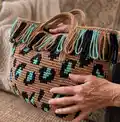
🧢 Beautiful ✨ Detailed πŸ’ Adorable

Leopard tote Pattern

Leopard tote Pattern
4.4β˜… Rating
12-15 Hours Time Needed
2.5K Made This
βœ‚οΈ

Intermediate Level

Ideal for those with basic crochet experience, featuring slightly more advanced stitches and techniques to expand your skills.

⏱️

Multi-Day Project

A rewarding 12+ hour journeyβ€”perfect for dedicated crafters who love detailed work.

✨

Stylish Touch

An elegant detail to elevate any look, combining traditional techniques with contemporary design sensibilities.

About This Leopard tote Pattern

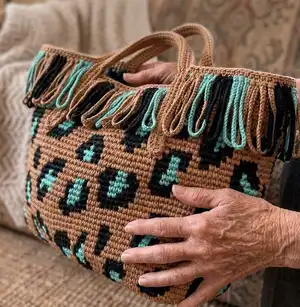
This pattern creates a leopard-print raffia tote worked around a leather base with a neat felt lining and full fringe. It uses jacquard colorwork in raffia yarn and includes detailed instructions for the base trim, body, fringe and finishing. The design is sturdy and decorative, perfect for gifting or everyday use.

Leopard tote Pattern crochet pattern - detailed view of completed project

Youll learn to work from a leather base, crochet with multiple raffia skeins for jacquard, attach fringe and sew a felt lining. Clear step-by-step photos and tips are included.

Why You'll Love This Leopard tote Pattern

I absolutely love this pattern because it turns simple raffia yarn into a fashion-forward tote with a professional finish. I enjoy the combination of textile techniques β€” crocheting, colorwork jacquard and simple sewing β€” that result in a very sturdy, wearable bag. The leopard print and fringe add personality while the leather base gives stability and structure. Making this tote feels rewarding at every step, from the neat base trim to the final sewn-in lining.

Leopard tote Pattern step 1 - construction progress Leopard tote Pattern step 2 - assembly progress Leopard tote Pattern step 3 - details and accessories Leopard tote Pattern step 4 - final assembly and finishing

Switch Things Up

I love how easy it is to customize this tote by simply changing colors β€” swap the leopard palette for monochrome tones or bright, playful hues to suit your wardrobe.

You can make the bag larger or smaller by adjusting the number of rows and stitches; add more rows for a taller tote or fewer rows for a compact clutch-sized bag.

I often try different fringe lengths and mixes of color when I make multiples; shorter fringe looks neater and longer fringe feels more boho-chic.

If you prefer a softer handle, replace the sewn-on leather straps with crocheted handles or wrap suede cord for a different feel and look.

For a softer interior, use cotton fabric for the lining instead of felt and add a zip pocket or magnetic snap for closure to increase functionality.

I also sometimes add a base stiffener or thin plastic canvas between the leather and felt if I want extra structure for heavy use.

Try mixing raffia with a thin cotton cord for some rows to change texture and make subtle stripe effects that work with the leopard print.

To simplify jacquard, you can paint small details with fabric paint instead of color-changing β€” it makes the process much faster and is great for beginners.

I recommend experimenting with hook sizes for the final edge trim: a slightly larger hook creates a looser trim while a smaller hook tightens the edge for a crisp finish.

If you want a handbag rather than a tote, add a zip closure and a lining pocket, or attach a clasp and a detachable shoulder strap for versatility.

Common Mistakes & How to Fix Them

βœ— Not straightening raffia before working can make the yarn bulky and uneven; always fluff or steam and straighten your raffia skeins before crocheting to get an even canvas. βœ— Pulling color-change floats too tightly will distort the jacquard and tighten the bag; crochet the last stitch before a color change with the next color and keep floats loose inside. βœ— Skipping stitch markers causes misaligned halves and pattern errors; place markers at the start of each half and mark key points like the 1st loops of halves. βœ— Failing to steam and shape the base and fringe leads to a floppy finish; steam the base after 10-12 rows and steam the fringe to shape it neatly. βœ— Not hiding or securing yarn ends weakens the finish and looks messy; hide ends under the first loop of the row, secure with knots and use PVA glue if needed. βœ— Allowing skeins to tangle during jacquard will cause knots and tension issues; arrange skeins in order, keep them separated and untwist threads as needed while working.

Leopard tote Pattern

Make a stylish raffia leopard tote that combines bold print, sturdy construction and playful fringe. This pattern guides you through attaching a leather bottom, crocheting a jacquard canvas in raffia, adding fringe and sewing a felt lining so your bag looks professional. Youll enjoy step-by-step photos and clear instructions to create a durable, eye-catching everyday tote.

Intermediate 12-15 Hours

Materials Needed for Leopard tote Pattern

β€” Main Fabric

  • 01
    Raffia yarn, 3 colors, approximately 225 yards (200 m) each (example yarn: Ispie). Colors used: Autumn (main), Black, Salt Lake (green accent)
  • 02
    Leather bottom 12 x 4 inches (30 x 10 cm) with 60 holes
  • 03
    Felt for the lining, 2 mm thick (strip approx. 9 inches x 36 inches / 23 x 90 cm and bottom piece)
  • 04
    Fringe: 160 pieces, 8 inches (20 cm) long (approx. 80 main/ 60 green/ 20 black pieces)

β€” Tools Required

  • 01
    Crochet hook size 3 mm
  • 02
    Optional 4-4.5 mm hook for edge/tension adjustment
  • 03
    Leather bottom 12*4 inches (30*10 cm) with 60 holes
  • 04
    Sewing handles (75*1.5 cm)
  • 05
    Plastic needle with large eyelet
  • 06
    Sewing thread and needle
  • 07
    Pins for assembly
  • 08
    2 stitch markers
  • 09
    Scissors
  • 10
    PVA glue
  • 11
    Iron for steaming and shaping
  • 12
    Measuring tape or ruler

Progress Tracker

0% Complete

β€” Base trim of the bottom :

Info :

Leave the end about 8 inches (20 cm) long to close the rows of the base trim.

Info :

Crochet around the bottom edge as shown in the picture.

Round 1 :

Insert the hook in the side hole in the middle, pull the loop.

Round 2 :

Make CH, crochet 2 SC in the same hole.

Round 3 :

Next crochet 3 SC in each hole along the side part.

Round 4 :

Crochet 3 SC in 1 in the corner.

Round 5 :

Crochet 3 SC in 1, 2 SC in 1 along the long side of the bottom, repeat to the corner.

Round 6 :

Crochet 3 SC in 1 in the 2nd corner.

Round 7 :

Crochet 3 SC in each hole along the 2nd side part.

Round 8 :

Crochet 3 SC in 1 in the 3rd corner.

Round 9 :

Crochet 3 SC in 1, 2 SC in 1 along the 2nd long side of the bottom, repeat to the corner.

Round 10 :

Crochet 3 SC in 1 in the 4th corner.

Round 11 :

Crochet 3 SC in 1 in the hole, which are left on the 1st side part.

Round 12 :

Crochet the last SC with the end. Pull out the end. Pull the end under the 1st loop of the row. Pull back to the wrong side.

Info :

There are 160 loops now.

Round 13 :

Pull the working loop, crochet SlSt in each hole.

Round 14 :

Crochet the last SlSt with the end. Pull out the end. Pull the end under the 1st loop of the row. Pull back to the wrong side.

Info :

Cut the thread, tie the knot. Hide the ends.

β€” Crochet the base part :

1 row :

Take 3 skeins of the raffia yarn. Place it so that the thread unwinds counterclockwise.

Info :

Take the thread of the base color. Insert the hook in the middle loop on the side part of the bottom on the back loop and the jumper only.

Info :

Pull the loop. Take 2 more thread of 2 different colors, put on along the row, crochet CH.

1 row continued :

Crochet row with SC on the back loop and the jumper only. Crochet the leopard print following to the pattern provided in the attachment.

Info :

When crocheting jacquard, crochet the last stitch before the color change with the next color. Do not pull the threads tightly inside to avoid tightening the canvas.

Info :

Pattern consists of 80 loops, that is, we crochet 2 halves with the same pattern (=160).

Info :

Place the markers in the 1st loops of the halves of the row.

Info :

Always pull the working loop to the level of the hook by 15-17 mm to make the canvas even and tight. After crocheting, pull the loop back.

Info :

Crochet the last SC in the 1st loop of the row.

Info :

Next crochet a spiral.

2 row :

Crochet 80+80 SC following to the pattern (=160).

3 row :

Crochet 80+80 SC following to the pattern (=160).

4 row :

Crochet 80+80 SC following to the pattern (=160).

Info :

Now hide the ends at the beginning of crocheting, and cut off the excess.

5 row :

Crochet 80+80 SC following to the pattern (=160).

6-30 rows :

Crochet 80+80 SC following to the pattern (=160).

Info :

Steam the base of the bag with an iron after crocheting 10-12 rows.

Info :

You can crochet more rows in height following to the pattern as desired.

Info :

In the last row, before 2 SC to the marker, cut off additional threads, leaving only the main thread. Crochet 2 SC with a gradual decrease in the height of the SC.

Info :

Remove the markers.

β€” Base trim :

Info :

Crochet SlSt in each SC of the last row. Pull the loop by 4-5 mm, so as not to tighten the edge. You can take a 4-4.5 mm hook.

Info :

Cut the thread, pull out the end. Pull the end under the 1st SlSt of the row. Pull back to the wrong side. Strengthen and hide the end on the wrong side. Steam the base of the bag with an iron.

β€” Fringe :

Info :

Cut 160 pieces of fringe 8 inches (20 cm) long, of the main, green and black colors (approximately 80/ 60/ 20, respectively).

Fringe (P1) :

Insert the hook from the wrong side under the braid and the loop of the base trim, grab the middle of the fringe, pull it out and pull the ends in the loop. Tighten the loop.

Fringe (P2) :

Make the fringe in each loop of the edge (160 pieces). Choose the color of the fringe, which is the color of the braid of the last row.

Info :

Steam the fringe with an iron, shape with hands. Cut off the excess.

β€” Sew on the handles :

Step 1 :

Count 6 holes from the corners of the bottom. Put markers on the edge of the bag opposite the sixth holes.

Step 2 :

Put the handles near the markers.

Step 3 :

Sew on the handles with the plastic needle. Make a few stitches.

Step 4 :

Tie the knot and hide the ends. You can fix it with PVA glue.

β€” Lining :

Step 1 :

Take felt 2 mm thick for the lining. Cut the bottom according to the shape and size of the leather bottom without seam allowances. Make 4 notches on the bottom.

Step 2 :

Measure the perimeter of the edge of the bag (in my example, 36 inches (90 cm)).

Step 3 :

Measure the height of the bag (in my example, 9 inches (23 cm)).

Step 4 :

Cut a stripe from felt 9 inches (23 cm) high and 36 inches (90 cm) long.

Step 5 :

Sweep the stripe in a circle along the side seam.

Step 6 :

Make 4 notches.

Step 7 :

Match the notches of the bottom and the stripe, pin with a pins.

Step 8 :

Sweep both parts.

Step 9 :

Make 10 mm tucks at the corners.

Step 10 :

Sew the lining.

Info :

At this stage, you can give it to the atelier.

β€” Sew in the lining :

Step 1 :

Put in the lining in the bag. Pin with a pins.

Step 2 :

Sew neat stitches through one SC. Make a several fixing stitches along the seam. Strengthen and hide the end of the thread.

Info :

Congratulations! Your cute tote with trends print is ready πŸ‘

Assembly Instructions

  • Attach the leather bottom by crocheting around its holes and forming the base trim; finish the trim and ensure there are 160 loops before continuing with the body.
  • Position and sew the handles: count 6 holes from each corner, mark the spots on the canvas, place the handles near the markers and sew with a plastic needle; tie knots, hide ends and fix with PVA glue if desired.
  • Make and attach fringe: cut 160 fringe pieces (8 inches/20 cm), insert each into the loop along the edge from the wrong side and tighten the loop, then steam and shape the fringe.
  • Insert felt lining: cut felt bottom to leather shape, cut a felt stripe for the side (height x perimeter), match notches and sew the lining into the bag with neat hand stitches through one SC; secure ends and hide thread.

Important Notes

  • πŸ’‘Always straighten raffia yarn before working; fluff by hand or steam with an iron depending on the brand.
  • πŸ’‘Use stitch markers to identify the halves and starting loops to maintain the jacquard pattern alignment through the rows.
  • πŸ’‘Steam the base after 10-12 rows to stabilize the shape and steam/shape the fringe for a professional finish.
  • πŸ’‘When changing skeins, glue or lightly wrap joined ends with PVA and hide the ends to prevent unraveling.

This raffia Leopard Tote pattern guides you from the leather base to the fringed finishing touches, creating a statement bag with durable structure. With clear photos and helpful tips, youll finish a polished, wearable tote that turns heads. Share your finished piece or gift it β€” it makes a gorgeous handmade present. πŸ‘œβœ¨

You ask,

we answer.

FAQs

What size will the finished piece be?

The finished bag in the example measures approximately 18 inches (45 cm) in length and about 9.5 inches (24 cm) in height without fringe, using the specified materials.

Can I use different yarn weights for this pattern?

This pattern is designed for raffia yarn; using a different yarn weight will change the canvas density and final size. If you change yarn weight, adjust the hook and expect a different finished dimension.

Do I need prior crochet experience for this pattern?

This pattern is rated intermediate and assumes familiarity with single crochet, slip stitch, working in the back loop, jacquard color changes, and basic finishing and sewing skills.

How long does this project typically take to complete?

Most crafters will complete this tote in 12-15 hours over multiple sessions, depending on speed, jacquard experience and time spent on finishing like lining and handles.