🧢 Beautiful ✨ Detailed πŸ’ Adorable

Garden Path Throw Pattern

Garden Path Throw Pattern
4.4β˜… Rating
12-15 Hours Time Needed
2.3K Made This
βœ‚οΈ

Intermediate Level

Ideal for those with basic crochet experience, featuring slightly more advanced stitches and techniques to expand your skills.

⏱️

Multi-Day Project

A rewarding 12+ hour journeyβ€”perfect for dedicated crafters who love detailed work.

πŸ€—

Soft Hug

Gentle, plush, and full of warmth, creating a sense of comfort and coziness wherever they find a home.

About This Garden Path Throw Pattern

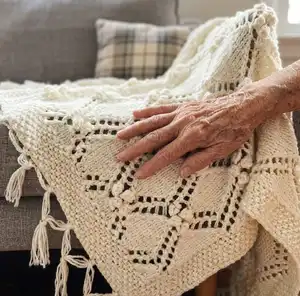
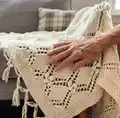
This pattern creates a 46x46" throw with decorative staggered eyelet-diamonds separated by charming little bobbles. The design is worked flat in a seed stitch border with a repeated lace-and-bobble panel, and finished with a feminine knotted fringe. Techniques used include simple lace, centered double decreases, bobble-making, and working from a chart or written row instructions.

Garden Path Throw Pattern crochet pattern - detailed view of completed project

The pattern includes both charted and written instructions for the lace motif, full finishing notes, and a step-by-step fringe tutorial. Worked in bulky superwash merino, it blocks to a soft, open fabric perfect for home decor.

Why You'll Love This Garden Path Throw Pattern

I absolutely love this pattern because the combination of airy lace diamonds and tactile bobbles gives the throw so much character and charm. The stitch pattern is surprisingly easy to memorize once you work a repeat or two, making it relaxing to knit while still interesting. I enjoy how the seed stitch borders frame the lace and give the piece a handcrafted, polished edge. Blocking and adding the fringe is one of my favorite finishing steps β€” it transforms the piece into something that looks intentional and luxurious. This throw is both decorative and cozy, and I love gifting versions of it in soft neutrals.

Garden Path Throw Pattern step 1 - construction progress Garden Path Throw Pattern step 2 - assembly progress Garden Path Throw Pattern step 3 - details and accessories Garden Path Throw Pattern step 4 - final assembly and finishing

Switch Things Up

I love how versatile this pattern is for customization; you can swap the main color for a bold shade to make the diamond lace pop, or use a soft pastel for a gentler look.

To make a bigger or smaller throw, adjust the number of chart repeats across the width and add or subtract seed-stitch border stitches accordingly.

I often experiment with texture by substituting the seed stitch border with garter stitch for extra squish and structure at the edges.

Want a lighter version? Use a sport or DK weight yarn and smaller needles to create a finer, more delicate throw; just be mindful that bobble size will change.

If you like dramatic bobbles, work the bobble rows with a contrasting color and carry the tail up the wrong side or weave it in carefully for color pops.

I sometimes add a second-colored slipped stitch row between diamond repeats to create subtle striping without breaking the lace pattern.

Embellish your fringe by adding tiny beads or a metallic strand twisted with the yarn before knotting to give a shimmer effect.

Make a set by knitting one large throw and a matching cushion using a single chart repeat centered on a square pillow front.

For a luxury finish, knit in a wool-silk bulky blend; the added sheen and drape change how the diamonds and bobbles lie beautifully.

I recommend swatching the bobble sequence to practice shaping and tension before working the main piece; it saves time and ensures consistent bobbles across the throw.

Common Mistakes & How to Fix Them

βœ— Skipping stitch markers between seed stitch and lace panels can cause uneven separations; place markers to clearly mark panel boundaries before starting lace repeats. βœ— Wrapping the fringe strands too tightly will make fringe too short and stiff; wrap yarn loosely around the blocking mat and leave a little extra length for trimming. βœ— Not counting lace pattern repeats carefully may shift diamond placement; count repeats across the row and verify chart repeat boundaries regularly. βœ— Forgetting to twist and shape bobbles after blocking can make them lie flat; gently twist and shape each bobble while wet or after blocking so they sit proudly on the right side. βœ— Working with inconsistent tension across bulky yarn can distort diamond shapes; maintain even tension and check gauge periodically to keep diamonds square.

Garden Path Throw Pattern

Create a light, elegant throw with open lace diamonds and adorable bobble details. This Garden Path Throw blends texture and airy lace for a cozy but decorative blanket that dresses any sofa or bed. The pattern includes full written instructions, a chart, and detailed finishing and fringe steps to help you complete a beautiful heirloom-quality piece.

Intermediate 12-15 Hours

Materials Needed for Garden Path Throw Pattern

β€” Main Fabric

  • 01
    Knit Picks Bare Swish Bulky (100% Superwash Merino Wool), 137 yards/100 g: Natural 24389, 9 hanks (main color).

β€” Tools Required

  • 01
    US 11 (8mm) 40" or longer circular needles (or size to obtain gauge)
  • 02
    Size I (5.5mm) crochet hook, for attaching fringe
  • 03
    Yarn needle for weaving in ends
  • 04
    Stitch markers (optional)
  • 05
    12" blocking mat or picture frame for wrapping fringe strands
  • 06
    Scissors

Progress Tracker

0% Complete

β€” Notes :

Info :

This pretty throw is knit up in a simple and easy to memorize stitch pattern.

Info :

Sweet little bobbles are made on both right and wrong sides of the throw and separate the staggered eyelet-diamonds.

Info :

The open lace pattern creates a lightweight yet warm accessory for your home.

Info :

A feminine fringe decorates the top and bottom edges.

Info :

Read RS chart rows from right to left, and WS rows from left to right. Work the red-outlined pattern repeat 6 times.

Info :

Stitch markers may be placed if desired, for separating seed stitch sections from lace pattern.

β€” Seed Stitch :

Info :

Seed Stitch (worked over an odd number of sts). All Rows: (K1, P1) to last st, K1.

β€” CDD :

Info :

CDD: Sl 2 sts K-wise, K next st, pass 2 slipped sts over K st. 2 sts dec.

β€” Make Bobble (MB) :

Info :

Make Bobble (MB). RS Row: (K1, YO, K1, YO, K1) in the same st, drop all sts from LH needle, turn, K5, turn, K5, pass second st on RH needle over first st 4 times. 1 st left on RH needle. Place this st P-wise back onto LH needle and knit it. Bobble is now on RH needle and completed.

Info :

WS Row: (P1, YO, P1, YO, P1) in the same st, drop all sts from LH needle, turn, P5, turn, P5, pass second st on RH needle over first st 4 times. 1 st left on RH needle. Place this st P-wise back onto LH needle and purl it. Bobble is now on RH needle and completed.

β€” Directions :

Info :

Loosely CO 127 sts.

Row 1-11 :

Work Seed Stitch for 11 rows.

Row 12-155 :

Work Rows 1-24 of the chart or written instructions six times.

Rows 156-172 :

Work Rows 1-17 of the chart or written instructions once.

Rows 173-183 :

Work Seed Stitch for 11 rows, finishing with a WS row.

Final Row (RS) :

BO K-wise, loosely.

β€” Written Instructions for Chart :

Row 1 (RS) :

(K1, P1) x 3, K4, (K2tog, YO) x 2, K1, *K2, (YO, SSK) x 2, K4; rep from * a total of 6 times, K2, (YO, SSK) x 2, K2, (P1, K1) x 3.

Row 2 (WS) :

(K1, P1) x 3, K1, P to last 7 sts, (K1, P1) x 3.

Row 3 :

(K1, P1) x 3, K3, (K2tog, YO) x 2, K2, *K3, (YO, SSK) x 2, K3; rep from * a total of 6 times, K3, (YO, SSK) x 2, K3, (P1, K1) x 3.

Row 4 (WS) :

(K1, P1) x 3, K1, P to last 7 sts, (K1, P1) x 3.

Row 5 :

(K1, P1) x 3, K2, (K2tog, YO) x 2, K3, *K4, (YO, SSK) x 2, K2; rep from * a total of 6 times, K4, (YO, SSK) x 2, K2, (P1, K1) x 3.

Row 6 (WS) :

(K1, P1) x 3, K1, P to last 7 sts, (K1, P1) x 3.

Row 7 :

(K1, P1) x 3, K1, (K2tog, YO) x 2, K4, *K5, (YO, SSK) x 2, K1, CDD, YO, K2tog, YO, K4; rep from * a total of 6 times, K5, (YO, SSK) x 2, K1, MB, K1, YO, SSK, K4, (P1, K1) x 3.

Row 8 (WS) :

(K1, P1) x 3, K1, P to last 7 sts, (K1, P1) x 3.

Row 9 :

(K1, P1) x 3, K1, (YO, SSK) x 2, K4, *K5, (K2tog, YO) x 2, MB, K1, MB, P1, MB, P1; rep from * a total of 6 times, P8, (K1, P1) x 3, K1.

Row 10 :

(K1, P1) x 3, K1, P9, *P6, MB, P1, MB, P7; rep from * a total of 6 times, P8, (K1, P1) x 3, K1.

Row 11 :

(K1, P1) x 3, K1, P3, K2, (YO, SSK) x 2, K3, *K4, (K2tog, YO) x 2, MB, (K2tog, YO) x 2, K2; rep from * a total of 6 times, K3, (YO, SSK) x 2, K4, (P1, K1) x 3.

Row 12 :

(K1, P1) x 3, K3, K2, (P1, K1) x 3.

Row 13 :

(K1, P1) x 3, K3, (YO, SSK) x 2, K2, K3, (K2tog, YO) x 2, K2; rep from * a total of 6 times, K3, (YO, SSK) x 2, K3, (P1, K1) x 3.

Row 14 :

Repeat Row 2.

Row 15 :

(K1, P1) x 3, K4, (YO, SSK) x 2, K1, *K2, (K2tog, YO) x 2, K5; (YO, SSK) x 2, K1; rep from * a total of 6 times, K2, (K2tog, YO) x 2, K4, (P1, K1) x 3.

Row 16 :

(K1, P1) x 3, K3, K6, YO, SSK, YO, CDD, YO, K2tog, YO, K9, YO, SSK, YO; rep from * a total of 6 times, CDD, YO, K2tog, YO, K6, (P1, K1) x 3.

Row 17 :

(K1, P1) x 3, K3, K6, K2tog, YO, K1, MB, P1, MB, P1, MB, P1, MB, P1, *MB, P1, MB, P1; rep from * a total of 6 times, MB, P1, MB, P1, (K1, P1) x 3.

Row 18 :

Repeat Row 2.

Row 19 :

(K1, P1) x 3, K3, K6, YO, SSK, YO, *CDD, YO, K2tog, YO, K9; rep from * a total of 6 times, CDD, YO, K2tog, YO, K6, (P1, K1) x 3.

Row 20 :

Repeat Row 2.

Row 21 :

(K1, P1) x 3, K3, K6, K2tog, YO, K1, *MB, K1, YO, SSK, K9; rep from * a total of 6 times, MB, K1, YO, SSK, K6, (P1, K1) x 3.

Row 22 :

(K1, P1) x 3, K1, P7, MB, P1, MB, P13, MB, P1; rep from * a total of 6 times, MB, P7, (K1, P1) x 3, K1.

Row 23 :

(K1, P1) x 3, K5, (K2tog, YO) x 2, *MB, (YO, SSK) x 2, K7, (K2tog, YO) x 2; rep from * a total of 6 times, MB, (YO, SSK) x 2, K5, (P1, K1) x 3.

Row 24 :

Rep Row 2.

Info :

Rows 12, 14, 16, 18, 20: Repeat Row 2.

Info :

Work Row 1-24 as written above for the chart repeat, continuing as directed in Directions section.

β€” Finishing :

Info :

Weave in ends, wash and block to Finished Measurements, twisting and shaping all bobbles so that they appear on the right side of the throw.

β€” Fringe :

Info :

Wrap yarn loosely around a 12" blocking mat or 12" picture frame 64 times. Wrap a few extra more times to be sure you have enough strands. Note: Do not wrap your yarn too tightly or your fringe will be too short. Cut yarn. Cut across the bottom of all the strands. You will have 64 strands of yarn, each measuring 24" long.

Info :

Repeat this once more, so that you have a total of 128 strands of yarn. Gather 4 strands of yarn for each group of edge fringe. There will be 16 groups along the bottom and 16 along the top. Gather 2 strands of yarn for each group of corner fringe. There will be 4 groups total, 2 for top 2 corners, 2 for bottom 2 corners.

Info :

Using crochet hook, insert the hook from back to front, through CO or BO row, fold the group of strands in half and pull through the throw to the back. Insert thumb and index finger through the center of the loop just made, grab the doubled strands and pull through the loop. Pull tightly to make a knot and secure strands.

Info :

Place all 32 groups of fringe all along the top and bottom edges. Each group should be centered in the middle of a diamond shape, with the 4 corner groups being attached at the first or last cast on/bind off st of the row. All corner fringe will now have 4 strands hanging below the knot. All edging fringe will have 8 strands.

Info :

After all 32 groupings of fringe have been knotted onto throw, beginning at the bottom left of the throw, grab all 4 strands of the corner fringe and knot it together with half (4 strands) of the 8 strands of fringe to the right. Then, grab the other half (4 strands) of this fringe group and knot it together with 4 strands from the next fringe group to the right. Repeat this all the way to the right end of the throw, finishing by knotting half of the last edge fringe group (4 strands) together with all 4 strands of the corner fringe group (4 strands) together with all 4 strands of the corner fringe.

Info :

Use scissors to make ends of fringe the same length, about 2". Rep on opposite edge of throw.

Assembly Instructions

  • Weave in all ends securely and block the throw to the finished measurements, shaping and twisting bobbles so they sit on the right side of the fabric.
  • Attach fringe along the top and bottom edges only: place 16 groups across the top and 16 across the bottom, centered in the diamond shapes and attached at the CO or BO rows.
  • For each edge fringe group, fold 4 strands in half, insert hook from back to front through edge stitch, pull loop through, then pull doubled strands through the loop and tighten to form a knot.
  • For corner fringe groups, use groups of 2 doubled strands (4 strands total) and then knot adjacent groups together as directed to create continuous decorative knots at each edge.
  • After knotting all fringe groups, trim all fringe ends evenly to approximately 2" in length and repeat the same fringe placement on the opposite edge of the throw.

Important Notes

  • πŸ’‘Use stitch markers to separate seed stitch border from lace panels to keep pattern alignment accurate across long rows.
  • πŸ’‘Block the throw after finishing to open up the lace diamonds and set the bobbles so they show on the right side.
  • πŸ’‘Wrap fringe strands loosely when preparing them for attachment; wrapping too tight will shorten the finished fringe.

This Garden Path Throw is a cozy and elegant addition to any home, blending airy lace diamonds with tactile bobbles for a beautiful textured finish. The bulky merino yarn creates a plush drape and the knotted fringe adds a feminine, handcrafted touch you will love. Make one for your home or as a thoughtful handmade gift β€” it will be treasured for years. 🧢🏑

You ask,

we answer.

FAQs

What size will the finished piece be?

The finished throw measures approximately 46 x 46 inches, not including fringe.

Can I use a different yarn weight for this pattern?

Yes, but changing yarn weight will affect finished size and drape; choose a suitable needle to obtain gauge and expect size adjustments.

Do I need prior experience for this pattern?

This pattern is rated intermediate and uses lace techniques, centered double decreases, and bobbles; basic knitting and chart-reading skills are recommended.

How long does this project typically take to complete?

Most knitters will spend about 12-15 hours, though time can vary based on experience and how many times the lace repeat is worked.

How many fringe strands do I need and how are they grouped?

Prepare 128 individual strands by wrapping yarn twice around a 12" frame (64 each time). Group into 32 groups: 16 along bottom, 16 along top; edge groups use 4-strand groups, corners use 4 strands arranged as two doubled groups.

How should I care for the finished throw?

Follow yarn care instructions for superwash merino; gentle wash and block flat to maintain shape and bobble texture. Handle fringe gently when washing.