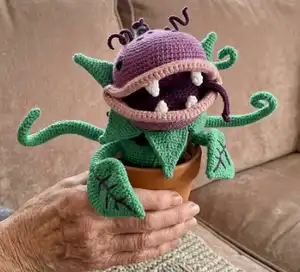
Make a mischievous, pocket-sized peckish plant with this full crochet pattern. You will crochet a cuddly plant head, mouth, petals, leaves and pot with clear step-by-step rounds and photos. The design includes wire-stiffened vines and pipe-cleaner details for poseable fun — perfect as a quirky gift or shelf friend. Follow the detailed instructions to assemble every piece and finish with embroidered veins and wispy hair.
Progress Tracker
0% Complete
— Cozy Plant Pot :
Info :
Make 1 in light brown.
Round 1 :
start 7sc in a magic ring [7]
Round 2 :
inc in all 7 sts [14]
Round 3 :
(1sc, inc in next st) repeat 7 times [21]
Round 4 :
(2sc, inc in next st) repeat 7 times [28]
Round 5 :
(3sc, inc in next st) repeat 7 times [35]
Round 6 :
(4sc, inc in next st) repeat 7 times [42]
Round 7 :
(5sc, inc in next st) repeat 7 times [49]
Round 8 :
(6sc, inc in next st) repeat 7 times [56]
Round 9 :
(7sc, inc in next st) repeat 7 times [63]
Round 10 :
(8sc, inc in next st) repeat 6 times, 9sc [69]
Round 11 :
working in BLO, slst in all 69 sts [69]
Round 12 :
working into the same back loops and over the slip stitches, sc in all 69 sts [69] This creates a more defined, firmer round at the base of the pot!
Round 13 - 17 :
sc in all 69 sts - 5 rounds
Round 18 :
(22sc, inc in next st) repeat 3 times [72]
Round 19 - 22 :
sc in all 72 sts - 4 rounds
Round 23 :
(23sc, inc in next st) repeat 3 times [75]
Round 24 - 27 :
sc in all 75 sts - 4 rounds
Round 28 :
(24sc, inc in next st) repeat 3 times [78]
Round 29 - 32 :
sc in all 78 sts - 4 rounds
Info :
Next round starts the lip of the pot.
Round 33 :
working in FLO, (12sc, inc in next st) repeat 6 times [84]
Round 34 - 45 :
sc in all 84 sts - 12 rounds
Round 46 :
(12sc, inv dec) repeat 6 times [78]
Info :
Fold over the last 13 rounds down to Rnd 33 to form the lip of the pot.
Round 47 :
working in both loops of current round and free back loops from left over from Rnd 33, slst in all 78 sts to close the lip [78]
Info :
Fasten off, weave in the ends.
— Inner Mouth :
Info :
Make 1 in purple. Ch13, start 2nd ch from hook, work in a round, along both sides of the chain.
Round 1 :
3sc in next ch, 10sc, 3sc in last ch, carry on along the other side of the chain, 10sc, skip last ch [26]
Round 2 :
(inc in next 3 st, 10sc) repeat 2 times [32]
Round 3 :
(inc in next st, 1sc) repeat 3 times, 10sc, (inc in next st, 1sc) repeat 3 times, 10sc [38]
Round 4 :
(2sc, inc in next st) repeat 3 times, 10sc, (2sc, inc in next st) repeat 3 times, 10sc [44]
Round 5 :
(inc in next st, 3sc) repeat 3 times, 10sc, (inc in next st, 3sc) repeat 3 times, 10sc [50]
Round 6 :
(4sc, inc in next st) repeat 3 times, 10sc, (4sc, inc in next st) repeat 3 times, 10sc [56]
Round 7 :
(inc in next st, 5sc) repeat 3 times, 10sc, (inc in next st, 5sc) repeat 3 times, 10sc [62]
Round 8 :
(6sc, inc in next st) repeat 3 times, 10sc, (6sc, inc in next st) repeat 3 times, 10sc [68]
Round 9 :
(inc in next st, 7sc) repeat 3 times, 10sc, (inc in next st, 7sc) repeat 3 times, 10sc [74]
Round 10 :
(8sc, inc in next st) repeat 3 times, 10sc, (8sc, inc in next st) repeat 3 times, 10sc [80]
Round 11 :
(inc in next st, 9sc) repeat 3 times, 10sc, (inc in next st, 9sc) repeat 3 times, 10sc [86]
Round 12 - 13 :
sc in all 86 sts - 2 rounds
Round 14 :
3slst, 33sc, 10slst, 33sc, 7slst [86]
Info :
Fasten off, weave in the end. Note: the slip stitches will sit in the corners of the mouth when joining the pieces.
— Top of the Head :
Round 1 :
start 6sc in a magic ring [6]
Round 2 :
inc in all 6 sts [12]
— Bottom of the Head + Joining the pieces :
Round 1 :
start 6sc in a magic ring [6]
Round 2 - 12 :
work the same way as Top of the Head.
Round 13 - 15 :
sc in all 72 sts - 3 rounds
Info :
Next join in the inner mouth to the bottom of the head. Pick up the Inner mouth and place it under the bottom of the head, wrong sides together, lining up the middle of the slip stitched section with the start of next round.
Info :
Start joining the 2 pieces in middle of the slip stitch section from Rnd 14 of the Inner Mouth, working through both layers.
Round 16 :
work 5sc along the head + slip stitches of the mouth, 33sc along head + mouth, 5sc along the head + slip stitches, next pick up the top half of the head so it rests over the remaining half of the inner mouth, work 5sc along the head + slip stitches, 33sc along head + mouth, 5sc along the head + slip stitches [86]
Info :
Fasten off and weave in the ends.
Info :
Now the head is joined together add in some safety eyes to the top half. Use the corners of the mouth as guides and add the eyes - count 5 sts away from the corner and 5 rounds up and place the eye there, poke a hole in the fabric with a knitting needle or a pencil first to make this easier.
— Lips :
Info :
Join pink yarn to the corner of the mouth.
Round 1 :
work in FLO, sc in all 86 sts [86]
Round 2 - 8 :
sc in all 86 sts - 7 rounds
Info :
Add a ring of wire or pipe cleaners, enclosing it in the tube with the next round. I like to double them up for strength.
Round 9 :
working in FLO + remaining free back loop of the mouth - sc in all 86 sts [86]
Info :
Fasten off and weave in the ends.
Info :
Add stuffing to the top and bottom half of the head, keeping the roof of the mouth flat.
Info :
With the top of the head towards you, join lilac to the corner of the remaining free stitches of two halves of the head, and close the gap with a row of single crochet, working the stitches through both layers.
— Top Fangs :
Info :
Make 2 or more in white.
Round 1 :
start 6sc in a magic ring [6]
Round 2 :
sc in all 6 sts [6]
Round 3 :
(inc in next st, 2sc) repeat 2 times [8]
Round 4 :
sc in all 8 sts [8]
Round 5 :
(inc in next st, 3sc) repeat 2 times [10]
Info :
Fasten off, leave a tail for sewing.
— Bottom Fangs :
Info :
Make 2 or more in white.
Round 1 :
start 6sc in a magic ring [6]
Round 2 :
sc in all 6 sts [6]
Round 3 :
(inc in next st, 2sc) repeat 2 times [8]
Info :
Fasten off, leave a tail for sewing.
Info :
Sew the fangs to the inside seam of the lips in your preferred spot. On the sample the top fangs are sitting further apart than the bottom ones.
Info :
Press the corners of the mouth up into a cheeky smile and move on to making the body!
— Stem Petals :
Round 1 :
start 6sc in a magic ring [6]
Round 2 - 3 :
sc in all 6 sts - 2 rounds
Round 4 :
(1sc, inc in next st) repeat 3 times [9]
Round 5 :
sc in all 9 sts [9]
Round 6 :
(2sc, inc in next st) repeat 3 times [12]
Round 7 :
sc in all 12 sts [12]
Round 8 :
(3sc, inc in next st) repeat 3 times [15]
Round 9 :
sc in all 15 sts [15]
Round 10 :
(4sc, inc in next st) repeat 3 times [18]
Round 11 :
sc in all 18 sts [18]
Round 12 :
(5sc, inc in next st) repeat 3 times [21]
Round 13 :
sc in all 21 sts [21]
Round 14 :
(6sc, inc in next st) repeat 3 times [24]
Round 15 :
sc in all 24 sts [24]
Round 16 :
do not stuff, fold the piece flat and work next sts through both layers, 12 sc [12]
Info :
Fasten off the first 5 petals. Do not fasten off the last petal, carry on to join them into the stem, trapping the leftover yarn tails as you work.
— Joining the Stem :
Info :
Carry on work from the 6th petal. Join all the petals together to make 1 round, make sure they are all facing right way up when joining, with the wrong side of Rnd 16 down.
Round 1 :
(bring next petal to the work, 12sc along the top) repeat 5 times, then work 12sc along the original (6th) petal [72]
Round 2 - 3 :
sc in all 72 sts - 2 rounds
Round 4 :
(5sc, inv dec, 5sc) repeat 6 times [66]
Round 5 - 6 :
sc in all 66 sts - 2 rounds
Round 7 :
(5sc, inv dec, 4sc) repeat 6 times [60]
Info :
Next group of rounds create a small bend in the stem. If you want the stem to point straight up instead of forward you can work Rnds 8 - 26 as single crochet rounds instead.
Round 8 :
30slst in back loops only (BLO), 30sc in both loops [60]
Round 9 :
30slst in BLO of the slip stitches, 30sc in both loops [60]
Round 10 :
30sc in free front loops (FLO) from both last 2 rounds, 30sc in both loops [60]
Round 11 :
30slst in BLO from Rnd 9 (behind the current round), 30sc in both loops [60]
Round 12 :
30slst in BLO of the slsts, 30sc in both loops [60]
Round 13 :
30sc in free stitches from Rnd 10, 30sc [60]
Info :
Notice how the stem now tilts forward a little!
Round 14 - 17 :
sc in all 60 sts - 4 rounds
Info :
Now lets add another bend.
Round 18 :
2sc, 26slst in BLO, 32sc in both loops [60]
Round 19 :
2sc, 26slst in BLO of the slsts, 32sc in both loops [60]
Round 20 :
2sc, 26sc in free FLO from last 2 rounds, then work in both loops: 2sc, inv dec, 12sc, inv dec, 12sc, inv dec [57]
Round 21 :
29sc, inv dec, 11sc, inv dec, 11sc, inv dec [54]
Round 22 - 26 :
sc in all 54 sts - 5 rounds
Round 27 :
slst in all 54 sts [54]
Info :
Fasten off and weave in the ends.
— Soil :
Info :
Join dark brown to any slip stitch from Rnd 27 of the stem.
Round 1 :
sc in all 54 sts [54]
Round 2 :
(8sc, inc in next st) repeat 6 times [60]
Round 3 :
(9sc, inc in next st) repeat 6 times [66]
Round 4 :
(5sc, inc in next st, 5sc) repeat 6 times [72]
Round 5 :
(inc in next st, 1sc) repeat 6 times [78]
Info :
Next round joins the soil to the pot. Fold back the brim of the pot so that the slip stitch round is easy to get to. Work the next round through both loops of the soil and Rnd 47 (the slip stitch round) of the pot, pulling the yarn from below the pots slip stitches.
Round 6 :
slst in all 78 sts [78]
Info :
Fasten off and weave in the ends.
— Twirly Vines :
Round 1 :
start 5sc in a magic ring [5]
Round 2 - 6 :
sc in all 5 sts - 5 rounds
Round 7 :
inc in next st, 4sc [6]
Round 8 - 12 :
sc in all 6 sts - 5 rounds
Round 13 :
inc in next st, 5sc [7]
Round 14 - 18 :
sc in all 7 sts - 5 rounds
Round 19 :
inc in next st, 6sc [8]
Round 20 - 24 :
sc in all 8 sts - 5 rounds
Round 25 :
inc in next st, 7sc [9]
Round 26 - 30 :
sc in all 9 sts - 5 rounds
Round 31 :
inc in next st, 8sc [10]
Round 32 - 36 :
sc in all 10 sts - 5 rounds
Round 37 :
inc in next st, 9sc [11]
Round 38 - 42 :
sc in all 11 sts - 5 rounds
Round 43 :
inc in next st, 10sc [12]
Round 44 - 55 :
sc in all 12 sts - 12 rounds
Info :
Fasten off, leave a tail for sewing.
— Grippy Leaves :
Round 1 :
start 6sc in a magic ring [6]
Round 2 :
sc in all 6 sts [6]
Round 3 :
(1sc, 3sc in next st, 1sc) repeat 2 times [10]
Round 4 :
sc in all 10 sts [10]
Round 5 :
(2sc, 3sc in next st, 2sc) repeat 2 times [14]
Round 6 :
sc in all 14 sts [14]
Round 7 :
(3sc, 3sc in next st, 3sc) repeat 2 times [18]
Round 8 :
sc in all 18 sts [18]
Round 9 :
(4sc, 3sc in next st, 4sc) repeat 2 times [22]
Round 10 :
sc in all 22 sts [22]
Round 11 :
(5sc, 3sc in next st, 5sc) repeat 2 times [26]
Round 12 :
sc in all 26 sts [26]
Round 13 :
(6sc, 3sc in next st, 6sc) repeat 2 times [30]
Round 14 :
sc in all 30 sts [30]
Round 15 :
(7sc, 3sc in next st, 7sc) repeat 2 times [34]
Round 16 :
sc in all 34 sts [34]
Round 17 :
(8sc, inc in next st, 8sc) repeat 2 times [36]
Round 18 - 20 :
sc in all 36 sts - 3 rounds
Round 21 :
(inv dec, 4sc) repeat 6 times [30]
Round 22 :
(3sc, inv dec) repeat 6 times [24]
Round 23 :
(inv dec, 2sc) repeat 6 times [18]
Round 24 :
(1sc, inv dec) repeat 6 times [12]
Round 25 :
sc in all 12 sts [12]
Round 26 :
inv dec, 10sc [11]
Round 27 :
inv dec, 9sc [10]
Round 28 - 32 :
sc in all 10 sts - 5 rounds
Round 33 :
inc in next st, 9sc [11]
Round 34 - 38 :
sc in all 11 sts - 5 rounds
Round 39 :
inc in next st, 10sc [12]
Round 40 :
sc in all 12 sts [12]
Info :
Fasten off, leave a tail for sewing. Press leaves flat. Add wire or pipe cleaners to the leaves and vines, doubling them up for strength.
— Protective Spikes :
Info :
Make as many as you fancy in purple yarn.
Instruction :
Ch4, start 2nd ch from hook. Row 1: 1slst, 1sc, 1hdc [3]
Info :
Fasten off, leave a tail for sewing.
— Wispy Hair :
Info :
Make as many as you fancy in purple yarn.
Instruction :
Row 1: Ch25 [25]
Info :
Fasten off, leave a tail for sewing. Wrap the wispy hair around a thick straw or a knitting needle, cover in PVA glue or starch and leave to dry overnight. When completely dry take the hair off the straw and trim one of the tail ends.
— Stingy Tongue :
Info :
Make 1 in purple yarn.
Instruction :
Ch26, start 2nd ch from hook, for neater edges work in third loop/back hump of the chains.
Row 1 :
1slst in next ch, 2sc, 2hdc, ch6, start 2nd ch from hook, slst in next ch, 2sc, 2hdc, now carry on along the main chain, 21dc [21+forked tip]
Info :
Fasten off, leave a tail for sewing.
— Assembly :
Info :
First we will add stuffing to the plant pot. To keep the base flat it helps to add in a circle of felt or thick card into the base before adding the stuffing.
Info :
Clarence is quite top-heavy, but sewing the vines to the back of the pot is enough to counter-balance the head. You could also add a balloon weight or weighted beads for extra stability.
Step 1 :
Cut a circle of felt, foam or card to fit the base of the pot.
Step 2 :
Place into the pot and then add in plenty of toy stuffing.
Step 3 :
Sew the Grippy Leaves to the sides of the body, either side of the bend - push the ends of the pipe cleaners into the body before sewing.
Step 4 :
Next secure the Twirly Vines to the soil behind the body, pushing the ends of the pipe cleaners into the soil.
Step 5 :
Spread the vines evenly around the back of the plant, you can twist together the leftover parts of the pipe cleaners inside the pot.
Step 6 :
Sew down each vine, then curl up the ends. Add stuffing to the body, leaving some space on the top for the head.
Step 7 :
Place the head into the neck opening, choosing the direction you would like it to look in. With a tail of lilac yarn sew the head into the neck, first going through each stitch of the back seam and the 3 back petals.
Step 8 :
Then go around the lower half of the head, stitching where the chin sits on the petals. Turn up the corners of the mouth into a cheeky smile. Sew the Protective Spikes randomly over the body - add as many as you like!
Step 9 :
Embroider spots with purple yarn on top of the head and embroider veins onto the leaves, going through both layers and doubling the thread for a bold line.
Step 10 :
Open the mouth again and sew the tongue to the inside of the mouth, letting it flop to the side. Next sew the wispy hair to the top of the head between the spots and arrange as you like. To help the back petals stand up catch each one with a tail of green yarn, securing it to the head.
This playful Clarence pattern makes a quirky, poseable amigurumi plant full of personality. It combines simple amigurumi techniques with clever internal supports for lasting shape and fun posing. Perfect for gifting or brightening your shelf with handmade mischief. 🧶🌿