🧢 Beautiful ✨ Detailed πŸ’ Adorable

Citrus Slice Coasters Pattern

Citrus Slice Coasters Pattern
4.5β˜… Rating
2-3 Hours Time Needed
2.0K Made This
βœ‚οΈ

Intermediate Level

Ideal for those with basic crochet experience, featuring slightly more advanced stitches and techniques to expand your skills.

⏱️

Bite-Sized Project

Finishes in 2-4 hoursβ€”perfect for an afternoon of creative relaxation.

🏑

Cozy Accent

A warm touch for your space that transforms ordinary corners into inviting nooks filled with handmade charm.

About This Citrus Slice Coasters Pattern

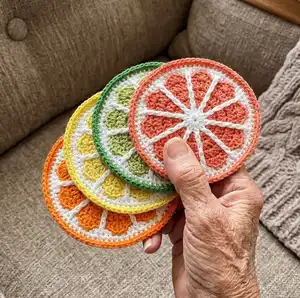
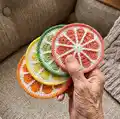
This pattern creates round citrus slice coasters worked in cotton yarn with a textured segment look and a neat outer edge. You will use front post stitches and worked-in-round construction to make vibrant coaster slices inspired by lemon, lime, orange, and grapefruit. The instructions include photos and detailed round-by-round steps to help you follow along.

Citrus Slice Coasters Pattern crochet pattern - detailed view of completed project

Each coaster measures about 11 cm (4.5") when using the recommended yarn and hook. The pattern uses Scheepjes Catona yarn and shows exact color suggestions for four fruit styles.

Why You'll Love This Citrus Slice Coasters Pattern

I absolutely love this pattern because it combines bright colorwork with simple shaping to create a cheerful and practical project. I enjoy how quickly each coaster works up β€” you can make several in an afternoon and customize the color combos to match your kitchen or gifts. The use of front post double crochet adds texture that really makes the 'segments' pop, which is one of my favorite details. Sharing these coasters with friends always sparks compliments and inspires people to try small, color-focused crochet projects.

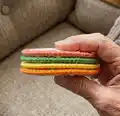
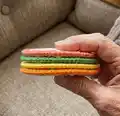
Citrus Slice Coasters Pattern step 1 - construction progress Citrus Slice Coasters Pattern step 2 - assembly progress Citrus Slice Coasters Pattern step 3 - details and accessories Citrus Slice Coasters Pattern step 4 - final assembly and finishing

Switch Things Up

I love customizing the color palette for these coasters, and I often swap the suggested shades for seasonal tones like pastels in spring or jewel tones in winter.

Try using a thicker cotton or a DK weight yarn with a larger hook to make larger, more absorbent trivets or placemats.

For mini versions, use thinner thread and a smaller hook to create keychain or ornament-sized citrus slices I give as little gifts.

I sometimes embroider a tiny seed detail in the center with contrasting embroidery thread to add personality to each slice.

Consider joining multiple slices with a simple slip stitch border to create a bright table runner or garland for parties.

I like adding a felt backing or a thin layer of cork glued to the back for extra protection and to prevent slipping on smooth surfaces.

Swap the white 'pith' color for a tonal version to create a subtler, modern coaster set for a minimalist kitchen.

Experiment with adding a small loop of chain and a button to hang a single coaster as a decorative piece when not in use.

Use variegated cotton for the segment color for a mottled, hand-dyed look that still keeps the raised white segments as a focal point.

I often mix yarn brands and blend textures β€” just check gauge and adjust hook size; changing stitch tension slightly will alter the finished diameter.

Common Mistakes & How to Fix Them

βœ— Changing color in the middle of the round instead of at the end causes loose loops and uneven joins; drop the old color and work the last slip stitch with the new color so the change is neat and all tails are on the WS. βœ— Working the front-post stitches in the wrong place flattens the segment texture and ruins the intended look; make sure to work FPdc around the stitch of the indicated round two rows below as instructed. βœ— Not placing or removing the stitch marker correctly can shift your marked stitch location; remove the marker only when working in the marked stitch and keep it when working around that marked stitch. βœ— Skipping counts when repeating segment groups leads to shape distortion and mismatched slices; count stitches after each round and follow the repeated sequence exactly the indicated number of times. βœ— Pulling yarn too tight while carrying colors can pucker the coaster edge; carry yarn loosely on WS and keep tension even so the coaster lays flat.

Citrus Slice Coasters Pattern

Make a set of bright, summery citrus slice coasters using cotton yarn and simple crochet techniques. This cheerful pattern guides you through each round with clear photos and step-by-step instructions so you can create colorful coasters for your home or as handmade gifts. Perfect for adding a pop of color to your table and practicing front post stitches and surface detail.

Intermediate 2-3 Hours

Materials Needed for Citrus Slice Coasters Pattern

β€” Main Fabric

  • 01
    Scheepjes Catona 50 (100% cotton, 125 m [137 yds]/50 g [1.8 oz]), color 106 Snow White - 1 skein for all coasters
  • 02
    Scheepjes Catona 10 (100% cotton, 25 m [27 yds]/10 g [0.35 oz]) - 1 skein of each color used for segments and outer edge
  • 03
    MC Lemon: 403 Lemonade (Catona 10) - main segment color for Lemon coaster
  • 04
    CC Lemon contrast: 280 Lemon (Catona 10) - contrast color for Lemon coaster edge
  • 05
    MC Lime: 392 Lime Juice (Catona 10) - main segment color for Lime coaster
  • 06
    CC Lime contrast: 412 Forest Green (Catona 10) - contrast color for Lime coaster edge
  • 07
    MC Orange: 208 Yellow Gold (Catona 10) - main segment color for Orange coaster
  • 08
    CC Orange contrast: 281 Tangerine (Catona 10) - contrast color for Orange coaster edge
  • 09
    MC Grapefruit: 252 Watermelon (Catona 10) - main segment color for Grapefruit coaster
  • 10
    CC Grapefruit contrast: 524 Apricot (Catona 10) - contrast color for Grapefruit coaster

β€” Tools Required

  • 01
    3 mm (US Size D/3) crochet hook
  • 02
    Stitch marker
  • 03
    Yarn needle
  • 04
    Scissors

Progress Tracker

0% Complete

β€” Pattern Notes :

Infos :

The color change is made at the end of the round: work as indicated until the end of the round, drop 1st color, work the last sl st with the 2nd color to join the round, continue the next round with the new color. Make sure all yarn tails and carries are on WS of work. From Round 4 to Round 9 the sts are worked in sts of the same color 2 rounds below. When working in sts of the same color 2 rounds below, always work in front of ch-sps of the previous round. Remove stitch maker when working in marked stitch, but do NOT remove if working around marked stitch.

β€” Stitches and Abbreviations :

Infos :

BLO: back loop only: insert hook only in back loop of indicated st. CC: contrasting color. ch: chain. ch-sp: chain space. dc: double crochet. FPdc: front post double crochet: yarn over and insert hook from front to back to front around post of previous row, yarn over and pull up loop, [yarn over and pull through 2 loops] 2 times. hdc: half double crochet. MC: main color. sl st: slip stitch. sc: single crochet.

β€” Instructions :

Info :

With White, ch 4, sl st to form a ring.

Round 1 :

Round 1 (White): Ch 3 (counts as dc), dc in ring, place marker in st just made, 9 dc in ring, sl st in 3rd ch of beginning ch-3 sp to join. (11 dc)

Round 2 :

Round 2 (White): Ch 1 (doesn't count), FPdc around st at base of ch-1, ch 2, [FPdc around next st, ch 2] 10 times, with MC sl st in first FPdc to join. (11 FPdc, 11 ch-2 sps)

Round 3 :

Round 3 (MC): Ch 1, working in front of ch-sps, 2 dc in marked st of Round 1, place marker in first dc just made, [ch 1, skip FPdc of Round 2, 2 dc in next st of Round 1] 10 times, with White sl st in the beginning ch-1 to join. (22 dc, 11 ch-1 sps)

Round 4 :

Round 4 (White): Ch 1 (doesn't count), FPdc around st of same color of Round 2 below, ch 3, skip 2 sts of Round 3, [FPdc around next st of Round 2, ch 3, skip 2 sts of Round 3] 10 times, with MC sl st in first FPdc to join. (11 FPdc, 11 ch-3 sps)

Round 5 :

Round 5 (MC): Ch 1, dc in marked st of Round 3, place marker in st just made, 2 dc in next dc of Round 3, [ch 1, skip FPdc of Round 4, dc in next dc of Round 3, 2 dc in next dc of Round 3] 10 times, with White sl st in the beginning ch-1 to join. (33 dc, 11 ch-1 sps)

Round 6 :

Round 6 (White): Ch 1 (doesn't count), FPdc around st of same color of Round 4 below, ch 4, skip 3 sts of Round 5 [FPdc around next st of Round 4, ch 4, skip 3 sts of Round 5] 10 times, with MC sl st in first FPdc to join. (11 FPdc, 11 ch-4 sps)

Round 7 :

Round 7 (MC): Ch 1, dc in marked st of Round 5, place marker in st just made, 2 dc in next dc of Round 5, dc in next dc of Round 5, [ch 1, skip FPdc of Round 6, dc in next dc of Round 5, 2 dc in next dc of Round 5, dc in next dc of Round 5] 10 times, with White sl st in the beginning ch-1 to join. (44 dc, 11 ch-1 sps)

Round 8 :

Round 8 (White): Ch 1 (doesn't count), FPdc around st of same color of Round 6 below, ch 5, skip 4 sts of Round 7, [FPdc around next st of Round 6, ch 5, skip 4 sts of Round 7] 10 times, with MC sl st in first FPdc to join. (11 FPdc, 11 ch-5 sps)

Round 9 :

Round 9 (MC): Ch 1, sc in marked st of Round 7, (hdc, dc) in next dc, (dc, hdc) in next dc, sc in next dc, [ch 1, skip FPdc of Round 8, sc in next dc of Round 7, (hdc, dc) in next dc, (dc, hdc) in next dc, sc in next dc] 10 times, with White sl st in the beginning ch-1 to join, fasten off MC. (22 sc, 22 hdc, 22 dc, 11 ch-1 sps)

Round 10 :

Round 10 (White): Ch 1 (doesn't count), [FPdc around st of same color of Round 8 below, BLO-dc in next st of Round 9, BLO-hdc in next st, BLO-sc in each next 2 sts, BLO-hdc in next st, BLO-dc in next st] 11 times, sl st in first FPdc to join. (11 FPdc, 22 BLO-dc, 22 BLO-hdc, 22 BLO-sc)

Round 11 :

Round 11 (White): Ch 1 (doesn't count), 2 sc in st at base of ch-1, sc in each next 10 sts, [2 sc in next st, sc in each next 10 sts] 6 times, sl st in first sc to join, fasten off White. (84 sc)

Round 12 :

Round 12 (CC): Join CC in any st of Round 11; ch 1 (doesn't count), 2 sc in st at base of ch-1, sc in each next 11 sts, [2 sc in next st, sc in each next 11 sts] 6 times, sl st in first sc to join, fasten off CC. (91 sc)

β€” Finishing :

Info :

Weave in yarn ends. Block to measurements.

Assembly Instructions

  • Weave in yarn ends securely using a yarn needle and trim tails close to the fabric.
  • Block each coaster to measurements (11 cm / 4.5") to flatten and set the stitches for an even finish.
  • Keep all yarn tails and carried yarn on the wrong side (WS) of the work when changing colors so the right side stays neat.
  • When working with the marked stitch, remove the stitch marker only if instructed to work in the marked stitch; keep the marker when working around that stitch.

Important Notes

  • πŸ’‘Use a stitch marker to mark the first stitch of rounds and to identify the marked stitch used for segment placement.
  • πŸ’‘Make color changes at the end of the round: drop the old color and complete the last slip stitch with the new color to join neatly.
  • πŸ’‘Work the FPdc stitches in the stitch of the round two rounds below as indicated to create the raised segment texture.
  • πŸ’‘Block your finished coasters to the measurements to ensure they lay flat and achieve the correct diameter.

These cheerful Citrus Slice Coasters brighten any table and make lovely small gifts for friends and family. 🌸 Each coaster is quick to make and pops with color when you use the suggested Scheepjes Catona shades. Customize your set with your favorite color combos, block them flat, and enjoy a sunny, handmade touch in your kitchen. 🍊🧢

You ask,

we answer.

FAQs

What size will the finished piece be?

The finished coaster measures approximately 11 cm (4.5") when using the recommended Scheepjes Catona yarn and a 3 mm hook.

Can I use different yarn weights for this pattern?

Yes, you can use different yarn weights but the finished size will change. Use an appropriate hook for your chosen yarn and be prepared to adjust gauge; heavier yarn will make a thicker, larger coaster.

Do I need prior crochet experience for this pattern?

This pattern is rated intermediate and uses FPdc (front post double crochet) and working in front of previous chain-spaces, so basic knowledge of stitches and working in the round is recommended.

How long does this project typically take to complete?

Most crocheters complete a single coaster in 2-3 hours including weaving in ends and blocking, though time may vary based on experience and customization.