🧢 Beautiful ✨ Detailed πŸ’ Adorable

Christmas Hoop Embroidery Pattern

Christmas Hoop Embroidery Pattern
4.2β˜… Rating
2-4 Hours Time Needed
3.7K Made This
βœ‚οΈ

Beginner Friendly Level

Perfect for those just starting their crochet journey, with clear instructions and simple techniques

⏱️

Bite-Sized Project

Finishes in 2-4 hoursβ€”perfect for an afternoon of creative relaxation.

πŸŽ„

Holiday Cheer

Festive fun for the season, bringing handmade magic to celebrations and creating new family traditions.

About This Christmas Hoop Embroidery Pattern

This pattern creates a seasonal Christmas hoop embroidery with holly leaves, woven wheel flowers, a candy cane, a bauble and a stocking. It combines basic embroidery stitches like satin stitch, backstitch, chain stitch, fishbone and woven wheel so you can make a textured, professional-looking piece. The PDF includes a printable transfer pattern and a clear color guide with DMC thread references for easy stitching.
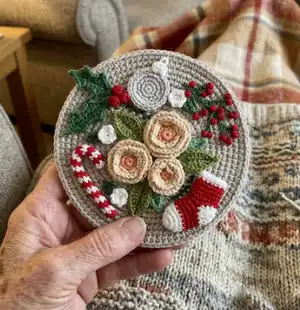
Christmas Hoop Embroidery Pattern crochet pattern - detailed view of completed project

Designed for beginners and all levels, the instructions are visual and descriptive for each stitch used. The project finishes nicely in a 15 cm hoop and makes a lovely holiday decoration or gift.

Why You'll Love This Christmas Hoop Embroidery Pattern

I absolutely love this pattern because it brings together simple stitches into a charming seasonal composition that looks far more detailed than it is. I enjoy how the woven wheel flowers add instant texture and personality to the design. I love that it uses familiar stitches so you can practice new techniques while producing a finished decoration. I feel proud seeing the piece framed in the hoop, and I think youll love gifting it or using it as a holiday accent.

Christmas Hoop Embroidery Pattern step 1 - construction progress Christmas Hoop Embroidery Pattern step 2 - assembly progress Christmas Hoop Embroidery Pattern step 3 - details and accessories Christmas Hoop Embroidery Pattern step 4 - final assembly and finishing

Switch Things Up

I love customizing this design by changing the color palette; try pale pastels for a soft winter look or jewel tones for a rich, festive piece.

I sometimes swap the 15 cm hoop for a smaller or larger hoop to create ornaments or statement pieces; adjust the pattern scale when resizing.

I often add beads or sequins to the bauble or berries to give them sparkle and dimension; small seed beads work well when sewn on after stitching.

I recommend trying metallic or variegated threads for accent stitches like backstitch stems or satin stitch highlights to make your embroidery pop.

I like to vary the flower centers by combining woven wheel stitches and a small French knot cluster to experiment with texture.

I sometimes mix linen and cotton fabrics to change the overall drape and lookβ€”linen gives a more rustic feel while cotton canvas looks smooth and modern.

I also create a set of matching ornaments by reducing the pattern and using thinner floss for tiny versions suitable for tree hangers.

I often embroider only selected motifs (holly and candy cane, for example) to make smaller projects or gift tags without completing the full composition.

I encourage you to experiment with different finishing techniques: frame under glass, back with printed felt, or sew into a small pillow to make your work functional.

I usually document my color choices and stitch order so I can reproduce or vary the design easily for gifts or seasonal sets.

Common Mistakes & How to Fix Them

βœ— Not transferring the pattern accurately can lead to misplaced motifs; use carbon paper, a window transfer method, or carefully trace the printable pattern to ensure the design sits correctly in your hoop. βœ— Pulling satin stitches too tight will pucker the fabric and distort shapes; keep tension even and allow stitches to sit flat without pulling the fabric together. βœ— Skipping stitch-order planning causes crowded areas and awkward overlaps; plan which elements to stitch first (typically large filled areas then small details) and work from center outward when possible. βœ— Using too many floss strands or inconsistent thread thickness changes the texture unexpectedly; use the recommended DMC thread count and keep strands consistent throughout the project. βœ— Neglecting to secure thread ends properly will cause knots to come undone later; always weave ends to the back and secure them with small stitches or knots hidden in the backing.
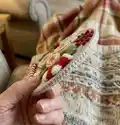
Christmas Hoop Embroidery Pattern

Create a festive Christmas hoop embroidery using simple stitches and clear step-by-step instructions. This pattern guides you through satin stitch, fishbone, woven wheel and French knot techniques to build a cheerful holiday motif. Perfect for hoop framing or gifting, the design includes flowers, holly, a candy cane and a stocking. Youll enjoy the printable transfer pattern and DMC color guide to make stitching quick and fun.

Beginner Friendly 2-4 Hours

Materials Needed for Christmas Hoop Embroidery Pattern

β€” Main Fabric

  • 01
    15 cm embroidery hoop (wood, plastic or bamboo) - 1 piece (recommended wooden hoop for natural aesthetic)
  • 02
    100% cotton embroidery threads (DMC recommended) - assorted colors (DMC 666, DMC BLANC, DMC 700, DMC 3841, DMC 353, DMC 352, DMC 954, DMC 702 where used) - small skeins of each color
  • 03
    Fabric: 100% cotton or linen canvas - enough to fit a 15 cm hoop (recommended two layers of cotton canvas for stability)
  • 04
    Felt or craft cardboard circle for finishing the back of the hoop - one circle sized to inner hoop
  • 05
    Carbon transfer paper - one sheet to transfer the printable pattern

β€” Tools Required

  • 01
    15 cm embroidery hoop (inner and outer hoop)
  • 02
    Embroidery needles (sharp embroidery needle sizes 7-10 recommended)
  • 03
    Scissors for handmade and thread snips
  • 04
    Marker or simple pen for transferring the pattern
  • 05
    Carbon paper for transferring the pattern to fabric
  • 06
    Pins to hold felt while finishing (optional)
  • 07
    A printed copy of the PDF pattern for transfer
  • 08
    Thimble (optional) and small ruler (optional)

Progress Tracker

0% Complete

β€” Materials :

Info :

1. 15 cm hoop. (You can choose wood, plastic or bamboo hoop) I prefer to use wooden hoop because its natural and aesthetic. 2. Needle for embroidery. 3. Threads. I recommend you to choose 100% cotton threads. For this hoop I use DMC threads (Attention! This is just my recommendation; you can use any available colors). 4. Fabric. I recommend you to choose natural fabrics 100 % Cotton or linen canvas. For this pattern I used cotton canvas. (I used two layers) 5. Marker or simple pen for transferring the pattern. 6. Felt or craft cardboard for finished the hoop. (I used to felt for my hoop.) But it's not obligatory. 7. Scissors for handmade. You can use any scissors that you have at home. 8. Carbon Paper for transfer pattern. 9. And finally you need my PDF pattern.

β€” Pattern for printing :

Info :

Pattern for printing: print the circular transfer pattern provided in the PDF and use it to trace the design onto your fabric; the pattern shows the complete layout inside the hoop including leaves, flowers, candy cane, bauble and stocking.

β€” Color and Stitch guide :

Infos :

Color and stitch guide labels used in the project include: Satin Stitch DMC 666. Satin Stitch DMC BLANC. Chain Stitch DMC 3841. Satin Stitch DMC 700. Back Stitch DMC 700. French Knot Stitch DMC BLANC. Woven wheel stitch DMC BLANC. Fishbone Stitch DMC 700. Satin Stitch DMC 666 for candy cane highlights. Woven wheel stitch DMC 353 for flower leaves. French knot stitch DMC 352 for small buds. Fishbone Stitch DMC 954 used for some leaf variations. Fishbone Stitch DMC 702 appears as a fishbone option in photos. These DMC references are suggestions to reproduce the photographed colorway.

β€” Stitch Tutorials :

1. Back Stitch :

Backstitch : The Backstitch is a simple stitch that can be used to create straight lines of any length or direction. Bring your needle up through the fabric. (1) Bring it down a small way behind this to create a small straight stitch (2). Bring your needle up with a gap ahead of the previous stitch taking it back down where the previous stitch started. Continue along the length of the line.

2. Satin Stitch :

Satin Stitch. The satin stitch is a filler stitch that can be used to create a smooth surface and add large areas of color to your embroidery. Bring your needle up through the fabric at a point on the outer edge of the shape you wish to fill (1). Insert the needle again at the point opposite the entry point on the other side of the shape (2). Repeat this stitch again, this time bringing your needle up beside the first stitch. Continue this repetition until the shape is filled.

3. Fishbone Stitch :

The fishbone stitch, made up of slanted diagonal stitches, is a filling stitch that is often used for making leaves or feathers. One of the most classic embroidery stitches. Up from the back to start (1). Down on the (2) opposite side to make a stitch. Up from the point (3) underside coming up next to the original starting point. Back down again (4) making another stitch and ready to continue in this fashion.

4. Chain Stitch :

1: Stitch up through the fabric where you want your chain to start – point A. 2: Stitch back down into the exact same hole you stitched up through. Do not pull your thread all the way through. 3: Stitch up at point B, making sure the needle goes through the loop. 4: Tighten the thread neatly, so that there’s no loose thread but so that the chain loop is still a loop. 5: Stitch down at point B, continuing the same stitch up and down through the same hole, catching each loop of thread process. The back of the work will be a line of straight stitches.

5. French Knot Stitch :

French knot Pull the needle up through the fabric. Wind the thread to make a knot. Wrap the thread around the needle two times and put the needle back at the same hole it just came through near. Pull gently to form a small knot on the surface. Practice on scrap fabric to control tension and size.

6. Woven wheel embroidery stitch :

Draw a circle and make 5 straight stitches evenly spaced out around the circle. Come up through the fabric just to the side of where the stitches meet in the center. Begin weaving your needle and thread under and over the spokes of the stitches until you have filled in the entire circle. To end the stitch, simply bring your thread to the back and secure it.

7. Woven wheel stitch + French Knot stitch for making flowers :

At first you need to print the scheme and transfer it to the fabric. You can do using carbon paper. Also you can transfer image using your window, smartphone or tablet. Just put the scheme onto your window and then put the fabric. It’ll be better if you fix it on the window with scotch tape. And then transfer the image with pen or pencil. And now you can start embroidery! Welcome to my embroidery world!

β€” How to Finish :

Info :

Youve finished your embroidery. 1. Cut a felt or craft cardboard circle according to the size of inner hoop. 2. Pin felt to gathered fabric. Overstitch the two fabrics together. Pass the needle through the gathered fabric. Then through the felt and back out. Bring the needle back to the top of the hoop. Leaving a small gap, pass the needle back through both layers of fabric. Bring the needle out. Repeat until the backing is secured and neat.

Assembly Instructions

  • Print and transfer the circular pattern to the fabric using carbon paper or the window transfer method, aligning the design to sit centered inside a 15 cm hoop.
  • Place the fabric tightly in the inner and outer hoop, tighten the hoop screws, and adjust fabric tension so the surface is smooth and drum-like before stitching.
  • Work larger filled elements first (satin stitch areas, woven wheel flowers), then add leaves with fishbone and small details such as berries with French knots and stems with backstitch.
  • When the embroidery is complete, cut a felt or craft cardboard circle to the inner hoop size, pin it to the gathered fabric at the back and overstitch both layers around the edge to finish neatly.
  • Weave and secure thread ends to the back as you go to prevent loose ends, and trim any excess fabric around the outside of the hoop if desired for a tidy presentation.

Important Notes

  • πŸ’‘Use carbon paper or the window transfer method to accurately transfer the printable pattern to your fabric before starting embroidery.
  • πŸ’‘Keep satin and woven wheel stitch tension even to avoid puckering; practice on scrap fabric if you are new to these stitches.
  • πŸ’‘Pin or tack your felt backing in place before overstitching to ensure a flat, professional finish and to protect the back of your stitches.
  • πŸ’‘Work in good light and use an embroidery hoop that keeps the fabric taut for clean stitch placement and consistent results.

This Christmas hoop embroidery pattern makes a beautiful seasonal accent or gift thats easy to personalize and quick to stitch. πŸŽ„ Use the printable pattern and DMC color guide to follow along or change colors to match your holiday decor. Enjoy the meditative process of stitching satin fills, woven wheel flowers and playful French knot berries β€” such a joyful little project! ✨

You ask,

we answer.

FAQs

What size will the finished piece be?

The finished embroidery fits a 15 cm (approximately 6 inch) hoop when you use the provided printable pattern and recommended fabric.

Can I use different thread brands or yarn weights for this pattern?

Yes, you can use different embroidery floss brands, but color and thickness may vary; DMC stranded cotton is recommended for the photographed results and consistent stitch coverage.

Do I need prior embroidery experience for this pattern?

This pattern is beginner friendly and includes clear instructions for the basic stitches used, but practicing satin, fishbone and woven wheel stitches on scrap fabric is helpful before stitching the final piece.

How long does this project typically take to complete?

Most stitchers complete this hoop in 2-4 hours depending on experience and how much detail they include; it makes a great afternoon project.