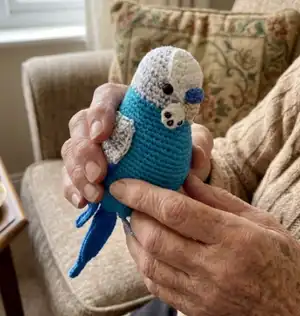
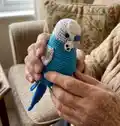
Make a charming hand-crocheted budgerigar toy with clear step-by-step instructions, photos and assembly notes. This pattern guides you through wire-framed legs and tail, wing feathers with wire cores, and detailed facial pieces for a realistic finish. You will learn winding, shaping and invisible closures to create a sturdy, display-ready bird. Perfect for makers who enjoy tiny details and mixed techniques.
Progress Tracker
0% Complete
— Leg - make two :
Info :
We make leg with toes on a wire frame.
Step 1 :
Cut 4 pieces of wire 8 cm (3 inch) long.
Step 2 :
On the tip of the wire, wind the yarn in a single layer 16 mm (0,6 inch) long, moisten it with PVA glue and fix the tip with a clip. Let it dry.
Step 3 :
We don't cut the thread from the fourth toe. Put your toes together and continue to wrap, forming a leg. The winding length is 3 cm (1,2 inch). It can also be impregnated with PVA glue.
Step 4 :
We make the limiter with a pair of turns with a textile band-aid at a height of 2 cm (0,8 inch) from the toes. The leg is ready.
Step 5 :
Repeat for the second leg.
Info :
We insert the wire foot into the amigurumi circle, but do not tighten it. Put the foot aside. Crochet the second same foot.
Round 1 :
6 sc in MC, we close the ring, but do not tighten it! We direct the tail from the ring inward, but do not crochet or shorten.
Round 4 :
(inc, 2 sc) * 2 = 8, to close the work invisibly without skipping the loop = 9 (cheat sheet)
— Head-body :
Info :
We start crocheting with white yarn with the addition of dark blue thin bobbin thread or yellow yarn with the addition of dark olive bobbin thread.
Round 1 :
ch 5, 3 sc, inc, 3 sc on the other side of the chain = 8
Round 2 :
(inc, 2 sc, inc) * 2 = 12
Round 3 :
(sc, inc) * 6 = 18
Round 4 :
(2 sc, inc) * 6 = 24
Round 5 :
(3 sc, inc) * 6 = 30
Round 9 :
(inc, 14 sc) * 2 = 32 + LO
Info :
Change the thread to green / blue.
Round 11 :
inc, 31 sc = 33
Round 12 :
inc, 32 sc = 34
Round 13 :
(inc, 16 sc) * 2 = 36 + LO
Round 14 :
(inc, 17 sc) * 2 = 38
Round 15 :
inc, 18 sc, inc, 17 sc, inc = 41
Round 16 :
(inc, 19 sc) * 2, inc = 44
Round 18 :
inc, 42 sc, inc = 46 + LO
Round 22 :
inc, 44 sc, inc = 48
Round 28 :
dec, 46 sc = 47
Round 29 :
dec, 45 sc = 46
Round 30 :
dec, 44 sc = 45
Round 31 :
dec, 41 sc, dec = 43
Round 32 :
3 sc, dec, 33 sc, dec, 3 sc = 41
Round 33 :
7 sc, dec, 23 sc, dec, 7 sc = 39
Info :
Partially fill the toy with fiberfill (photo 1).
Round 34 :
dec, sc, 5 join sc with thigh, 2 sc, dec, 15 sc, dec, 2 sc, 5 join sc with thigh, sc, dec = 32 (photo 2-3, scheme). Attention! The number of loops in a row does not match the arithmetic operations, since we crocheted 5 loops per thigh, and left 4 loops each.
Info :
Since the bird's body is partially stuffed and almost finished, we can determine the length of the legs in accordance with the proportions of the resulting figure (it depends heavily on the chosen yarn and knitting density). Measure the desired length of the leg and above this point, wrap a textile band-aid limiter in several layers. The thickness of the stopper should allow you to push it deep into the leg. Now you can pull the end of the thread and pull the amigurumi circle completely.
Action :
Twist the frame wires together, isolate the ends with a textile band-aid. Insert the frame into the bird's body. Carefully place the fiberfill so that the frame is not palpable. Press the legs to the chest so that they do not interfere with continuing crocheting.
Round 35 :
dec, 4 sc on the leg, 20 sc on the body, 4 sc on the leg, dec = 30
Round 36 :
7 sc, dec, 12 sc, dec, 7 sc = 28
Round 37 :
2 sc, dec, 20 sc, dec, 2 sc = 26
Round 38 :
5 sc, dec, 12 sc, dec, 5 sc = 24
Round 39 :
3 sc, dec, 14 sc, dec, 3 sc = 22
Round 40 :
sc, dec, 16 sc, dec, sc = 20
Round 41 :
sc, dec, sc, dec, 8 sc, dec, sc, dec, sc = 16 Fill the body with fiberfill.
Round 42 :
thru.dec, dec, 8 sc, dec, thru.dec = 12
Round 43 :
thru.dec, dec, 4 sc, dec, thru.dec = 8, fasten off, leaving a long thread for sewing the tail.
Info :
Fill the body with fiberfill finally. Bend the legs to a natural position. Bend toes - 2 forward and 2 back. Give the toes a curved shape with round pliers. Trim and file nails to prevent scratching.
— Wings :
Info :
Crochet yellow/white yarn with the addition of olive/dark blue fine bobbin thread.
Round 1 :
ch 6, inc, 3 sc, 3 sc in 1, 4 sc, sl st, ch, turn = 12 (photo 2)
Round 2 :
inc, 5 sc, inc, ch, turn = 9
Round 3 :
inc, 7 sc, inc, ch, turn = 11
Round 4 :
inc, 4 sc, 2 hdc, inc hdc, 2 dc, inc dc, turn = 14 (photo 3)
Round 5 :
inc dc, 2 dc, inc hdc, 2 hdc, 7 sc, 3 sc in 1, 11 sc, 2 sc, 2 sc, continue crocheting in the same direction.
Round 6 :
inc dc, 2 dc, inc hdc, 7 hdc, inc hdc, 3 hdc, sc, sl st, fasten off (photo 4). Cut the thread, leaving a tail for sewing. Crochet the second same wing.
— Feathers :
Info :
Wing feathers should be carefully starched or crocheted with carcass wire. Prefer to use 0.5 mm thick copper wire in the yarn winding. Wind thin wire tightly and wrap yarn over it so coils cover wire in one layer only.
Feather 1 :
ch 3, add wrapped wire, sc in the bend of the wire, 3 sc, sc in the same loop where the chain began, 2 sc on the base, turn.
Feather 2 :
skip 2, 3 sc, ch 3, sc in the band of the wire, 6 sc, sc in the same loop where the feather began, sc on the base, turn.
Feather 3 :
skip 1, 7 sc, ch 3, sc in the band of the wire, 10 sc, sc in the same loop where the feather began, 5 sc on the base, turn.
Feather 4 :
skip 1, 15 sc, 6 ch, sc in the band of the wire, 21 sc, sc in the same loop where the feather began, 3 sc on the base, sl st (photo 2), to close the work invisibly without skipping the loop (photo 3).
Info :
Repeat for the second wing in the same way, without mirroring anything (photo 4). The difference in the turning rows will not be noticeable. The edges of the base will be sewn to the body.
— Tail :
Info :
I also lay a frame wire with a winding in the tail so that I do not have to starch.
Feather 1 :
ch 25, 23 sc (photo 1-2), 3 sc in 1, 23 sc.
Feather 2 :
2 sc in the band of the wire, then crochet FLO: 15 sc, sc in the wire, turn, 15 sc; for both edges of the loop: inc.
Feather 3 :
inc, then crochet FLO: 15 sc, sc in the wire, turn, 15 sc, sc, sl st. Fasten the thread, hide the end of the thread inside the single crochets.
Info :
Bend the base of the tail with a corner, insert the tail into the remaining hole on the body. Sew on the tail with the end of the yarn left on the body.
— Forehead & cheeks :
Info :
Crochet yellow/white yarn in one thread.
Round 1 :
ch 6, 5 sc, ch, turn = 5
Round 2 :
inc, 3 sc, inc, ch, turn = 7
Round 3 :
inc, 5 sc, inc, ch, turn = 9
Round 4-5 :
9 sc, ch, turn
Round 6 :
dec, 5 sc, dec, ch, turn = 7
Round 7 :
dec, 3 sc, dec, ch, turn = 5
Round 8 :
dec, sc, dec = 3
Info :
Crochet in a circle with sc, make increase so that the muzzle will be smooth, sl st, ch (photo 1).
Round 9 :
3 sc, ch, turn = 3
Round 10 :
inc, sc, inc, ch, turn = 5
Round 11 :
(dc, 5 htr, dc) in 1, 3 sc, (dc, 5 htr, dc), sl st. Fasten off, leaving a long tail for sewing (photo 2).
— Cere :
Info :
Crochet in one thread in blue or brown.
Round 1 :
Ch 3, 4 sc in 1, 4 sc in 1, sl st (photo 3). Cut the thread, leaving the tip for sewing.
— Beak :
Info :
We crochet in a spiral around the chain by beige yarn.
Round 1 :
ch 4, 2 sc, inc, 2 sc = 6 (photo 4)
Round 3 :
dec, 3 sc = 4, fill with leftover yarn. Pull the hole by the front loops, leaving a long tail for sewing.
— Assembly :
Step 1 :
We sew the forehead behind both edges of the loops. The cheeks must cover the color change step, and the edge of the forehead is located in the middle of the initial chain of the parrot's head.
Step 2 :
We sew the beak with invisible stitches.
Step 3 :
We sew the cere on both edges of the loops, bending the upper edge so that the holes of the initial chain form the nostrils.
Step 4 :
Glue the eyes under the forehead. Please note: the eyes of the birds are located almost on the sides of the head. In animals, the eyes are located in front of the head.
Step 5 :
We embroider black spots on the cheeks with threads, beads or sequins, we embroider a blue stroke, as on photo.
Step 6 :
Give the toes a slightly curved shape. Bend the tips of the claws with round pliers at an angle of 90 degrees. File the claws so that they do not scratch.
Step 7 :
Take a picture of toy and don't forget to share the photo on social networks with the author's name: 'made by Svetlana Kononenko's MK / HOBBY-MK'.
Infos :
Cheat sheet: How to close the work invisibly, round or spiral, without skipping the loop - Pull the end of the yarn completely through the last stitch. Pass the hook through the first stitch, from the outside to the inside of the work (photo 1-2). We pick up the tail and pull it out of the loop (photo 3). Insert the hook from the outside into the middle of the last tied loop (photo 4). We pick up the tail and pull it out - a smoothing loop has formed. Pull up the tail so that the loop gets the desired size.
This budgerigar amigurumi pattern is perfect for makers who love detailed tiny projects and mixed techniques. It includes wire-framed legs and tail, wired feathers, and step-by-step shaping for a beautiful finished bird. Share your finished bird and tag the author to celebrate your handmade creation! 🐥🧶