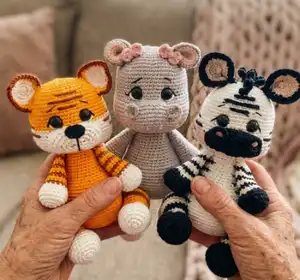
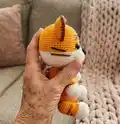
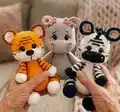
Make an adorable Benjamin Tiger amigurumi with this detailed intermediate crochet pattern. You will get step-by-step rounds for the head, body, limbs and accessories plus embroidery and assembly tips. Perfect for gifting or decorating, this pattern uses simple shaping and color changes to create a charming toy you will love to make.
Progress Tracker
0% Complete
— Head :
Round 1 :
Start with color EGG YOLK (2mm needle) - AM of 8 sc (8)
Round 2 :
Inc in each sc (16)
Round 3 :
[1 sc and 1 inc] 8x (24)
Round 4 :
[2 sc and 1 inc] 8x (32)
Round 5 :
[3 sc and 1 inc] 8x (40)
Round 7 :
[4 sc and 1 inc] 8x (48)
Round 8-21 :
sc, change to color DATE for detailing and stripes as indicated in pattern; work rounds maintaining stitch count and color changes (48-56 depending on increases)
Round 9 :
[5 ??? reading difficult - continue with pattern color changes and counts as shown in images]
Round 10 :
[6 sc and 1 inc] 3x, 1 sc, change to color DATE for stripes, 5 sc, 1 inc, 5 sc, change to color EGG YOLK, 1 sc, 1 inc, [6 sc and 1 inc] 3x (64)
Round 11 :
sc over sc (64)
Round 12 :
28 sc, change to color DATE, 30 ??? then 6 sc, change to color EGG YOLK, sc (64)
Round 13-17 :
sc over sc (64) - [5 rows]
Round 18-19 :
Change to color DATE for a couple of rows, then change back to color EGG YOLK and work 25 sc, change to color DATE for stripes (64)
Round 19 :
Change to color WHITE - [3 sc and 1 inc] 16x (80)
Round 20-27 :
sc over sc (80) - change color placements as pattern shows (80)
Round 21 :
sc over sc (80)
Round 22 :
Change to color DATE and WHITE changes: 23 sc, change to color WHITE 25, 32 sc, change to color DATE (80)
Round 23-27 :
sc over sc - [5 rows] (80)
Round 28 :
[3 sc and 1 dec] 16x (64)
Round 29 :
[1 dec and 2 sc] 16x (48)
Round 30 :
[1 sc and 1 dec] 16x (32)
Round 31 :
sc over sc all the way around (32). Close with sl st and cut a longer thread so you can sew the head to the body. Place the eyes between rows 16 and 17, separated by 6 sc visible between them. (TIP: when placing the locks, press them up to the second step of the eyes, this way they will be deeper, more beautiful and safer).
— Whites of the Eyes :
Info :
Use double Amigurumi yarn in color WHITE to make the whites of the eyes.
Step 1 :
Insert the needle into the open part of the head (leave a piece of thread so you can tie some knots at the end), exit with it right at the corner of the eye (tip: try to put the needle in the middle of the corner of your eye).
Step 2 :
Insert the needle right into the corner of the lower part of the eye and exit with it into the open part of the head. (Look at images 2 and 3).
Step 3 :
Now go out with the needle in the corner of the second eye (tip: try to put the needle in the middle of the corner of your eye).
Step 4 :
Insert the needle right into the corner of the lower part of the eye and exit into the open part of the head and then pull the two threads a little and tie 2 knots.
— Black Embroidery of Eyes :
Info :
Use double Cléa yarn in the color BLACK to do black eye embroidery
Step 1 :
Insert the needle into the open part of the head, exit with it right in the corner of the eye (tip: try to put the needle in the middle of the corner of your eye).
Step 2 :
Insert the needle right into the corner of the upper part of the eye and exit with it into the open part of the head.
Step 3 :
Go out with the needle in the corner of the second eye then insert into the corner of the upper part and exit into the open part. Pull threads a little and tie 2 knots.
— Eyebrows :
Info :
Use Cléa yarn in the color BLACK to do eyebrows (Do not use double wire)
Step 1 :
Insert the needle into the open part of the head (leave a piece of thread so you can tie some knots at the end), leave it on the second row above the eyes, skip 3 sc and insert the needle in a row above. (Look at images 1 and 2)
Step 2 :
Now do the same process on the other side of the eyes. Join the two ends of the thread and tie a few knots.
— Snout :
Round 1 :
Use color WHITE (2mm needle) - AM of 8 sc (8)
Round 2 :
Inc all around (16)
Round 3 :
4 sc, 4 inc, 4 sc, 4 inc (24)
Round 4 :
6 sc, 4 inc, 8 sc, 4 inc, 2 sc (32)
Round 5 :
8 sc, 4 inc, 12 sc, 4 inc, 4 sc (40)
Round 6 :
10 sc, 4 inc, 16 sc, 4 inc, 6 sc (48)
Info :
Close with sl st and cut a large thread, then sew the snout between rows 17 to 29 of the head (do not add stuffing). Sew the snout taking only the front loops of the sc. After sewing the snout, sink in the eyes.
— Muzzle Embroidery :
Info :
Use thread in color BLACK (needle 2mm)
Step 1 :
Make 5 ch, from the second ch, do 3 sc, in the last ch do 3 sc in the same place, at the bottom of the ch do 2 sc, in the last ch 2 sc in the same place (10). Close with sl st and cut a longer thread. Sew the black snout on top of the white snout and make the black detail as shown.
— Ears :
Round 1 :
Start with the line in color WHITE (2mm needle) - AM of 11 sc (11)
Round 2 :
3 sc in the same sc, 2 sc, 3 sc in the same sc, 2 sc, 3 sc in the same sc, 4 sc (17)
Round 3 :
1 sc, 3 sc in the same sc, 4 sc, 3 sc in the same sc, 4 sc, 3 sc in the same sc, 4 sc, 3 sc in the same sc, 5 sc (23)
Change :
Change to color EGG YOLK
Round 4 :
2 sc, 3 sc in the same sc, 6 sc, 3 sc in the same sc, 6 sc, 3 sc in the same sc, 6 sc (29)
Round 5 :
2 sc, change to color DATE, 21 sc, change to color EGG YOLK, 6 sc, finish with 2 sl sts, cut a longer thread for sewing. Sew the ears between rows 5 to 12 of the head, with 5 sc separating the eyes.
— Body :
Round 1 :
Use thread in color EGG YOLK (2mm needle) - AM of 8 sc (8)
Round 2 :
Inc all around (16)
Round 3 :
[1 sc and 1 inc] 8x (24)
Round 4 :
[2 sc and 1 inc] 8x (32)
Round 5 :
[3 sc and 1 inc] 8x (40)
Round 6 :
[4 sc and 1 inc] 8x (48)
Round 7 :
[5 sc and 1 inc] 8x (56)
Round 8 :
[6 sc and 1 inc] 8x (64)
Round 9-20 :
sc over sc (64) - [12 rows]
Round 21 :
16 sc, 16 dec, 16 sc (48)
Round 22-25 :
sc over sc (48) - [4 rows]
Round 26 :
[4 sc and 1 dec] 8x (40)
Round 27-30 :
sc over sc (40) - [4 rows]
Round 31 :
[3 sc and 1 dec] 8x (32)
Round 32-33 :
sc over sc all the way around (32) - [2 rows]. Close with sl st and finish.
— Legs :
Round 1 :
Start with the line in color WHITE (2mm needle) - AM of 6 sc (6)
Round 2 :
Inc all around (12)
Round 3 :
[1 sc and 1 inc] 6x (18)
Round 4 :
[2 sc and 1 inc] 6x (24)
Round 5 :
[3 sc and 1 inc] 6x (30)
Round 6-8 :
sc over sc (30) - [3 rows]
Round 9 :
6 sc, [1 dec and 1 sc] 6x, 6 sc (24)
Round 10 :
[2 sc and 1 dec] 6x (18)
Round 11 :
Change to color DATE - sc over sc (18)
Round 12 :
Change to color EGG YOLK - 6 sc, [1 inc] 6x, 6 sc (24)
Round 13 :
6 sc, [1 sc and 1 inc] 6x, 6 sc (30) Change to color DATE
Round 14 :
[1 inc] 2x, 24 sc, [1 inc] 4x (36)
Round 15-16 :
Change to color EGG YOLK - sc over sc (36)
Round 17 :
Change to color DATE - sc over sc (36)
Round 18 :
Change to color EGG YOLK - 8 sc, [1 sc and 1 dec] 6x, 10 sc (30)
Round 19 :
sc over sc (30)
Round 20 :
Change to color DATE - sc over sc (30)
Round 21 :
Change to color EGG YOLK - 8 sc, [1 dec] 6x, 10 sc (24)
Round 22 :
[1 dec] 2x, 12 sc, [1 dec] 4x (18) Add filling. But don't add too much padding to the thigh part, this part needs to be flatter.
Round 23 :
Change to color DATE - [1 sc and 1 dec] 6x (12)
Round 24 :
Change to color EGG YOLK - [1 dim] 6x (6). Close the leg with the magic ring inverted. Pass the thread from the outside to the inside only in the front loops of the 6 sc, then pull, tie a couple of knots and hide the thread.
— Leg Sewing :
Info :
Attach the legs to the body; position legs where desired. The pattern author likes to place legs a little forward so there isn't a huge space between them. Watch the tutorial video for exact placement.
— Arms :
Round 1 :
Start with the line in color WHITE (2mm needle) - AM of 6 sc (6)
Round 2 :
Inc all around (12)
Round 3 :
[1 sc and 1 inc] 6x (18)
Round 4 :
[2 sc and 1 inc] 6x (24)
Round 5-7 :
sc over sc (24) - [3 rows]
Round 8 :
3 sc, [1 dec and 1 sc] 6x, 3 sc (18)
Round 9 :
Change to color DATE - sc over sc (18)
Round 10-11 :
Change to color EGG YOLK - sc over sc (18) - [2 rows]
Round 12 :
Change to color DATE - sc over sc (18)
Round 13-17 :
Alternating color changes as pattern shows; sc over sc (18)
Round 18 :
Change to color DATE - sc over sc (18)
Info :
Only put padding on the lower part of the arm.
Round 19 :
Change to color EGG YOLK - [4 sc and 1 dec] 3x (15)
Round 20 :
[3 sc and 1 dec] 3x (12)
Round 21 :
Change to color DATE - Fold the arm in half and close it with 6 sc (6). Make 1 ch and cut a larger thread to sew the arms to the body.
— Arm Sewing :
Info :
Sew the arms on row 31 of the body, usually leaving a space of 7 or 8 sc between them. Watch the video for demonstration of exact placement.
— Tie - Boy Version :
Round 1 :
Use thread in color EUCALYPTUS (needle 2mm) - Make 16 ch, skip the first ch and from the second make 1 sc for each ch (15)
Round 2-12 :
Turn the work, make 1 ch, then sc over sc (15) - [11 rows]. Make 1 ch and fasten the thread. Fold the sachet tie and attach thread to middle, wrap and finish as pattern describes.
— Flores 2x - Girl Version :
Round 1 :
Start with color CREAM (2mm needle) - AM of 5 bp (5). Close with sl st in the front loop of the first sc. Go up 3 ch, in the next loop make 1 sl st. Follow this sequence until you complete 5 petals.
Round 2 :
In the second row, work on the straps behind the stitches in the first row. Make 1 increase all the way around (10). Close with sl st in sc. Change to color WHITE. Make the back petals: dc make 3 dc in the same place, 1 ch, 1 sl st in the next dc to complete 5 petals. Close with sl st and cut a longer thread on each side.
— Dress - Girl's Version :
Round 1 :
Use thread in color CREAM (needle 3mm) - Make 42 ch, close with sl st in the first ch (it will form a ch ring). Go up 3 ch and in the same place 1 hdc, continue doing 1 hdc increase for each ch (84). Close with sl st in the first ch counting from top to bottom.
Round 2 :
Go up 2 ch and do 1 hdc, 1 inc of hdc, follow this sequence until the end [2 hdc and 1 inc]. Close with sl st in the first ch counting from top to bottom.
Round 3-7 :
Go up 2 ch and do hdc over hdc all the way around. Close with sl st in the first ch counting from top to bottom. In the last row, close with sl st and fasten the thread.
This Benjamin Tiger amigurumi pattern brings a lovable character to life with stripes, sweet facial details, and tiny accessories. Use the included embroidery steps and photo tips to make the face extra expressive and unique. Enjoy making a handmade friend that is perfect for gifts or nursery decor. 🧸✨