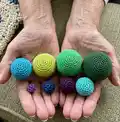
Make perfectly shaped crochet balls in almost any size with clear, practical instructions. This pattern breaks the ball into top, middle and bottom sections so you can scale up or down easily. You can use DK, sport or aran yarn and adjust hook size to get the size and firmness you want. Ideal for toys, beads, ornaments or doll heads — a versatile stash-busting project you'll return to again and again.
Progress Tracker
0% Complete
— Pattern Overview :
Info :
Work this in amigurumi style, in spirals, marking your row start (or end, as you please) so you don't lose track. No stepping up. This is written in UK style – US, see the abbreviations to translate.
Infos :
After making a lot of amigurumi items that had ball shapes in them, I realised that there was a simple mathematical way of working out how to get whatever size ball I was trying to make, more or less, knowing how many rows were needed between the shaping for the top and bottom of the ball (sphere). The first eight sizes are here in full, after that I tell you how to continue if you want to make larger ones.
— Materials :
Info :
Firm yarn – I’ve used PaintBox DK cotton for the main set of samples. Crochet hook to match the yarn – one size less than the yarn usually asks for is a good idea, to get a firmer fabric, so I used a 3.5mm hook instead of a 4mm for the DK cotton. Large-eye needle (or smaller hook) to finish the ends (pull through inside).
— Size :
Info :
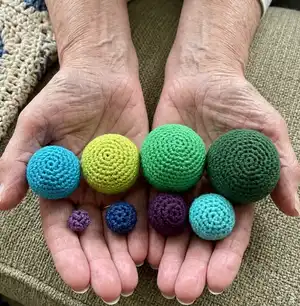
Just about any size you like. The balls in the main picture have circumferences of about 2.5, 5, 7.5, 10, 12.5, 15, 17.5 and 20 cm (1, 2, 3, 4, 5, 6, 7 and 8 inches). See Choosing the Size of your Ball for how to work out how to make the size you want – or to work out what size you are going to get from the number of rows and the yarn you have.
— Tension :
Info :
Absolutely depends on your yarn, but ideally firm. The basis of this pattern is that a dc (US – sc) crochet stitch is more-or-less the same height as its width. See the section on Choosing the Size of your Ball for more about tension and size.
— Abbreviations :
Info :
dc – double crochet, (what the US calls sc). dec – decrease, work two stitches together, dc two together (US, sc two together). Either pull one loop through each of the next two stitches so you have three loops on the hook and then finish them off together, or do an invisible decrease.
— Method :
Info :
Read the method notes in the original pattern if you are interested in the maths; you do not need to understand that to make the balls. The basis is that the circle sections produce a circumference and the number of middle rows determines the height so that if the number of middle rows equals the number of rows in the top circle section you get a ball roughly as high as it is wide.
— Top Section for an eight-row circle ball :
Round 1 :
6 dc into a magic ring.
Round 2 :
2dc into each dc (12)
Round 3 :
(dc, 2dc in next dc) repeat 6 times (18)
Round 4 :
1 dc, 2dc in next dc, (2 dc, 2dc in next dc) repeat 5 times, 1 dc (24)
Round 5 :
(3 dc, 2dc in next dc) repeat 6 times (30)
Round 6 :
2 dc, 2dc in next dc, (4 dc, 2dc in next dc) repeat 5 times, 2 dc (36)
Round 7 :
(5 dc, 2dc in next dc) repeat 6 times (42)
Round 8 :
3 dc, 2dc in next dc, (6 dc, 2dc in next dc) repeat 5 times, 3 dc (48)
— Middle section (any ball) :
Round 1 :
Middle Row: 1dc in each dc to end – repeat until you have as many 'middle rows' as you have rows in your top (circle) section.
— Bottom Section for an eight-row circle ball :
Round 8 :
3 dc, dec, (6 dc, dec) repeat 5 times, 3 dc (42)
Round 7 :
(5 dc, dec) repeat 6 times (36)
Round 6 :
2 dc, dec, (4 dc, dec) repeat 5 times, 2 dc (30)
Round 5 :
(3 dc, dec) repeat 6 times (24)
Round 4 :
1 dc, dec, (2 dc, dec) repeat 5 times, 1 dc (18)
Round 3 :
(dc, dec) repeat 6 times (12)
Round 1 :
Cut the yarn, leaving a long tail. Put the tail in a sewing needle, and thread through the front loop of each of the remaining 6 stitches going around the ring in the same direction you were working. Pull tight and finish the end, hiding it inside the ball.
— Stuffing :
Info :
Do not stuff the ball too firmly, it will distort the shape. Try to stuff evenly, if possible with small balls just use one piece of stuffing pushed in at perhaps the 18 stitch row (balls smaller than this may not need stuffing at all). If you need a lot of stuffing, try putting in a fairly large amount to start with and then spreading it out so that you can put the rest into the middle of the stuffing you've already put in – this tends to give a smoother, more even result. When you've finished off the ball, roll it in your hands for a while (or on a flat surface if it's too big for that) until it's as round as you can make it.
— The other 7 smallest sizes :
Info :
Take the first however many rows you want from the eight-row ball, the middle section, and the last same-number of rows, counting from the end. So for the tiniest ball with the yarn you have, just the first row, one middle row, and the last row. For the next size, the first two rows, two middle rows, and the last two rows. And so on for the first seven sizes.
— Larger Sizes :
Info :
Every row of the top circle section you increase (2dc in next dc) six stitches, evenly spread around the ball. The number of stitches between the increases gets bigger by one stitch on each row. If this is an odd number, start the row with that number of stitches, increase, then repeat that until the end of the row. If it is an even number, start with HALF that number of stitches, increase, then (the full number, increase) five times, then that half number again and you should be at the end of the row. The bottom circle works exactly the same way, except that instead of spacing your increases, as described above, you are spacing your decreases.
— Choosing the size of your ball :
Info :
Make a little sample about 15 stitches wide and ten rows high. Measure the width of six of the stitches in the middle (ish) of the last row. This is your Unit Measurement. Each size of ball has a circumference of the Unit Measurement multiplied by the number of rows in the top circle section. Use the table of stitches to find how many stitches and how much yarn you need for a given size, or weigh a sample to estimate yarn usage.
— Number of stitches in a ball (table summary) :
Info :
Table for first 12 sizes (rows in circle section vs stitches): 1 row: 6 stitches in circle section, 6 middle section stitches, total 18. 2 rows: 18 / 24 / 60. 3 rows: 36 / 54 / 126. 4 rows: 60 / 96 / 216. 5 rows: 90 / 150 / 330. 6 rows: 126 / 216 / 468. 7 rows: 168 / 294 / 630. 8 rows: 216 / 384 / 816. 9 rows: 270 / 486 / 1026. 10 rows: 330 / 600 / 1260. 11 rows: 396 / 726 / 1518. 12 rows: 486 / 864 / 1836.
— Ideas for using balls :
Info :
Balls work well as soft toys for children, baubles for holidays (change colours every row), beads for a necklace (use small or sparkly yarns), or as heads for dolls and animals. You can make half balls for hair or add a few middle rows to make an oval body for a toy.
This versatile ball pattern helps you make neat spheres from tiny beads to larger soft toys using the same method.🧶
Adjust the top, middle and bottom rows to create the exact size and firmness you need for toys, ornaments or craft projects.✨
Have fun experimenting with yarns and colours — these little balls are perfect for gifts, decorations and stash-busting projects! 🎁