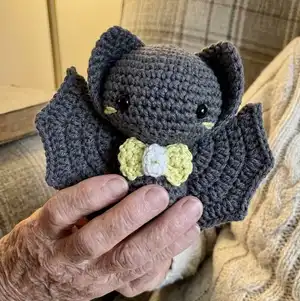
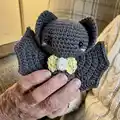
Make this adorable baby bat amigurumi to gift or keep — a sweet, pocket-sized plush with floppy wings and a cute bow-tie. The pattern uses simple amigurumi shaping, a decorative dc wing technique, and a tiny bow detail to personalise your bat. You will enjoy stitching the rounded head, stuffed body, and easy assembly steps to bring this little friend to life.
Progress Tracker
0% Complete
— Materials & Tools :
Info :
Approx. 25g yarn for your main colour. I use Scheepjes Catona in Anthracite - 501, Dark Olive - 387, Bridal White - 105. A small amount of yarn for your accent colour (blush and bow tie). I use Scheepjes Catona in Lime Juice - 392, Apricot - 524, Light Orchid - 226. A small amount of white yarn for the bow tie knot. I am using a 2.25mm crochet hook (use a hook suitable for the yarn you choose). 6mm safety eyes (you may need larger eyes depending on hook/yarn size). Stuffing. Darning/Tapestry needle. Pins. Scissors.
— Head :
Info :
IMPORTANT : Try to maintain a consistent tension throughout the whole project, including the wings (dc). Only make very tight sc stitches if you can also make very tight dc stitches.
Round 1 :
In your main colour, make 6 sc in mr. (6)
Round 3 :
(sc, inc) x 6 (18)
Round 4 :
(sc 2, inc) x 6 (24)
Round 5 :
(sc 3, inc) x 6 (30)
Round 6-7 :
sc in each - 2 rounds (36)
Round 8 :
(sc 4, inc) x 6 (36)
Round 9 :
(sc 5, inc) x 6 (42)
Round 9-12 :
sc in each - 4 rounds (42)
Info :
Insert safety eyes as shown. Do not add the backs yet, as it may be difficult to crochet the next round.
Info :
STEP 1: Count 7 stitches back from hook, 2 rows up, between rounds 10 + 11. Place first eye here. STEP 2: Count 10 stitches back. Place second eye here. You should have 8 visible stitches between the eyes.
Round 13 :
(sc 4, dec) x 7 (35) stuffing step 1
Round 14 :
(sc 3, dec) x 7 (28) stuffing step 2
Round 15 :
(sc 2, dec) x 7 (21)
Round 16 :
(sc, dec) x 7 (14) stuffing step 3
Info :
Slst, FO, and weave in tail.
Info :
STUFFING & SHAPING - STEP 1: Place the backs on your safety eyes and begin to stuff. Tuck plenty of stuffing above the eye area. This helps to keep the eyes looking 'straight and forward' later.
Info :
STUFFING & SHAPING - STEP 2: Stuff rounds 12 and above. Gently pad out the area between, and around, the eyes. Don't stuff too firmly just yet.
Info :
STUFFING & SHAPING - STEP 3: Add stuffing a little at a time until you have a nice rounded shape. Take care to not dislodge the eyes, and don't overstuff your decrease rounds!
— Body :
Round 1 :
Continue with your main colour and make 6 sc in mr. (6)
Round 2 :
(inc, sc) x 3 (9)
Round 3 :
(inc, sc 2) x 3 (12)
Round 4 :
(inc, sc 3) x 3 (15)
Round 5 :
(inc, sc 4) x 3 (18)
Round 6 :
(inc, sc 2) x 6 (24)
Round 6-8 :
sc in each stitch - 3 rounds (24)
Info :
Begin to stuff the body. From here, stuff as you go.
Round 9 :
(dec, sc 6) x 3 (21)
Round 10 :
sc in each stitch (21)
Round 11 :
(dec, sc 5) x 3 (18)
Round 12 :
(sc 3, dec, sc 2, dec) x 2 (14)
Info :
Sc in the next 3 stitches, Slst in the next. Cut yarn, leaving a long tail for sewing, and pull through.
Info :
Ensure the body is stuffed firm to maintain the shape. Line up the slst on the body with the slst on the head. Stitch the head and body together through the front loops only.
Info :
EMBROIDER BLUSH STEP 1: Insert your needle through the opening and bring out two stitches back from the eye, between rounds 11 & 12.
Info :
EMBROIDER BLUSH STEP 2: Embroider those two stitches once, then bring your needle back in next to the eye and out through the opening.
Info :
EMBROIDER BLUSH STEP 3: Repeat for the other side.
Info :
EMBROIDER BLUSH STEP 4: Tie your ends together securely, and trim off the excess.
— Ears :
Info :
3sc = make 3 sc into the same stitch. 2sc = make 2 sc into the same stitch.
Round 1 :
Start with 6 sc in mr. (6)
Round 2 :
(3sc, sc) x 3 (12)
Round 3 :
Sc, (3sc, sc 3) x 2, 3sc, sc 2 (18)
Round 4 :
Sc 2, (3sc, sc 5) x 2, 3sc, sc 3 (24)
Round 5 :
Sc 3, (3sc, sc 7) x 2, 3sc, sc 4 (30)
Round 6 :
Sc 4, (2sc, sc 9) x 2, 2sc, sc 4, slst (33)
Info :
Cut yarn, and pull through - leaving approx. 40cm tail. Make the second ear.
— Wings :
Info :
Ch3 counts as 1 dc. Dc-inc = make 2 dc in the same stitch. 2dc ch 2 2dc = make 2 dc in the next stitch, chain 2, then make another 2 dc in the same stitch. Make 2.
Round 1 :
Ch3, dc 15, slst into ch2 (16)
Round 2 :
Ch3, dc in same ch2 space, (dc, dc-inc) x 7, dc, slst in ch2 (24)
Round 3 :
Ch3, dc in same ch2 space, (dc 2, dc-inc) x 7, dc 2, slst in ch2 (32)
Round 4 :
Ch3, dc in same ch2 space, (dc 3, dc-inc) x 7, dc 3, slst in ch2 (40)
Round 5 :
Ch3, dc in same ch2 space, ch2, 2dc in the same space then... (dc 4, 2dc ch2 2dc) x 7, dc 4, slst in ch2 (80)
Info :
Cut approx. 60 cm of yarn and pull through.
Info :
Fold your work in half to create the wing shape. **Be sure that the ch2 points match the opposite side** Stitch together through the back loops only. Once you reach the end, thread your needle back through the wing to your starting point.
Info :
IMPORTANT : Try to keep your dc stitches neat and compact. The finished wing should be almost as tall as the head and body. Small differences should not matter. If your wing is much larger - you may need to try a smaller hook.
— Bow-tie :
Info :
The bow-tie should look slightly oversized. As a guide, it should fall roughly the same width as the eyes. You can add/remove chains, or use a different hook, to achieve the right size (if you need to).
Item Name (Accent Bow) :
In your accent colour... Ch 8, hdc in 3rd ch from hook, hdc in each space (6)
Round 2-4 :
Ch 2, turn, hdc in each stitch (6) - 3 rows - 4 rows in total. Fasten off and weave in ends.
Item Name (White Knot) :
In white... Ch 7 with a 10cm tail. Dc in 3rd ch from hook, dc in each space (4). Slst into ch1, cut 10cm and pull through. Go to step 1 (assembly).
Info :
Step 1: Thread your chain tail through the middle of the opposite end creating a loop at the back. Step 2: Pinch the coloured piece, place face down inside the loop and pull gently. Step 3: Thread your ends through the middle loops on the opposite side. Pull tight and knot. Weave and trim one loose end, leaving the other for sewing. Finished bow-tie.
— Assembly :
Info :
Point A: The front corner of the ear should be placed in the second stitch back from the blush, one row down, between rounds 12 and 13.
Info :
Point B: The back corner should go between rounds 8 and 9. Approx. 3 stitches apart.
Info :
Point C: Gently pinch the top tip of the ear, then flatten against the head. Pin between rounds 3 and 4.
Info :
Always check how the ears look from the front before sewing. You may need to adjust the positioning slightly. If you need to adjust, first check point C - pinning/unpinning an extra stitch or two may fix it. If that doesn't help, leave point A the same and adjust points B and C to achieve the desired look.
Info :
To attach, pick up both loops on the ear, and go directly under the corresponding stitch on the head. Pull tight for a neat finish. Work through each stitch. Then fasten off discreetly and weave in the end.
Info :
If you are making a very small bat, like mine, the pins will be sticking out through the body. Please take care handling until the pins are removed!
Info :
Pin the wings to the body, creating a narrow V-shape. The starting rings should be positioned where the body meets the head, 3-4 stitches apart. The head will be in the way at this point. You can bend the wing back slightly to get the correct position. The bottom points of the wing should meet towards the tail.
Info :
Thread your needle and attach the wing from bottom to top, the same way we attached the ears. One stitch every 2-3 body rows should be enough.
Info :
Once you've secured the top, bring your needle through to the side of the body - roughly in line with the ear. Pick up a stitch from the wing and attach to the body. Pull tight. Work your needle towards the bottom part of his body, pick up another stitch from the wing and attach, pull tight. Fasten off discreetly and weave in the end.
Info :
Attach the bow-tie between the 2nd and 3rd rows beneath the head. Gently squish him back into shape with your fingers and you're all done!
This baby bat was created to be a lovable little companion you can finish in a weekend. It is small, squishy, and perfect for gifting or nursery decor. Try different colour bows and yarns to make each one unique. 🧶🎀