🧢 Beautiful ✨ Detailed πŸ’ Adorable

Adrian Pants Pattern

Adrian Pants Pattern
4.9β˜… Rating
5-7 Hours Time Needed
2.2K Made This
βœ‚οΈ

Intermediate Level

Ideal for those with basic crochet experience, featuring slightly more advanced stitches and techniques to expand your skills.

⏱️

Weekend Treat

Takes 5-7 hours, making it an enjoyable project to finish over a couple of days.

πŸ‘•

Casual Chic

Relaxed style with a modern twist, perfect for everyday wear while maintaining that handcrafted uniqueness.

About This Adrian Pants Pattern

This pattern creates a pair of cozy, striped childrens pants knitted top-down with a neat, knitted hem and elastic waist. It features short rows for a better back fit, a gusset for comfort, and 1x1 ribbed cuffs. The stripes are worked in rounds with two colors and the pattern includes exact yarn quantities for five sizes.
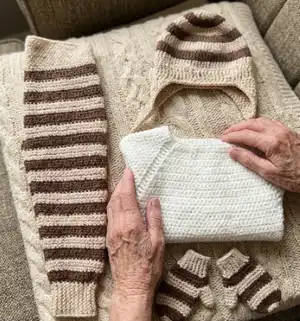
Adrian Pants Pattern crochet pattern - detailed view of completed project

You will work the body in stockinette in the round, shape a gusset with increases at markers, and finish each leg with decreases and ribbed cuffs. Detailed notes on German short rows are included to help you shape the back perfectly.

Why You'll Love This Adrian Pants Pattern

I absolutely love this pattern because it combines simple construction with thoughtful shaping that makes the pants fit wonderfully. I enjoy the clean look of the knitted hem β€” it gives a professional finish without extra sewing. The stripe pattern is playful and easy to customize, so I often make sets in different colorways. Working the gusset and short rows gives a great learning opportunity for knitters wanting to add shaping techniques to their skillset.

Adrian Pants Pattern step 1 - construction progress Adrian Pants Pattern step 2 - assembly progress Adrian Pants Pattern step 3 - details and accessories Adrian Pants Pattern step 4 - final assembly and finishing

Switch Things Up

I love how easy it is to customize the stripes β€” change the width or colors to make a playful or subtle look.

You can create a coordinated set by knitting matching mittens or a hat in the same stripe sequence.

If you want a chunkier look, use a thicker yarn and larger needles, but remember to swatch for gauge and adjust yardage.

For a slimmer leg, omit some decreases or reduce the number of leg decrease repetitions and measure frequently.

Try a textured stitch for the body instead of plain stockinette to add visual interest and warmth.

I sometimes add small sewn-on patches or simple embroidery near the cuff for a personalized detail.

If you prefer a drawstring instead of elastic, pick a narrower elastic or cord and make a small buttoned opening in the waistband to thread it through.

To make shorties or shorts, stop before adding the gusset increases and work a wider ribbed hem instead of full-length legs.

For a vintage look, substitute the sport yarn with a wool blend and block more aggressively to open the fabric and soften the texture.

When making multiples, alternate color A and B positions so you get complementary outfits from the same two skeins.

Common Mistakes & How to Fix Them

βœ— Skipping the stitch marker for the center back or front will make short rows and gusset shaping confusing; place markers exactly as instructed and double-check placement before turning short rows. βœ— Not leaving a gap when knitting the hem down prevents you from threading the elastic later; when knitting the hem down, remember to leave a small gap or sew a narrow opening before finishing. βœ— Overly tight tension during increases for the gusset makes the crotch area tight and uncomfortable; maintain even, relaxed tension and block lightly if necessary. βœ— Forgetting to count stitches after the increase rounds will lead to incorrect sizing later; count your sts after the increase round and after the gusset rounds to ensure you have the correct number. βœ— Not using the German short row instructions correctly can create visible gaps; follow the provided gsr steps carefully and work both legs of the double stitch when required to close gaps properly.
Adrian Pants Pattern

Make comfortable, striped baby pants knitted top-down with a neat elastic waist. This pattern guides you through short rows, gusset shaping, and ribbed cuffs so your finished pants fit beautifully. Ideal for making matching sets or playful stripe combinations, the instructions are clear and practical. You will enjoy the textured fit and the professional-looking hem finish.

Intermediate 5-7 Hours

Materials Needed for Adrian Pants Pattern

β€” Main Fabric

  • 01
    Sport weight yarn (Color A) - 190 (220) 260 (300) 350 meters / 210 (250) 290 (330) 390 yards
  • 02
    Sport weight yarn (Color B) - 140 (160) 180 (200) 220 meters / 160 (180) 200 (220) 240 yards
  • 03
    Suggested sample yarn: Wool4You Capella (used on model) - colors 260 and 264
  • 04
    30 mm elastic for waist, approx. length 46 (49) 52 (55) 58 cm / 18 (19.5) 20.5 (21.25) 22.75 inches

β€” Tools Required

  • 01
    3 mm / US 2.5 circular needle 40 cm / 16 inches and DPNs
  • 02
    3.5 mm / US 4 circular needles 40 and 60 cm / 16 and 24 inches, and DPNs
  • 03
    Stitch markers (PM)
  • 04
    St stitch holder or waste yarn (to hold half the sts)
  • 05
    30 mm / inches elastic, approx. lengths listed in pattern
  • 06
    Tapestry/yarn needle for weaving in ends and sewing elastic
  • 07
    Measuring tape to check gauge and lengths
  • 08
    Scissors

Progress Tracker

0% Complete

β€” Body :

Info :

With ndl 3 mm / US 2.5 and color A, CO 112 (119) 126 (133) 140 sts. PM, join to work in the rnd.

Info :

Work stst in the rnd until your work measures 3 (3) 3.5 (3.5) 3.5 cm / 1.25 (1.25) 1.5 (1.5) 1.5 inches.

Round :

Next rnd: P all sts.

Info :

Then work sts in the rnd for another 3 (3) 3.5 (3.5) 3.5 cm / 1.25 (1.25) 1.5 (1.5) 1.5 inches.

Info :

Knit the hem down: The following rnd, fold your work at the purled rnd and knit the cast on edge together with the live sts, by working your ndl knitwise into the live st then into the associated CO st, and pull your yarn through both sts. Remember to leave a small gap to thread the elastic.

Info :

Tip: If you find this too complicated, you can knit this rnd, and sew down the hem later. But knitting it down gives it a neater look, so give it a try!

Round :

Next rnd: With ndl 3.5 mm / US 4 work one rnd while inc as follows: *K7, INC1*. Repeat *-* to end of rnd. You have 128 (136) 144 (152) 160 sts on your ndl.

β€” Short row shaping for the back :

Info :

Working short rows, you will add fabric in the back of the piece, to allow for better fit. Use the german short rows as described in the box below, or use your preferred short row technique.

β€” Short rows :

Row 1 :

row (RS): K6 sts past M, turn work.

Row 2 :

row (WS): gsr, P6 sts past M, turn work.

Row 3 :

row (RS): gsr, K6 sts past last TP, turn work.

Row 4 :

row (WS): gsr, P6 sts past last TP, turn work.

Info :

Repeat row 3 and 4 until you've turned a total of seven times on each side of the M in the back.

Info :

Next, start the stripe pattern: 7 rnds of each color. Continue in the rnd with the stripe pattern until your work measures approx. 15 (16) 17 (18) 19 cm / 6 (6.25) 6.75 (7) 7.5 inches center front. PM center front.

β€” Gusset :

Round 1 :

M1R, K1, SM, K1, M1L.

Round 2 :

no inc. K all sts.

Round 3 :

M1R, K2, SM, K2, M1L.

Round 4 :

no inc. K all sts.

Round 5 :

M1R, K3, SM, K3, M1L.

Round 6 :

no inc. K all sts.

Round 7 :

M1R, K4, SM, K4, M1L.

Info :

You have 144 (152) 160 (168) 176 sts on your ndl.

β€” Legs :

Info :

Slip half of the sts, from M to M, on a st holder. You have 72 (76) 80 (84) 88 sts on your ndl.

Info :

PM and join to work the remaining sts in the rnd while you continue the stripe pattern.

Info :

Leg dec: ssk, SM, k1, k2tog.

Info :

Work the leg dec every 2 (2) 2.5 (3) 3 cm / 0.75 (0.75) 1 (1.25) 1.25 inches, a total of 10 (11) 12 (13) 14 times.

Info :

This should leave you with 52 (54) 56 (58) 60 sts on your ndl.

Info :

Continue working in the rnd until the leg measures 22 (27) 33 (39) 45 cm / 8.75 (10.75) 13 (15.5) 17.75 inches.

β€” Cuff :

Info :

With ndl 3 mm / US 2.5 and color A, K one rnd.

Info :

Work 1x1 rib, i.e., K1, P1, until the rib measures approx. 6-10 cm / 2.5-4 inches.

Info :

Bind off in pattern.

Info :

Knit the other leg the same way and weave in all ends.

Assembly Instructions

  • If you knitted the hem down, thread the 30 mm elastic through the hem and adjust to the recommended waist length, then sew the ends of the elastic securely and close the gap.
  • If you left a small opening when knitting the hem down, use a safety pin to thread the elastic through the casing and stitch the opening closed afterwards.
  • After finishing both legs, join any loose floats or tails inside the garment and weave in all ends with a tapestry needle for a clean finish.
  • Block the finished pants gently to measurement, shape the gusset and leg lengths, and ensure the rib cuffs are even before final pressing and trimming of ends.

Important Notes

  • πŸ’‘Use stitch markers to indicate center front and the markers used for gusset increases so you don’t lose placement during rounds.
  • πŸ’‘Remember to leave a small gap when knitting the hem down so you can thread the elastic through the waistband easily.
  • πŸ’‘Follow the German short row (gsr) instructions exactly or use your preferred short row technique to avoid gaps in the back shaping.
  • πŸ’‘Check your gauge before starting; 24 sts = 10 cm / 4 inches is required for accurate sizing across the five sizes.

These Adrian pants are a cozy, striped favorite for little ones β€” perfect for play and layering. They are knitted top-down with a comfy gusset and a neat knitted hem for the elastic waist. Make them in matching sets or mix colors for playful looks. πŸ§ΆπŸ‘Ά

You ask,

we answer.

FAQs

What sizes are included in this pattern?

The pattern includes sizes 6-12 months, 18 months-2 years, 3-4 years, 5-6 years, and 7-8 years with metric and imperial measurements for each.

What gauge should I achieve?

The gauge is 24 sts = 10 cm / 4 inches in stockinette stitch; use the recommended yarn weight and needle sizes to get the correct gauge.

Can I substitute a different yarn weight?

You can substitute a different yarn weight, but it will affect the finished size and yardage; adjust needle size to match the recommended gauge for accurate sizing.

Do I need to know short rows to make these?

Yes, the pattern uses German short rows for back shaping. The pattern includes instructions for gsr, but you may use your preferred short row technique if you are more comfortable with it.